


Why building strength may be one of the greatest investments you make in your future self
For decades, good health has largely been measured by familiar numbers, body weight, cholesterol, blood pressure and blood sugar. We celebrate weight loss, count calories and track our Body Mass Index (BMI), believing these figures define our wellbeing. Yet there is another measure of health that often goes unnoticed.
How strong are you?
Can you rise from the floor without support? Carry heavy grocery bags with ease? Lift your suitcase into an over-head compartment? Climb several flights of stairs without becoming breathless? Recover your balance after a stumble?
These everyday tasks reveal something far more important than physical appearance they reflect your physical capacity. At the heart of that capacity lies one of the most overlooked organs in the human body: skeletal muscle.
For years, muscle was associated almost exclusively with athletes and bodybuilders. Today, medical science paints a very different picture. Researchers now recognise skeletal muscle as a vital organ that influences meta-bolism, mobility, bone health and healthy ageing. Increas-ingly, studies suggest that maintaining muscle strength may help people not only live longer but remain healthier and more independent throughout those extra years.
The Organ We Often Overlook
Most people think of the heart, liver and brain as organs. Few realise that skeletal muscle is the body’s largest metabolic organ, making up around 40 per cent of total body weight in healthy adults. Far from being passive tissue that simply moves our limbs, muscles constantly interact with nearly every major system in the body.
After a meal, skeletal muscle acts as one of the body’s primary sites for absorbing glucose from the bloodstream under the influence of insulin. In effect, healthy muscle functions as a vast metabolic warehouse, storing and utilising energy efficiently. When muscle mass declines, the body’s ability to regulate blood sugar also becomes less efficient, increasing the risk of insulin resistance and eventually type 2 diabetes.
This is particularly relevant for Pakistan, where diabetes has become a major public health challenge. According to the International Diabetes Federation, Pakistan has one of the world’s highest numbers of adults living with dia-betes. Alongside improved nutrition and weight manag-ement, preserving muscle through regular resistance exe-rcise is increasingly recognised as an important compo-nent of metabolic health.
Scientists have also discovered that muscles communi-cate with other organs. During exercise, contracting muscles release signalling proteins known as myokines, which influence inflammation, immune function and metabolic regulation. These discoveries have transformed our understanding of muscle from a simple mechanical tissue into an active participant in whole-body health.
Every time we challenge our muscles, we trigger a cascade of biological processes that extend well beyond movement.
The Quiet Loss of Strength
Unlike many health problems, muscle loss often develops gradually and without obvious warning. Beginning in middle age, adults naturally start losing muscle mass and strength, a process that accelerates with inactivity, poor nutrition, prolonged illness and ageing. In severe cases, this decline is known as sarcopenia, a condition increasingly recognised by physicians as a major contributor to frailty and loss of independence in older adults.
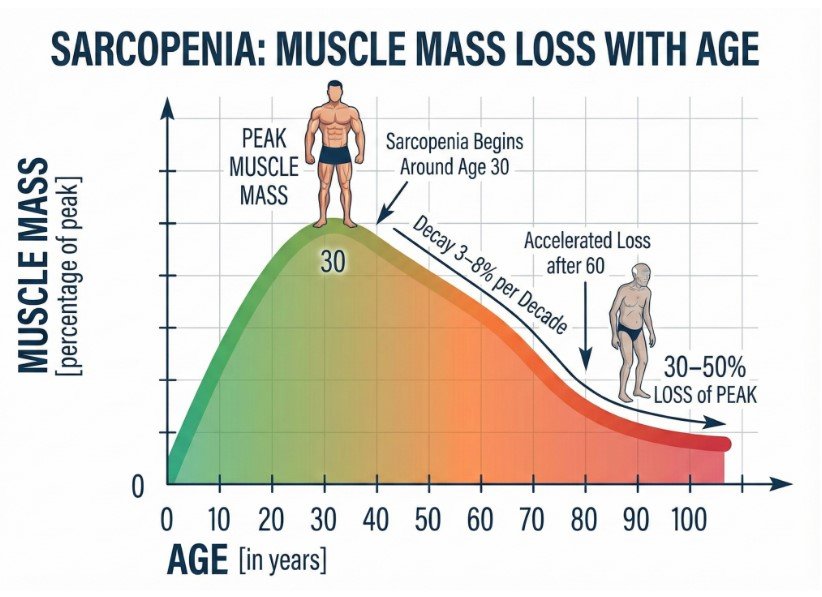
The signs rarely appear overnight. Instead, daily activities become subtly more difficult. You begin choosing lifts over stairs. Grocery bags feel heavier. Rising from a chair requires using your hands. You hesitate before sitting on the floor because getting back up seems harder than it once was. These small adjustments are easy to dismiss as normal ageing. Often, they are early signs that physical capacity is declining.
The human body constantly adapts to the demands placed upon it. Challenge your muscles regularly and they grow stronger. Remove those challenges and the body gradually concludes that the extra muscle is no longer necessary.
Strength Training: More Than a Gym Routine
When muscles work against resistance, whether through dumbbells, resistance bands, machines or even body weight, they receive a signal to adapt. Over time, they become stronger, more efficient and better able to support everyday activities. The weight itself is not the objective. The challenge is.
As strength improves, that challenge must gradually increase a concept known as progressive overload. This does not necessarily mean lifting dramatically heavier weights. Progress may involve performing additional repetitions, improving technique, increasing range of motion or advancing to a slightly more demanding exercise.
Recognising this growing body of evidence, the World Health Organization recommends that adults perform muscle-strengthening activities involving all major muscle groups at least twice a week, alongside regular aerobic exercise. Similarly, the American College of Sports Medicine identifies resistance training as one of the corner stones of healthy ageing, helping preserve muscle mass, improve bone density, reduce falls and maintain functional independence.
Walking Is Excellent But It Is Not the Whole Story
Walking remains one of the simplest and most effective forms of physical activity. It improves cardiovascular fitness, supports mental wellbeing, enhances circulation and encourages people to spend more time outdoors.
But walking and strength training serve different purposes. Aerobic exercise primarily strengthens the heart and lungs. Resistance exercise strengthens muscles and bones. Together, these elements create a well-rounded fitness programme.
The goal is not to choose one form of exercise over another but to recognise that each develops a different quality of movement. Perhaps the better question is not simply, “Do you exercise?” It is, “What aspects of your health are you training?”
Strength Beyond the Scale
When people lose weight rapidly particularly through severe calorie restriction they may lose muscle alongside fat. Two individuals can weigh exactly the same yet have vastly different levels of strength, mobility and metabolic health.
This is why many health professionals now encourage looking beyond body weight alone. A stronger body is often a healthier body, regardless of whether the scale changes dramatically.
Why Women Need to Join the Conversation
One of the biggest misconceptions surrounding strength training is that it is primarily for men.
For generations, many women have been encouraged to focus almost exclusively on becoming thinner through dieting and cardiovascular exercise, while avoiding weights for fear of becoming “bulky.”
Physiologically, that fear has little basis. Developing the level of muscle seen in competitive bodybuilders requires years of specialised training, nutrition and hormonal factors that most women simply do not possess.
The far greater risk is entering later life with insufficient muscle. After menopause, declining oestrogen levels contribute to reductions in muscle mass and bone density, increasing the likelihood of osteoporosis, falls and fractures. Resistance training helps slow these changes by strengthening both muscles and bones while improving balance and joint stability.
The woman who begins strength training in her forties is investing in the health of the woman she hopes to be in her seventies.
Where Yoga Fits In
Yoga is highly effective for improving flexibility, balance, posture and body awareness, while many postures also build muscular endurance through body-weight resis-tance. However, yoga and progressive strength training serve different purposes.
As we age, maintaining muscle mass and bone health requires progressively challenging our muscles with greater resistance. Rather than competing, the two app-roaches complement each other: yoga enhances mobility, coordination and mindful movement, while strength train-ing builds muscle, protects bones and preserves funct-ional independence. Together, they provide a balanced foundation for healthy ageing.
Train for the Life You Want
We spend years investing in our careers, homes and finan-cial security, yet our future ultimately depends on the health of our bodies. Muscle is one of our greatest assets, not because it changes our appearance, but because it preserves mobility, resilience and independence. The greatest wealth we carry into old age may not be our savings, but the strength we have built over a lifetime.
The formula is simple: challenge your muscles regularly, eat enough protein, allow time for recovery and stay consistent.
The writer can be reached at mick66yen@gmail.com