

Mauritius-Pakistan: Charting a Shared Future
H.E. Mr. Munsoo Kurrimbaccus, High Commissioner of Mauritius to Pakistan, on cultural diplomacy, economic cooperation, Mauritius’s development journey and the future of bilateral relations
Interview by Aliya Agha
Mauritius is often celebrated for its turquoise waters, pristine beaches and world-class hospitality. Yet behind its appeal as a tourist destination lies a remarkable story of economic transformation, cultural coexistence and investment in human capital. A country once dependent on sugarcane has diversified into manufacturing, tourism and financial services, and is now looking towards the blue economy as its next frontier.
For H.E. Mr. Munsoo Kurrimbaccus, the High Commissioner of Mauritius to Pakistan, diplomacy is about much more than official engagements. His own journey from grassroots social activism and youth development to trade unionism and international diplomacy has shaped his belief in the power of people, education and cultural exchange.
In this conversation with Aliya Agha on MT Out Loud, the High Commissioner discusses Mauritius’s development model, the challenges facing its youth, the country’s distinctive multicultural society, opportunities for Pakistan–Mauritius cooperation in trade and investment, the threat of climate change and his vision for cultural diplomacy. He also explains why he believes Pakistan has enormous untapped tourism potential and why its historical heritage deserves greater international recognition.
FROM SOCIAL ACTIVISM TO DIPLOMACY
Q: Your career has been quite unconventional. Before becoming the High Commissioner, you were a social activist, social practitioner and trade unionist. How did this journey begin?
H.E. Mr. Munsoo Kurrimbaccus: I have been active since a very young age. I was working as a clerk at a school, and after school I had nothing much to do. In 1997, I participated in a village election and lost by around 22 votes.
I then decided that I did not need to be an elected member of the council to serve my village. I could contribute through social work.
I started with environmental awareness and cleaning campaigns because we live in a coastal region. I subsequently joined a large NGO in Mauritius, and my involvement attracted the attention of other organisations. The National Agency for the Treatment and Rehabilitation of Drug Abusers also approached me to join its youth team.
Around 2005, I established my own NGO. I became involved in various social initiatives and eventually emerged as a national figure and an international speaker, particularly on drug prevention among young people. I travelled to different countries to share my experiences and participated in United Nations activities abroad.
Those engagements gave me valuable international exposure. They also made me realise that I needed to improve my academic qualifications.
Q: What motivated you to return to education, and how did that change your life?
H.E. Mr. Munsoo Kurrimbaccus: After one of my presentations, someone assumed that I was a university professor. I had only completed secondary school at that stage. I explained that I was simply an international speaker, but the experience made me realise that I should improve my qualifications.
Fortunately, I received a scholarship from the NGO Trust Fund in Mauritius to undertake a foundation course at the University of Mauritius. One of my lecturers soon encouraged me to pursue a degree because I was a mature student who kept asking questions that went beyond the course.
I followed that advice. I completed a degree in social work with first-class honours and was ranked first in my cohort. I received a scholarship for my master’s degree in social development and later completed an MBA.
Education strengthened my understanding of the social issues I had been working on for years. I continued my activism and became a trade unionist, participating actively in public discussions and television talk shows. I was known for speaking frankly and saying what I believed needed to be said.
Q: How did you move from social activism and politics into diplomacy?
H.E. Mr. Munsoo Kurrimbaccus: My media exposure made me quite popular, and political parties regularly approached me. Politics had interested me since childhood, so I eventually entered the political arena.
I contested the 2019 general election but lost. Our party had not joined an alliance, and in Mauritius, electoral alliances are very important to winning elections.
I remained active at the grassroots level in my constituency. Ahead of the 2024 general election, I became part of a major alliance, and my candidacy was confirmed. Subsequently, I was asked to give my ticket to a woman candidate, which I did.
I was then appointed to my diplomatic position in Pakistan. It was a different path from the one I had initially imagined, but my commitment to public service remained the same.
MAURITIUS AND ITS YOUNGER GENERATION
Q: Mauritius is often perceived as a young and vibrant island nation. What are the principal challenges facing its youth today?
H.E. Mr. Munsoo Kurrimbaccus: Mauritius is no longer a particularly youthful country. Our average age is around 39 to 40, although some figures place it closer to 42. We are gradually moving towards an ageing population, and our population growth has stagnated.
We are a welfare state. Education is free from pre-primary through tertiary level for Mauritians, and healthcare is free as well. If a patient requires surgery that cannot be performed in Mauritius, the government can sponsor treatment abroad. We also have a universal pension, which people receive from the age of 60.
Our young people, especially young women, are highly educated and increasingly career-oriented. They marry later and often postpone having children. These changes reflect our social progress, but they also contribute to demographic challenges.
At the same time, we face a serious problem with drugs. Mauritius has developed rapidly and enjoys a relatively high standard of living. Unfortunately, this has also made it an attractive market for drug mafias.
Official statistics indicate around 10,000 young people affected by drugs, although social workers believe the actual figure may be higher. This is a significant challenge for the government, civil society and the relevant authorities.
However, I would not want to portray Mauritian youth only through their problems. Our young people are highly educated, creative and dynamic. Many are developing new ideas, organisations and activities, using social media in positive ways. We must address the challenges while supporting their potential.
THE SECRET OF MAURITIUS’S CULTURAL HARMONY
Q: Mauritius is influenced by African, Asian and European cultures. What holds this diverse society together?
H.E. Mr. Munsoo Kurrimbaccus: Mauritius is an extraordinary example of a multicultural society. We have no indigenous population in the historical sense. The island was successively occupied by the Dutch, French and British, and its population was shaped by different waves of migration.
The French brought enslaved people from Madagascar, Mozambique and other parts of Africa. After the abolition of slavery, the British brought indentured labourers from India and also migrants from China. There were other influences as well.
Over time, these communities formed a mosaic of cultures. There have been intermarriages, shared experiences and close relationships between people of different backgrounds.
We live in peace and harmony, and we understand that this is essential for our future. We are a small island, and we cannot afford to allow divisions to undermine our society. Our religions respect one another. You may find a temple and a mosque close to each other without any problem.
I live in a village in southern Mauritius where our relationships with our Hindu neighbours are very close. When they have a wedding, we participate in their celebrations. Sometimes, for three or four days, we do not cook at home because we go to our neighbours’ celebrations. During Diwali, we exchange cakes and sweets. During Eid, our neighbours wait for the sewaiyan.
These are everyday expressions of friendship and integration. They show that harmony is not simply something written in official documents; it is something people practise.
Mauritius is beautiful because of its natural environment, but its people enhance that beauty.
Q: You speak several languages, including Urdu. What is your connection with the language?
H.E. Mr. Munsoo Kurrimbaccus: My parents and grandparents came from a community with roots in Bihar, and they spoke Bhojpuri. I learnt Bhojpuri from them and still speak it.
I studied Urdu at school by choice. We did not speak Urdu at home, but I developed a love for the language through my education.
I can speak Bhojpuri, Urdu, French, English and Mauritian Creole, which is our country’s mother language. I can also manage a little Arabic, although I am not fluent.
Urdu is a very beautiful language. It is poetic, philosophical and sophisticated. Poetry has a particular place in its culture, and I love Urdu.
Our ability to learn and appreciate different languages reflects the multicultural nature of Mauritius. Language helps people connect with one another, and it can create friendships across geographical and cultural boundaries.
HOW A RESOURCE-POOR COUNTRY BUILT ITS ECONOMY
Q: Mauritius has limited natural resources. How did the country build a successful and diversified economy?
H.E. Mr. Munsoo Kurrimbaccus: At the time of independence, some British economists believed Mauritius was doomed to fail because it lacked natural resources. At that time, our economy depended largely on sugarcane, and sugar was our principal industry.
Employment was seasonal. Young people found work during the harvest, but for much of the year they were unemployed.
Our forefathers asked a fundamental question: if we did not have natural resources, what could we invest in? Their answer was human capital. We decided that our people would be our greatest asset.
The government invested in free education and healthcare. The thinking was straightforward: if we had an educated workforce and a healthy population, we would have the foundation for development.
We then began diversifying. In the 1980s, Mauritius encouraged investors to establish manufacturing industries, offering facilities and incentives. This created employment and generated economic growth.
One important social consequence was women’s participation in the workforce. Many women who had traditionally remained at home began working in factories. Their economic participation challenged established expectations and contributed to wider social change. Women subsequently gained greater access to education and leadership opportunities across different sectors, although political representation remains an area where progress is needed.
We diversified further into tourism and hospitality, supported by investment in education and professional training. Later, we developed our financial and service industries, including banking, offshore financial services, insurance, equity and management companies, and related professional services.
Today, services form a major pillar of our economy. But we know we must continue diversifying. Our next major opportunity is the blue economy.
Our experience demonstrates that a country does not need to possess abundant natural resources to develop. It must identify its strengths, invest in its people and continually adapt its economic model.
THE BLUE ECONOMY: AN OPPORTUNITY FOR PAKISTAN AND MAURITIUS
Q: What does the blue economy mean for Mauritius, and where do you see opportunities for cooperation with Pakistan?
H.E. Mr. Munsoo Kurrimbaccus: Pakistan has a substantial coastline and is also situated on the Indian Ocean. It has expertise that could be relevant to Mauritius.
For me, the blue economy is much more than a seafood hub. Fisheries are one component, but the concept is considerably broader.
Both Pakistan and Mauritius face energy challenges. As economies develop, electricity demand increases. We should explore the potential of generating electricity from ocean waves, developing cosmetics and pharmaceutical products from marine resources, and investigating resources on the seabed that have not yet been fully explored.
There are many products and opportunities associated with the sea. Mapping maritime areas and understanding the resources available can help countries identify areas for future investment.
I believe there is scope for Pakistan and Mauritius to collaborate in these fields. We can exchange expertise, explore possibilities and identify projects that could benefit both countries.
The blue economy should be approached as a long-term development opportunity, supported by technical knowledge, responsible resource management and investment.
ISLAMIC FINANCE AND ECONOMIC INCLUSION
Q: You have expressed interest in Islamic finance. How can it work within an international financial-services environment that also serves people who do not follow the Islamic financial system?
H.E. Mr. Munsoo Kurrimbaccus: I would first distinguish between Islamic banking and Islamic finance. My interest is in Islamic finance, which is a broader concept.
The idea is to provide financing arrangements that are fairer and help people and communities move away from the burdens associated with conventional interest-based borrowing.
Consider the example of buying a car. Under a conventional loan, the vehicle loses value as it depreciates, but the interest payable may increase when the benchmark rate changes. The customer can face greater financing costs even as the asset’s value declines.
In the financing arrangement I described, an Islamic finance company purchases the car and enters into an agreement with the customer. The agreed terms and margin are established in the contract rather than being changed in response to every movement in interest rates.
The appeal is greater predictability and fairness for the customer. It can also help businesses plan their finances with more certainty.
Islamic finance is not limited to purchasing cars or other consumer assets. It can support people who want to establish start-ups, create businesses or undertake ventures. It can help empower marginalised communities and contribute to poverty reduction.
Of course, international financial arrangements are sophisticated, and technical experts must assess how they operate across different jurisdictions. But I believe the underlying principle is important: finance should help people participate in economic activity and create opportunities for themselves.
TRADE, INVESTMENT AND MAURITIUS AS A GATEWAY TO AFRICA
Q: What opportunities are available for Pakistani businesses in Mauritius?
H.E. Mr. Munsoo Kurrimbaccus: Mauritius already imports a range of products from Pakistan, including basmati rice, cement, petroleum products, linen, pharmaceuticals, cosmetics and other goods.
Our exports to Pakistan are much more limited, consisting largely of scrap metals, including aluminium. There is room to explore how this trade relationship can become more balanced and diversified.
However, we must recognise that Mauritius is a small market, with a population of approximately 1.2 million. The opportunity is not limited to selling products to Mauritian consumers.
Mauritius can also serve as a platform for Pakistani businesses seeking to engage with African markets. There are companies and investors already using the country in this way. Its financial-services and management-company infrastructure can also be relevant to investment and regional business activity.
There are opportunities to invest in Mauritius itself, but businesses need proper information about the legal and commercial framework. I intend to facilitate engagement between Pakistani chambers of commerce and technical representatives of our Economic Development Board so that interested businesses can understand the available options.
Tourism is an immediate priority in my work. I am also working towards engagement with leading Pakistani travel companies and intend to pursue further business contacts and investment discussions.
The objective is to turn interest into practical cooperation. Businesses need to meet the right people, understand the regulations and assess the opportunities before making investment decisions.
Q: So Mauritius can be more than an export market for Pakistan?
H.E. Mr. Munsoo Kurrimbaccus: Absolutely. It can be a gateway to Africa, as well as an investment destination in its own right.
Pakistan and Mauritius can explore trade, investment and professional cooperation. But we should approach these opportunities with a clear understanding of the market and the technical requirements.
Our institutions can help businesses identify where the opportunities lie. Once the right connections are established, the private sector can assess how to move forward.
TOURISM: AFFORDABILITY AND SUSTAINABILITY
Q: Mauritius is known for luxury resorts. Is it an expensive destination, or can ordinary travellers afford to visit?
H.E. Mr. Munsoo Kurrimbaccus: Mauritius offers a range of experiences. Some resorts are extremely luxurious and expensive. They provide everything a visitor could want, from exceptional accommodation to leisure facilities, and people may be happy to spend an entire holiday within the resort.
But we also have other hotels, including four-star properties, that provide very good service at more affordable prices compared with some competing island destinations.
Local food is affordable, too. You can enjoy traditional dishes such as dal puri and other local favourites without spending a great deal. In the example I gave, a meal could cost around 100 rupees.
Mauritius is therefore not exclusively a destination for wealthy tourists. Travellers can choose the experience that suits their budget.
Q: Tourism can put considerable pressure on natural resources. How does Mauritius balance visitor numbers with environmental protection?
H.E. Mr. Munsoo Kurrimbaccus: Waste is becoming a resource, and we need to find better ways to recycle and reuse it.
Mauritius has a population of approximately 1.25 million, while we received around 1.49 million tourists in the previous year—roughly 1.5 million visitors. This means we must take the protection of our fragile ecosystem very seriously.
We have made substantial efforts to preserve our environment. One approach is to involve tourists in conservation activities, such as planting mangroves. This allows visitors to contribute directly to sustainable development and understand why a small island state needs careful environmental management.
Tourism must be compatible with protecting the natural resources on which it depends. We need to educate visitors and encourage them to become partners in environmental preservation.
Our major environmental challenges are rising sea levels, global warming and climate change. These threats require sustained attention because our natural environment is central to our national identity and tourism economy.
CLIMATE CHANGE AND THE THREAT TO MAURITIUS’S COASTLINE
Q: What are the specific risks Mauritius faces from climate change and coastal erosion?
H.E. Mr. Munsoo Kurrimbaccus: Research conducted in 2022 suggested that by 2050, coastal erosion could result in the loss of approximately 20 metres of shoreline, increasing to around 50 metres by 2100.
Losing that much shoreline would have serious consequences. Our beaches are among our most important natural assets, and many hotels are located along the coast. Continued erosion could threaten both the beaches and tourism infrastructure.
Cyclones make the situation more difficult because they can wash away the white sand from our beaches. We are exploring different ways to address the problem. We have worked with Japanese partners on measures involving the placement of pebbles along beaches, and experimentation is continuing to determine which approaches are most effective.
We must find ways to preserve our coastline and protect our environment.
However, Mauritius is not an atoll. We are a volcanic island with mountains, valleys, waterfalls, highlands and plains. I do not believe Mauritius itself will disappear beneath the sea.
That does not mean we can be complacent. The loss of beaches and the damage caused by coastal erosion remain serious challenges, and we are working to identify the best ways to address them.
HOW MAURITIUS SEES PAKISTAN
Q: How do people in Mauritius perceive Pakistan? Is there interest in visiting, studying or doing business here?
H.E. Mr. Munsoo Kurrimbaccus: In the 1970s, many Mauritians came to Pakistan for education. Those numbers declined considerably over time, partly because negative perceptions developed and people became concerned about safety.
I want to help change that perception because Pakistan is a wonderful country. The people are hospitable, kind and generous.
Pakistan has enormous tourism potential. It has a coastline, deserts, valleys and mountains, as well as four distinct seasons. The northern areas are exceptionally beautiful, and I believe Pakistan has everything to offer modern travellers.
The country needs to open up more to international tourism and communicate its attractions effectively. Mauritians should consider Pakistan as a destination for their holidays, just as Pakistanis visit Mauritius.
My objective is not simply to bring more Pakistanis to Mauritius. It is also to encourage more Mauritians to visit Pakistan. Tourism should work in both directions.
I have been in contact with people working in tourism promotion, and I hope we can convince more Mauritians to discover Pakistan. Some already visit regularly, but there is considerable scope to increase that interest.
When people travel, they experience a country directly. They meet its citizens, discover its culture and form their own impressions. That is an important way to strengthen friendship between nations.
CULTURAL DIPLOMACY: TAKING PAKISTAN’S HERITAGE TO THE WORLD
Q: What is your vision for the future of relations between Mauritius and Pakistan?
H.E. Mr. Munsoo Kurrimbaccus: When I arrived in Pakistan, I wanted to enhance our bilateral relations, strengthen our friendship and deepen our ties. But one of the major areas I want to focus on is cultural diplomacy.
Pakistan has an enormous cultural heritage. The Gandhara civilisation is particularly significant, but there is also the heritage of the Indus Valley civilisation and the archaeological sites associated with Peshawar.
Pakistan has a long and important history, and I believe that this heritage should be better known internationally. It should be presented not only to Mauritius but to the wider world.
I have a great interest in history and heritage, and I believe Pakistan has preserved much of its cultural inheritance. The next step is to ensure that more people understand its importance.
Cultural diplomacy can help countries develop relationships that go beyond formal agreements. It creates opportunities for people to understand each other through history, art, language, tourism and shared experiences.
Pakistan has so much to offer in this regard. We should work to make its heritage more visible and use it to build stronger connections between our countries.
Q: Finally, what has your personal experience of Pakistan been like?
H.E. Mr. Munsoo Kurrimbaccus: I came to Pakistan with the intention of strengthening our bilateral relationship, but my personal experience has been very special.
The people have welcomed me so warmly that I never felt homesick. I did not feel that I was in a foreign country. I felt at home almost immediately.
Pakistanis are very hospitable, kind and generous. I would like to thank them from the bottom of my heart for the way they have received me.
I love the people of Pakistan, and I am grateful for the friendship and affection they have shown me.
I fell in love with Pakistan.
BUILDING BRIDGES THAT LAST
The High Commissioner’s perspective brings together two countries with different geographies but a shared interest in expanding opportunity through cooperation. Mauritius’s development experience highlights the importance of education, healthcare, skills and economic diversification. Its multicultural society demonstrates how coexistence can become part of a nation’s identity, while its environmental challenges underline the need to protect natural assets in a changing climate.
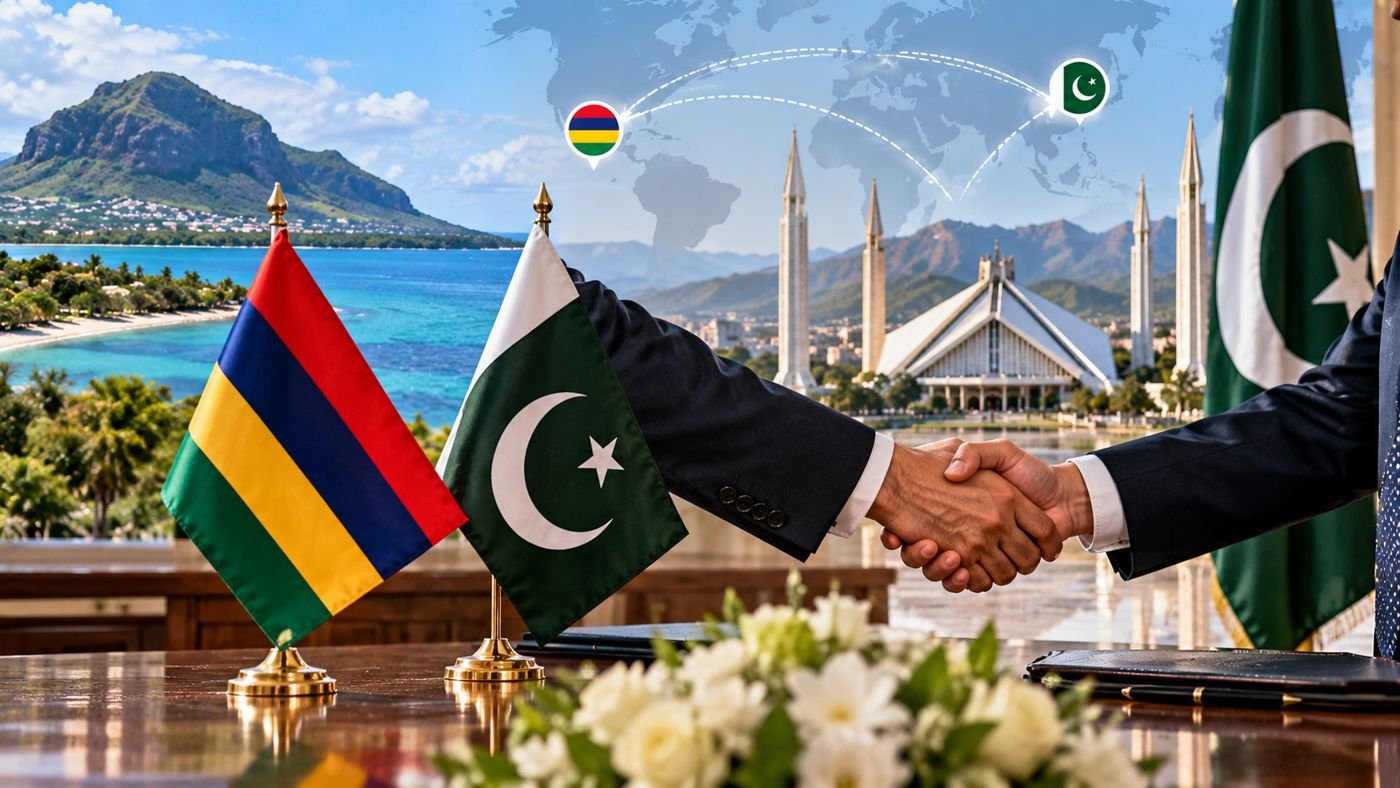
For Pakistan and Mauritius, the opportunities extend beyond traditional trade. Maritime cooperation, investment, Islamic finance, reciprocal tourism and cultural diplomacy all offer avenues for closer engagement.
For H.E. Mr. Munsoo Kurrimbaccus, the essential task is to translate goodwill into lasting connections between institutions, businesses and people. His diplomatic vision is rooted in the belief that friendship becomes stronger when countries understand one another, share knowledge and create opportunities together.
That is the promise of a diplomacy that builds bridges.