



Iqbal’s Poetry Embodies the Essence of the Quran-Sunnah: Prof. Zaid-Gul-Khattak
Silence over atrocities in Palestine is not an option: Dr Shoaib Suddle
Palestinian scholar Mufti Dr Mahmoud Yousuf Al-Shobaki urges protection of Pakistan, the only nuclear power in the Muslim world
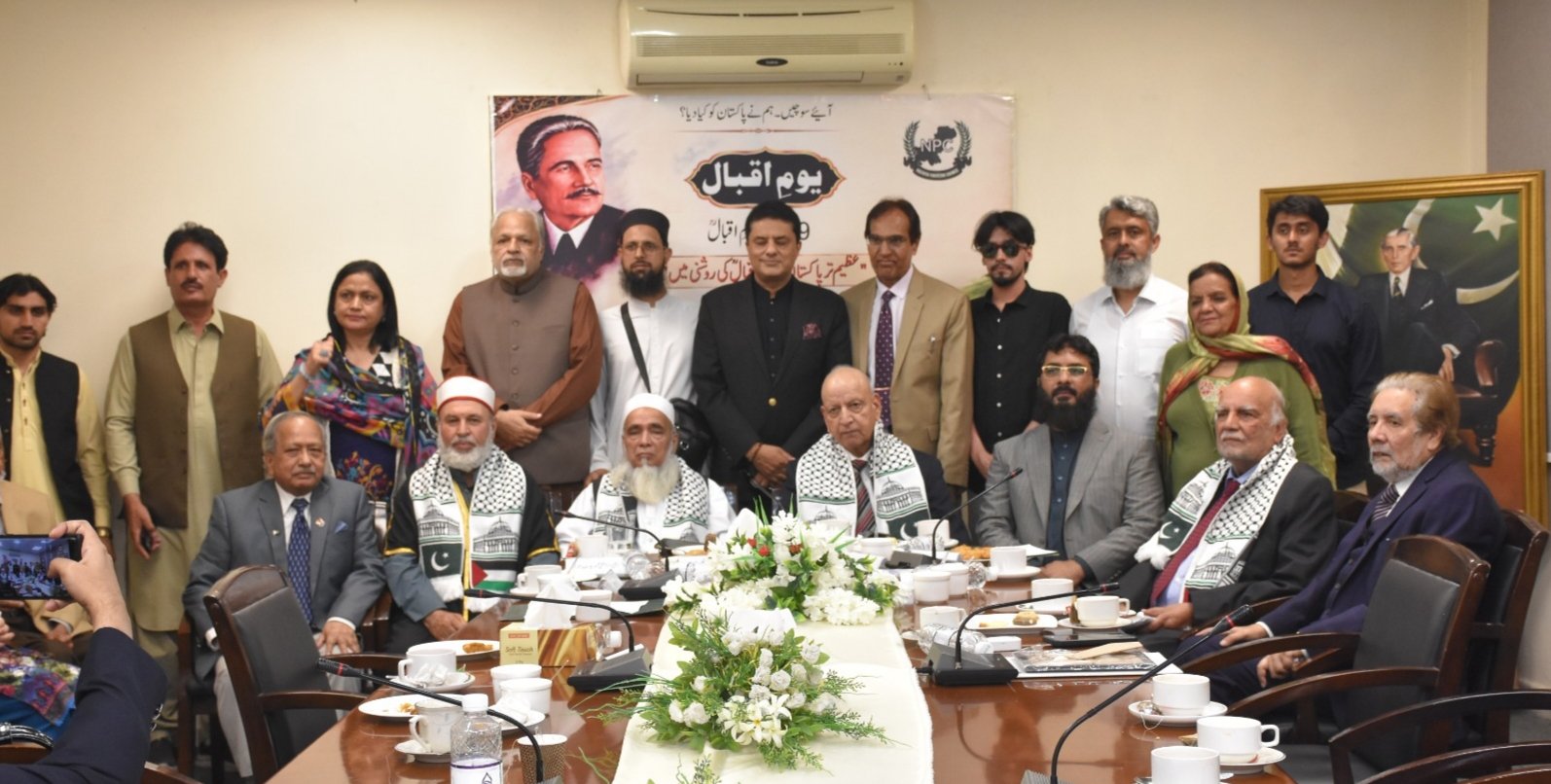
Islamabad – 11 November 2026 (MT Team) : Allama Muhammad Iqbal’s poetry embodies the essence of the Quran and Sunnah, and there is a need to translate his teachings into practice, said Professor Zaid Gul Khattak while presiding over an Iqbal Day ceremony organised by the Nazriya Pakistan Council Trust at Aiwan-e-Quaid, Islamabad.
The ceremony was held under the theme “A Greater Pakistan in the Light of Iqbal’s Thought.”
Prof. Zaid Gul Khattak observed that it was astonishing that people who had not even read a single poem of Iqbal attentively were making claims on social media that the poet had never presented the concept of Pakistan. He maintained that it was, in fact, Iqbal who had envisioned political autonomy, a distinct identity and a separate homeland for the Muslims of South Asia.
He said Iqbal aspired to establish a political and social entity where the values embodied in the Uswa-e-Hasana (the exemplary life of the Holy Prophet Muhammad, Peace Be Upon Him) could flourish, enabling the Muslim Ummah to recognise the true purpose of its existence.
Speaking as the chief guest, Dr Shoaib Suddle said that society had drifted in different directions and expressed hope that the prevailing challenges would soon be overcome by returning to the path highlighted by Iqbal.
He said Islam did not advocate unrestricted freedom but taught that adherence to religious principles could transform individuals as well as society as a whole. While he did not foresee a political leader who would fully represent Iqbal’s philosophy, he stressed that people must understand and embrace the true spirit of his teachings.
Dr Suddle also expressed concern over the continuing atrocities in Gaza and Palestine, saying that people should not remain silent but play their role in raising their voices against the suffering of the Palestinian people.
Chairman of the Nazriya Pakistan Council Trust, Mian Muhammad Javed, said that Iqbal was not only an enlightened thinker himself but also deeply admired light and enlightenment. References to the sun, moon and stars frequently appeared in his poetry. He added that Iqbal spoke for all humanity and that his message was universal in nature.
Palestinian scholar Sheikh Dr Mufti Mahmoud Yousuf Al-Shobaki, who attended the ceremony from Gaza, said that Allama Iqbal was not merely the thinker of Pakistan but also a thinker of the entire Muslim Ummah. He had presented the concept of Muslim unity and a shared identity.
Expressing gratitude to the Council for inviting him, he described Iqbal as a true Muslim and a man of exceptional intellectual stature. He said Iqbal had raised the issue of Palestine at an early stage and urged the Muslim Ummah to stand with the Palestinian people.
He called for vigilance against Zionist and Israeli designs, claiming that Pakistan remained among the countries targeted by such agendas because of its status as the only nuclear-armed state in the Muslim world. He prayed that Allah Almighty would protect Pakistan from all hostile designs and threats.
Dr Abdul Ghafoor Abid, another guest of honour, suggested that anyone wishing to understand Iqbal and his philosophy should study three important books: Iqbal and the Reconstruction of Religious Thought in English, Pas Cheh Bayad Kard in Persian, and Hayat-e-Iqbal. Referring to a controversial letter circulating on social media, he claimed that it was an artificial intelligence-generated fabrication. He emphasised that Iqbal’s work should be incorporated into the curricula of students at all educational levels.
Another guest of honour, Muhammad Idrees Azad, quoted Iqbal’s famous message that a nation cannot change its circumstances unless it first resolves to change itself. He also referred to the Quranic teaching conveying the same principle.
He highlighted Iqbal’s emphasis on industrial and technical education, recalling his warning that a nation possessing abundant mineral resources but lacking the capacity to process and manufacture them would remain dependent on others, importing finished products made from its own natural wealth.
Chairman of the Iqbal Studies Forum, Syed Zaheer Gilani, said that Iqbal was rightly known as the Poet of the East because his poetry had not only given a new intellectual direction to the Muslims of the subcontinent but had also awakened the entire East.
He observed that Iqbal’s poetry was not merely an exercise in artistic expression; rather, it was devoted to higher ideals and purposes. His work represented not just aesthetic expression but the development of a comprehensive intellectual and philosophical system.
CEO of ILO, Waheed Rumi, said that there was a need to reprogramme the national principles of unity, faith and discipline. He said the nation must revisit the missions of Quaid-e-Azam Muhammad Ali Jinnah and Allama Iqbal to transform Pakistan into a truly great state.
He also recalled that the late Zahid Malik, founding chairman of the Nazriya Pakistan Council Trust, had a great vision for nurturing the minds of Pakistan’s youth and shaping their intellectual and national outlook.
At the outset of the ceremony, Ahmad Mahmood-uz-Zaman presented a Naat in praise of the Holy Prophet Muhammad (Peace Be Upon Him).
Hosting the event, Hameed Qaiser said that Allama Iqbal was an extraordinary personality whose vision and intellectual insight had influenced not only the Indian subcontinent but the entire world. He observed that Pakistanis were fortunate that Iqbal was as deeply cherished by the Muslim world as he was by Pakistan.
The ceremony was attended by prominent intellectuals, scholars and distinguished guests.