


Climate Change Is Melting the Himalayas and Rewriting South Asia’s Water Future
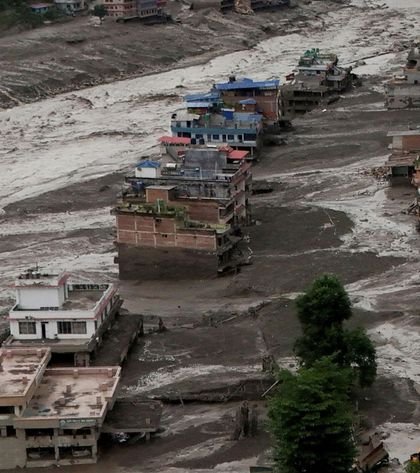
A catastrophic flood tore through Nepal’s mountainous Rasuwa district near the border with China’s Tibet region in August. A massive collapse involving glacier ice, rock and debris sent a destructive surge into the river system, sweeping away homes, roads, bridges and hydropower infrastruc-ture. The flood crossed into Tibet and destroyed the Gyirong border area, a major trade and transport corri-dor.The human cost was enormous.
By September 9, Reuters reported at least 1,380 confirmed deaths and around 5,500 people still missing across Nepal and Tibet. More than a dozen hydropower projects were affected, while hundreds of workers were caught in the disaster. Some survived for days underground before being rescued.
But the significance of Nepal’s disaster extends beyond the tragedy itself. It has brought into sharp focus a much larger story unfolding across the Hindu Kush Himalaya: climate change is transforming the region’s glaciers, snow, water systems and mountain hazards.
The August disaster should not be presented as proof that climate change directly caused every element of the event. Scientists must distinguish between long-term climate change and the specific geological and hydro-logical triggers of individual disasters.
The glaciers of the Hindu Kush Himalaya are shrinking, snow is declining and mountain hazards are becoming more dangerous. The catastrophic Nepal floods of August 2026 have provided a devastating reminder of what a warming cryosphere means for South Asia.
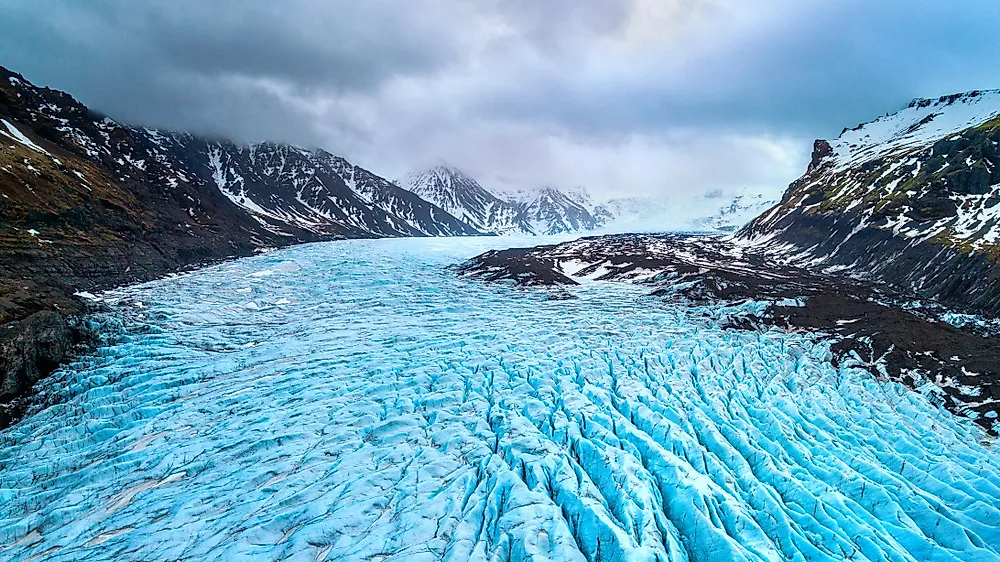
A glacier is a large, persistent body of snow and ice that forms on land and moves slowly under its own weight. It begins with snowfall.
When snow survives from one season to the next, it becomes compacted under the weight of newer snow. Over years, sometimes centuries, layers of snow are compressed into dense glacier ice.
Gravity then causes the ice to flow slowly downhill. Glaciers are therefore not simply frozen lakes. They are dynamic natural systems. They grow when snowfall and accumulation exceed ice loss. They shrink when melting, evaporation and other forms of ice loss exceed accumulation. This balance is known as glacier mass balance. A glacier with a negative mass balance is losing more ice than it gains. And across the Hindu Kush Himalaya, negative mass balance has become the dominant pattern.
The ICIMOD HKH Glacier Outlook 2026, based on more than five decades of observations, found that approximately 89% of recorded years had a negative glacier mass balance. The assessment also found that widespread glacier wastage has accelerated significantly since 2000, with post-2000 wastage approximately twice the rate observed previously.
Snow and ice can store water over much longer periods and release it gradually. This is why the Himalayas are sometimes described as the “water towers of Asia.”
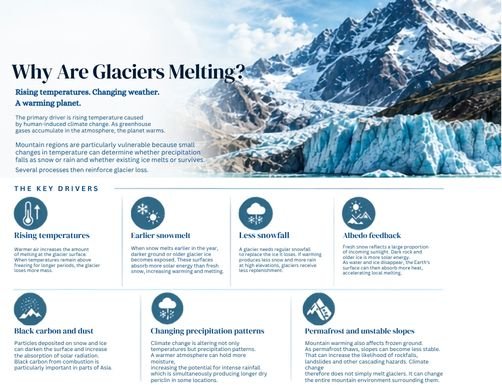
The Himalayas are warming. Glaciers are losing mass. Snow persistence is declining. Permafrost is becoming more vulnerable. And the consequences are moving downstream. For South Asia, the glacier crisis is therefore no longer simply an environmental story. It is a story about water, food, energy, economies and human security.
WHY DO GLACIERS MATTER?
The importance of glaciers goes far beyond their beauty.
The Hindu Kush Himalaya contains an estimated 54,000 glaciers covering approximately 60,000 square kilometres. These glaciers are a major component of the region’s water system and support agriculture, drinking water and hydropower for populations downstream.
Snow accumulates at high altitude during colder periods. Some of that snow eventually becomes glacier ice. The ice then releases water gradually through melting. This makes glaciers part of a natural water-regulation system.They do not simply provide water. They help influence when water is available. That distinction is crucial. Rainfall can arrive in a matter of hours or days.
THE NUMBERS TELL THE STORY
The scientific evidence of glacier decline is becoming increasingly difficult to ignore.
ICIMOD’s 2026 multidecadal assessment found that between 1990 and 2020, glacier area across the Hindu Kush Himalaya declined by approximately 12%. The same assessment found a significant reduction in the region’s ice reserves.
The deterioration has accelerated. The 2026 HKH Glacier Outlook reports that glacier wastage has approximately doubled since 2000. And the trend is not confined to the Himalaya alone. WMO reported in June 2026 that all 23 monitored glaciers in High-Mountain Asia lost mass during 2025. Scientists linked the losses to above-average temperatures and below-average winter snowfall.
Globally, the picture is equally serious. The World Meteorological Organization reports that glaciers worldwide lost an average of approximately 273 billion tonnes of mass every year between 2000 and 2023, contributing around 0.75 millimetres annually to global sea-level rise. The world’s glaciers are therefore not simply retreating visually.They are losing physical mass.
THE SNOW PROBLEM
Glaciers are only one part of the cryosphere. Snow is another. And 2026 has produced another warning. In April, ICIMOD reported that seasonal snow cover across the Hindu Kush Himalaya was 27.8% below the long-term average. It was the lowest snow persistence recorded in more than two decades and marked the fourth consecutive year of below-normal snow persistence. This matters because seasonal snow is an important source of water for the region’s rivers.
Snow is effectively another form of natural storage. It accumulates during colder months and melts as temperatures rise. If less snow accumulates, or if it melts earlier than usual, the timing of river flows changes. That can create problems for agriculture, hydropower and water management. The result is an increasingly compli-cated picture: Glaciers are shrinking. Snow is declining. Rainfall is becoming more variable. And extreme precipit-ation events can still produce devastating floods. Climate change is therefore not simply making South Asia “drier.” It is making the water cycle less predictable.
THE GLACIER PARADOX
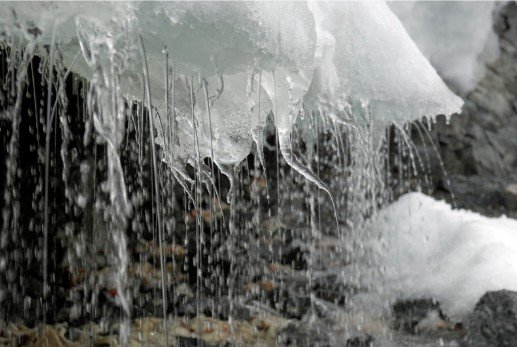
There is a misconception that glacier melting automat-ically means more water. In the short term, accelerated melting can indeed increase runoff in some basins.
But that cannot continue indefinitely. A glacier is a finite store of ice. If it loses more mass than it gains year after year, its ability to provide additional meltwater eventually declines. This creates what can be called the glacier paradox, accelerated melting can temporarily increase water availability while simultaneously destroying the natural storage system that provides long-term water security.
That is why glacier loss is not simply a future problem.
It is a transition problem. Societies can experience more runoff and more floods at one stage, followed later by declining glacier contributions and increasing water stress.
The timing will vary from basin to basin. But the underlying principle is the same, The loss of ice means the loss of natural water storage.
NEPAL: WHEN CLIMATE RISK BECAME A HUMAN DISASTER
The August 2026 Nepal catastrophe provides a dramatic illustration of the other side of the equation. A glacier collapse sent enormous quantities of ice, rock, mud and water into the river system. The resulting flood destroyed villages and infrastructure and overwhelmed hydropower facilities. Reuters reported that around 900 hydropower workers were at facilities affected by the disaster, while approximately 121 workers were believed to have been trapped in tunnels during the rescue operation.
The flood also destroyed the Gyirong border crossing between Nepal and Tibet. Nepal subsequently appealed for approximately $5 billion in international assistance for initial reconstruction, framing the disaster within the broader question of climate justice. The disaster demons-trates an important principle. Climate change does not have to produce a single direct chain from “warming” to “flood”. Instead, it can alter the conditions under which multiple hazards interact.
Changing snowmelt, glacier runoff, rainfall patterns and sediment loads can affect generation and infra-structure. At the same time, extreme floods can damage power stations, transmission lines and roads required to operate and maintain them.
FROM CLIMATE CHANGE TO FOOD SECURITY
The glacier crisis eventually becomes a food crisis.
Farmers need predictable water. Crops require water at particular stages of growth. If river flows become more erratic, irrigation planning becomes more difficult. If floods become more intense, crops and agricultural infrastructure can be destroyed. If dry periods lengthen, groundwater is placed under greater pressure.
The chain is straightforward: Glacier and snow change → river-flow change → irrigation uncertainty → agricultural risk → food-price pressure.
This is why glacier monitoring belongs in economic planning.
FROM FOOD SECURITY TO ENERGY SECURITY
The same logic applies to electricity. Countries have invested heavily in hydropower because its rivers provide a major renewable energy resource. But hydropower depends upon water.
Changing snowmelt, glacier runoff, rainfall patterns and sediment loads can affect generation and infrastructure. At the same time, extreme floods can damage power stations, transmission lines and roads required to operate and maintain them. The Nepal disaster showed the vulnerability of mountain hydropower infrastructure in particularly dramatic terms.
The lesson for us is not to abandon hydropower. It is to build hydropower for the climate that is coming rather than the climate that has passed.
THE REAL MEANING OF 2026
The significance of 2026 is not that one year has sud-denly caused the Himalayan glacier crisis. It is that several indicators are now pointing in the same direction. Glacier wastage in the HKH has accelerated. The region has lost substantial glacier area since 1990. Around 89% of observed years have recorded negative glacier mass balance. All 23 WMO-monitored High-Mountain Asia glaciers lost mass in 2025. HKH snow persistence in 2026 was 27.8% below the long-term average. The region experienced its fourth consecutive year of below-normal snow persistence.
And on August 26, a catastrophic glacier-related flood devastated communities and infrastructure in Nepal and Tibet. These facts should not be presented as evidence that climate change caused every individual disaster. They are evidence of something broader: The physical conditions of the Himalayan climate system are changing.
THE FUTURE AFTER THE ICE
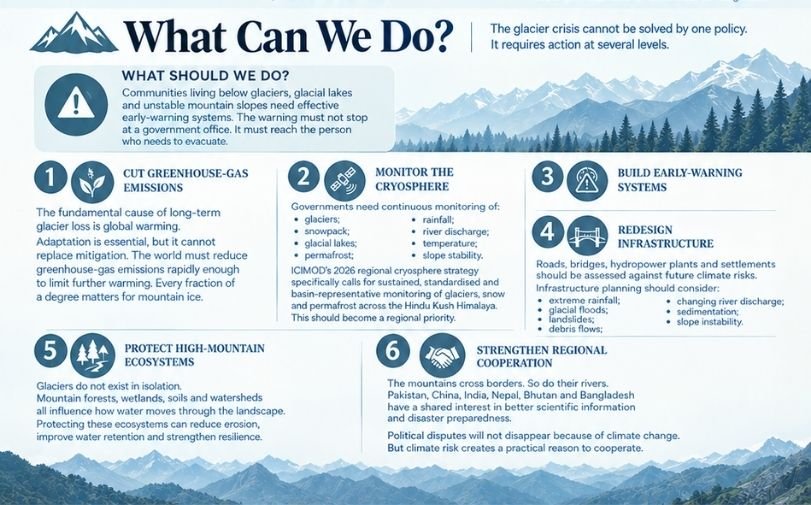
The glaciers are already sending a warning. If governments continue to treat their retreat as a distant environmental concern rather than an immediate security and development crisis, the consequences will be far more destructive. Unchecked warming will mean shrinking natural water reserves, increasingly unpredictable rivers, more severe floods and landslides, greater pressure on food and energy systems, and rising displacement across vulnerable mountain communities. For Pakistan and the wider region, the cost of inaction will not be measured only in melting ice, but in lost lives, damaged economies, disrupted agriculture and growing competition over water. The window for preventive action is narrowing. What happens after the ice is gone cannot be reversed by emergency response. The choices made today will determine whether South Asia faces a manageable climate transition or a future defined by recurring disasters and water insecurity.