



Labour, Law, and the Cost of Keeping Cities Running After Midnight
Across Pakistan’s major urban centres, Karachi, Lahore, and Islamabad, a significant portion of economic activity unfolds after dark. While the visible rhythm of the day suggests closure and rest, the operational reality is markedly different. Hospitals continue to function at full capacity, security personnel remain deployed across commercial and residential zones, petrol stations stay open, municipal cleaning services are mobilised, and an expanding network of delivery riders moves across cities responding to digital orders.
This nocturnal workforce is not incidental; it is fundamental to the continuity of urban life. Yet, despite its centrality, it remains structurally under-recognised, inadequately protected, and inconsistently regulated within Pakistan’s labour framework.

A Diverse but Unequal Workforce
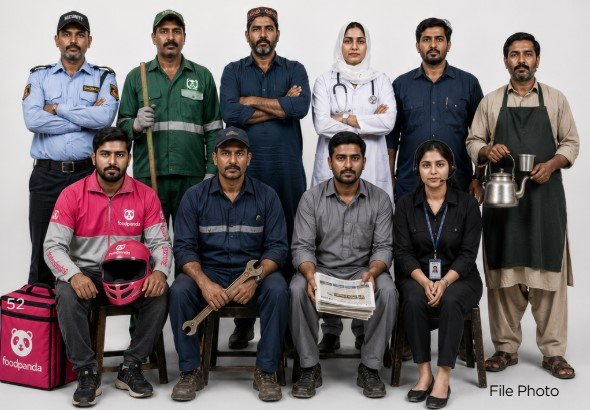
Night workers in Pakistan represent a diverse cross-section of the labour market, spanning both formal and informal sectors. Healthcare professionals doctors, nurses, and paramedics operate in structured environments but often under intense physical and emotional strain. Security guards, a ubiquitous presence across urban Pakistan, typically work extended shifts, often exceeding standard working hours, with minimal compensation adjustments for night duty.
Sanitation workers and cleaners, many of whom are employed informally, perform essential public health functions during hours when their labour remains largely unseen. Petrol pump attendants and retail staff ensure uninterrupted access to fuel and basic services. Increasingly, however, the most visible face of night work is that of the platform-based delivery rider, navigating urban spaces under algorithm-driven systems that prioritise efficiency over worker welfare.

The rise of the gig economy in Pakistan, facilitated by platforms such as Foodpanda, has introduced new opportunities for income generation, particularly for younger segments of the workforce. However, it has also exposed a significant regulatory vacuum. Platform workers operate in a grey area, often classified as independent contractors rather than employees. This classification effectively excludes them from core labour protections, including minimum wage guarantees, social security contributions, health insurance, and legal recourse in cases of dispute. While the flexibility of gig work is often highlighted as a benefit, the absence of structural safeguards places the burden of risk entirely on the worker.
Global Standards vs. Local Realities
This regulatory ambiguity is increasingly at odds with evolving global labour standards. Institutions such as the International Labour Organization have underscored the need to broaden the legal definition of “worker” to include those engaged in platform-based and non-standard forms of employment. The rationale is straightforward: the nature of work has changed, and legal frameworks must adapt accordingly. In the Pakistani context, this requires a deliberate policy shift to recognise platform workers as part of the broader labour force, irrespective of their contractual designation. Such recognition would not necessarily eliminate flexibility but would ensure the extension of baseline protections essential for dignity and security.
Health Risks of Working Through the Night
The challenges associated with night work extend beyond legal classification and into the domain of health and safety. Research referenced by the World Health Organization consistently highlights the physiological and psychological risks of working irregular hours. Disruption of circadian rhythms, increased susceptibility to cardiovascular and metabolic disorders, chronic fatigue, and mental health strain are well-documented consequences of sustained night shifts. In Pakistan, where occupational health standards are unevenly implemented, these risks are further exacerbated by limited access to healthcare, absence of employer-supported insurance, and lack of routine health monitoring for workers engaged in night shifts.
Safety and Gendered Vulnerabilities
Safety concerns are equally pressing. Delivery riders face heightened risks of road accidents and theft, particularly in poorly lit or low-surveillance areas. Security guards often work in isolation, making them vulnerable to physical harm. Female workers, although present in sectors such as healthcare and call centres, encounter additional barriers related to safe transportation, workplace harassment, and societal perceptions of women working at night. These factors collectively constrain broader participation and reinforce gender disparities within the night economy.

Legal Frameworks and Enforcement Gaps
Pakistan’s existing labour laws do provide a framework for regulating working hours, overtime, and workplace conditions. However, the effectiveness of these provisions is undermined by weak enforcement mechanisms and limited coverage of informal sectors. There is also a notable absence of policies specifically addressing night work. Unlike several international jurisdictions where night shift allowances or wage premiums are mandated, Pakistan lacks a standardised approach to compensating workers for the additional physical and social costs associated with nocturnal labour. This gap is particularly significant given the documented health implications and lifestyle disruptions linked to night work.
Towards Inclusive Labour Reforms
Addressing these challenges requires a comprehensive and forward-looking policy response. The first and most critical step is the formal inclusion of platform workers within the legal definition of “worker” or “labour.” This could be achieved through the introduction of an intermediate classification often referred to as “dependent contractor” which acknowledges the unique characteristics of gig work while extending essential protections. Such a framework would enable the application of minimum wage standards, access to social security schemes, and eligibility for dispute resolution mechanisms without fully imposing traditional employment structures on digital platforms.
Fair Compensation and Health Protections
In parallel, there is a need to institutionalise compensation mechanisms specific to night work. Introducing mandatory night shift allowances or wage differentials would recognise the additional burden borne by these workers and align compensation structures with international best practices. This must be complemented by stronger occu-pational health standards, including limits on consecutive night shifts, mandatory rest periods, and periodic health assessments. Employers, both in the formal sector and within the gig economy, should be required to contribute to health insurance and accident coverage schemes, ensuring that workers are not left unprotected in the event of illness or injury.
Strengthening Safety Infrastructure
Safety infrastructure also demands urgent attention. Urban planning and law enforcement strategies must account for the realities of night work by improving street lighting, icreasing police presence in high-risk areas, and facilitating safe transport options for workers, particularly women. Digital platforms, which exercise significant control over the working conditions of gig workers, should be mandated to integrate safety features such as real-time tracking, emergency response systems, and transparent communication channels.
Equally important is the need for reliable data. Pakistan currently lacks comprehensive statistics on the scale and distribution of night work across sectors. Without this data, policy interventions remain reactive and fragmented. A coordinated effort to document and analyse the night workforce would provide the empirical foundation necessary for informed decision-making and targeted reforms.
Ultimately, the issue of Pakistan’s unseen night workers is not merely a question of labour policy it is a reflection of how economic systems assign value and recognition. These workers are not peripheral actors; they are central to the functioning of urban economies. Their labour ensures continuity, safety, and service delivery in contexts where disruption is not an option.
From Recognition to Reform
Reframing this narrative requires moving beyond symbolic acknowledgment toward structural inclusion. It requires recognising that the sustainability of a modern economy depends not only on growth and innovation but also on the fairness and resilience of its labour systems. Incorporating platform workers into the legal definition of labour, strengthening enforcement mechanisms, and introducing targeted protections for night work are not incremental adjustments; they are necessary reforms to align Pakistan’s labour framework with contemporary realities.
The writer can be reached at mick66yen@gmail.com