



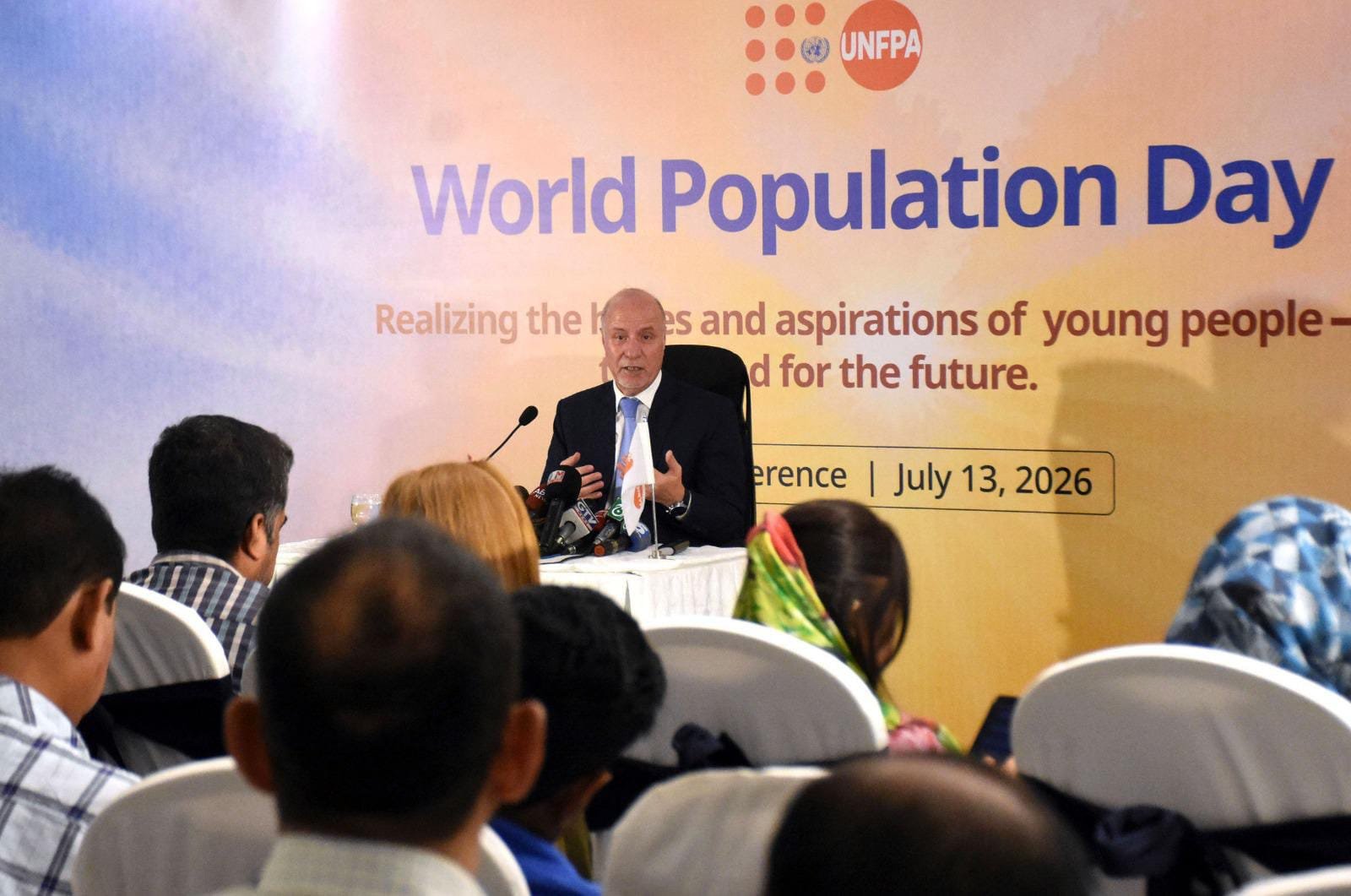
Pakistan population reaches around 257.2 million with one-third aged between 10 & 24 years: UNFPA report
Islamabad – 13 July 2026 (Adnan Hameed) : Pakistan’s rapidly growing population is no longer merely a health or economic challenge but has emerged as a matter of national security requiring coordinated action from the country’s political, military, religious and social leadership. The UNFPA Pakistan Representative Dr. Luay Shabaneh said this while addressing a media briefing here Monday on the eve of the World Population Day 2026.
He shared with media findings of a global report titled “Lives, Choices and Futures: What Young People Want and What Shapes Their Decisions About Relationships and Parenthood.” The report he said is based on responses from more than 100,000 young people aged 18-39 across 73 countries, including over 1,700 respondents from Pakistan. The findings came at a time when Pakistan’s population has reached around 257.2 million, with nearly one-third of citizens aged between 10 and 24 years, making investment in youth essential for the country’s future stability and prosperity, the UNFPA representative said.
While elaborating on key factors—challenges as well as opportunities—that contribute to increasing awareness among the youth regarding family planning, right choices of relationship, parenthood, marriage and children, Dr Luay said it is the time for Pakistan to grow rich and prosperous before its population grows old.
He also welcomed the government’s renewed focus on population management, particularly appreciating Prime Minister Shehbaz Sharif for personally chairing the National Population Council (NPC). He noted that inclusion of Field Marshal Syed Asim Munir in the national body reflects that population management has become a strategic national priority extending beyond the health sector to encompass economic resilience, social cohesion and national security.
He emphasized that sustainable population management cannot be achieved through government departments alone. Parliamentarians, provincial legislators, religious scholars and community leaders have a decisive role in promoting responsible parenthood, birth spacing, girls’ education and awareness while dispelling misconceptions surrounding reproductive health. Their collective engagement, he said, is vital to addressing one of Pakistan’s most pressing long-term challenges.
Dr. Shabaneh said the report highlights that young people across the world aspire to meaningful lives, stable relationships and families but increasingly face economic uncertainty, housing shortages, insecurity, gender inequality and climate-related concerns that influence their decisions regarding marriage and parenthood.
According to the Pakistan findings, 76 percent of respondents expressed optimism about the future despite mounting challenges. However, 53 percent cited conflict and security risks, economic insecurity, inequality, health concerns and environmental threats among their major worries.
The survey also revealed a gap between the number of children people currently have and the number they ideally desire. Women in Pakistan have an average of 1.8 children but would prefer 2.5, while men reported an average of 2.5 children and ideally wanted 3.4. Among Pakistanis aged 35-39 without children, 65 percent said they would like to become parents.
Dr. Shabaneh stressed that reproductive decisions are shaped by real-life circumstances rather than fertility targets alone. Young people identified financial security, stable employment, housing, emotional readiness, healthcare, gender equality and access to quality public services as the key conditions needed before starting families. He underlined that Pakistan’s youthful population represents an enormous opportunity if equipped with education, skills and employment. Otherwise, the country risks missing its demographic dividend.
Highlighting the growing importance of digital connectivity, Dr. Shabaneh said internet access has become a gateway to education, employment, information and civic participation. Expanding digital inclusion, especially for girls, rural youth and marginalized communities, is essential for unlocking Pakistan’s economic potential, particularly as the country already hosts one of the world’s largest young freelance workforces, he said. The UNFPA urges the federal and the provincial governments, development partners, civil society, religious and community leaders, academia, the private sector and youth organizations to jointly create an enabling environment for young people.
The agency recommended four priority areas: expanding youth skills and decent employment opportunities, including in the digital economy; integrating youth-friendly reproductive health services and birth spacing into universal health coverage; advancing gender equality and protecting girls from child marriage through sustained engagement with religious and community leaders; and strengthening health systems, midwifery services and dignified employment for women while addressing emerging challenges such as climate displacement and disability inclusion.
Dr. Shabaneh said World Population Day should remind policymakers that Pakistan’s future will not be determined solely by population growth but by the quality of choices made today. He reaffirmed UNFPA’s commitment to supporting Pakistan in ensuring that every pregnancy is wanted, every childbirth is safe and every young person has the opportunity to realize his or her full potential.