



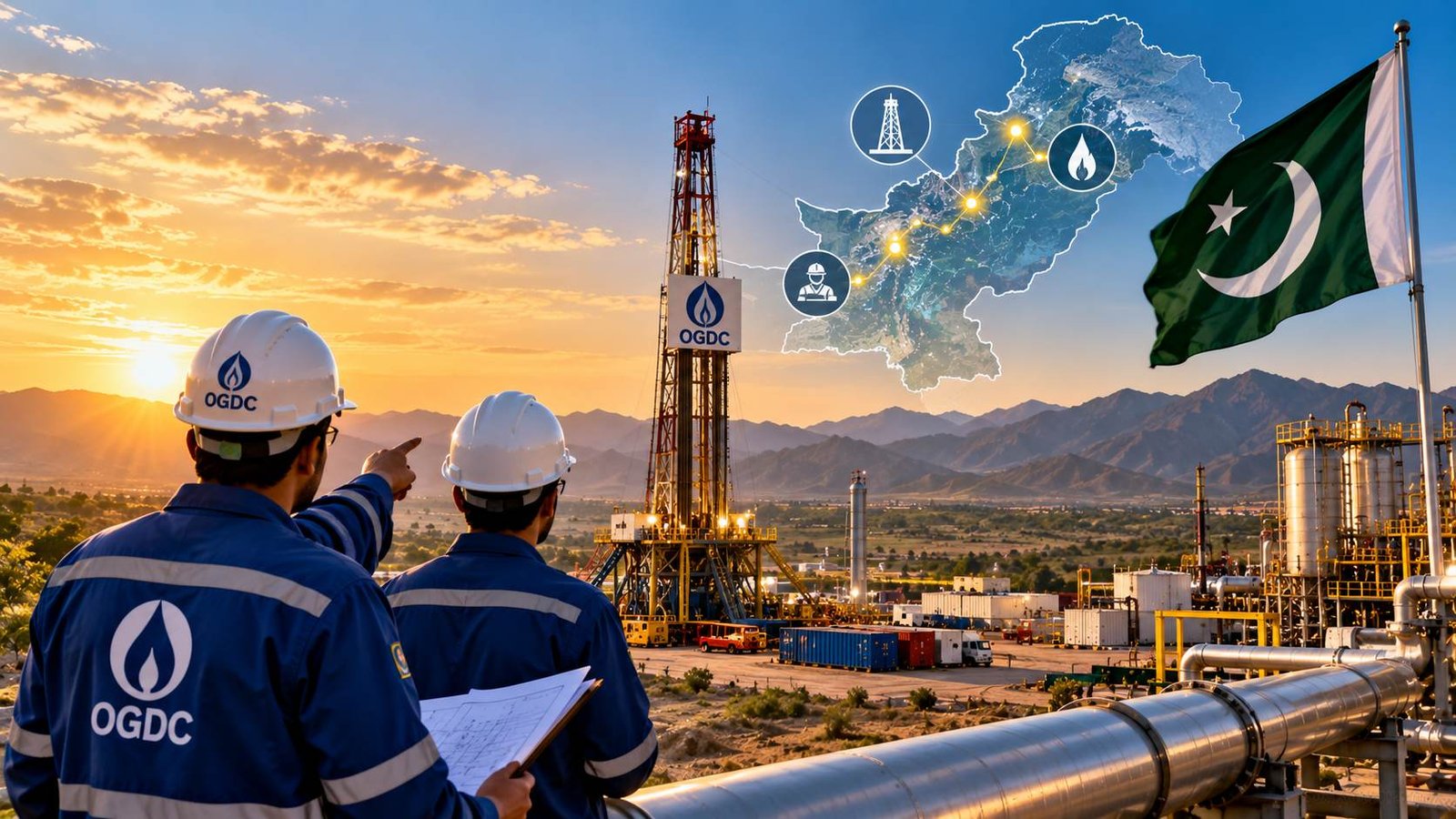
Strengthening Pakistan’s Energy Security Through Domestic Exploration
How OGDC’s expanding exploration efforts are contributing to indigenous energy supplies and the country’s economic resilience
Pakistan’s energy security is closely linked to its ability to discover, develop and efficiently utilise domestic hydrocarbon resources. As the country works to meet the energy requirements of households, industries, agriculture and power generation, indigenous oil and gas production remains an important component of its economic strategy. In this context, the Oil and Gas Development Company Limited (OGDC) continues to contribute to Pakistan’s energy landscape through exploration, field development and the production of domestic resources.
A recent milestone illustrates this effort. On September 6, 2026, the Lundali-1 well in Sindh’s Sukhpur-II Block achieved first gas, with production reaching 10 million standard cubic feet per day (MMscfd). The gas is being supplied to Sui Southern Gas Company Limited (SSGC), adding a new source of indigenous gas to the national supply system. OGDC holds a 30 per cent working interest in the block, alongside its joint venture partners.
The development, announced by the company in September, highlights the continuing importance of exploration and production activities in strengthening the availability of locally sourced energy.
The Strategic Value of Indigenous Resources
Domestic exploration matters because energy availability influences far more than the functioning of the power sector. Gas is used by industries, commercial enterprises, households and other parts of the economy. Reliable supplies can support industrial activity, employment and economic continuity, while disruptions and supply shortages can create additional costs for businesses and consumers.
Pakistan’s reliance on imported energy also exposes its economy to international price movements, foreign-exchange pressures and geopolitical uncertainty. Developing indigenous resources cannot eliminate these risks, but it can help diversify supply and reduce some exposure to external market shocks.
For this reason, exploration is not simply a technical exercise involving drilling wells and identifying underground reserves. It is part of a wider economic effort to improve the balance between domestic production and national demand.
The contribution of each new producing well depends on its output, operating life, production costs, infrastructure requirements and the quality of the resource. Nevertheless, successful discoveries that progress into commercial production can add valuable supplies to the energy system.
From Exploration to Production
Hydrocarbon exploration involves geological interpretation, seismic surveys, drilling, testing and the assessment of commercially recoverable resources. Even when a discovery is made, further investment and technical work may be required before production can begin.
Lundali-1 demonstrates the importance of moving from discovery to operational delivery. Its commissioning and subsequent supply of gas to SSGC show how an exploration asset can become part of the country’s energy supply chain.
The project also reflects the role of joint ventures in Pakistan’s exploration and production sector. According to the September 2026 announcement, Prime Global Energies Limited operates the Sukhpur-II Block with a 25 per cent working interest. Mari Energies Limited holds 30 per cent, while Turkish Petroleum Overseas Company Limited holds 15 per cent. OGDC’s participation gives it a stake in the development and production of the resource.
Such arrangements can combine technical capabilities, capital and operational expertise. In an industry characterised by substantial investment requirements and geological uncertainty, cooperation among companies can support the development of projects that might otherwise face greater financial or operational constraints.
Exploration Across Pakistan’s Sedimentary Basins
Lundali-1 is part of a broader picture of exploration and development activity in Pakistan. The country’s sedimentary basins offer opportunities for oil and gas exploration, although the commercial viability of individual prospects varies considerably.
OGDC’s 2025–26 operating record provides further context. According to the Associated Press of Pakistan’s report on the company’s annual results, OGDC drilled 23 wells and recorded 58,333 metres of drilling during the financial year, while securing interests in 15 additional exploration blocks. Its average daily net saleable production stood at 32,861 barrels of crude oil, 667 million cubic feet of gas and 670 tonnes of liquefied petroleum gas.
These figures illustrate the scale of the company’s exploration and production operations. They also underline the importance of maintaining investment in existing fields while pursuing new prospects.
Mature fields require continuing technical attention to sustain output, manage declining reservoir pressure and improve recovery. New discoveries, meanwhile, can expand the resource base and create opportunities for future production. Balancing these priorities is central to maintaining a stable domestic supply portfolio.
Linking Production with Economic Resilience
The benefits of domestic exploration depend on whether new resources can be developed efficiently and delivered to consumers. Production must be supported by appropriate processing facilities, transmission infrastructure, commercial arrangements and effective management of the wider gas supply chain.
Equally important is the need to use available energy efficiently. Greater domestic production can improve supply options, but long-term energy security also requires investment in renewable energy, conservation, efficient technologies and a diversified energy mix.
For Pakistan, the challenge is therefore twofold: developing commercially viable domestic resources and managing demand in ways that reduce avoidable waste and supply pressures.
Transparent reporting of production levels, investment decisions and operational performance is important to this process. It allows policymakers, investors and the public to understand how exploration activity translates into actual energy supplies and economic value.
Building for the Future
Pakistan’s energy requirements will continue to evolve alongside industrial development, urbanisation and changing patterns of consumption. Meeting those requirements will require sustained investment, technological capacity, responsible resource management and effective coordination across the energy sector.
OGDC’s Lundali-1 milestone offers a timely example of the contribution domestic exploration can make. With the well producing 10 MMscfd and supplying gas to SSGC, the project adds to the country’s indigenous energy resources and demonstrates the practical importance of bringing exploration assets into production.
The larger objective is to ensure that domestic resources contribute meaningfully to a more reliable and resilient energy system. Discoveries alone cannot resolve every challenge facing Pakistan’s energy sector. Their value ultimately depends on efficient development, dependable delivery and sound long-term planning.
As Pakistan pursues greater economic stability and industrial growth, continued exploration and responsible development of its indigenous oil and gas resources will remain an important part of the national energy equation.