



ISSI-PAIDAR Commemorate Zimbabwe’s National Day
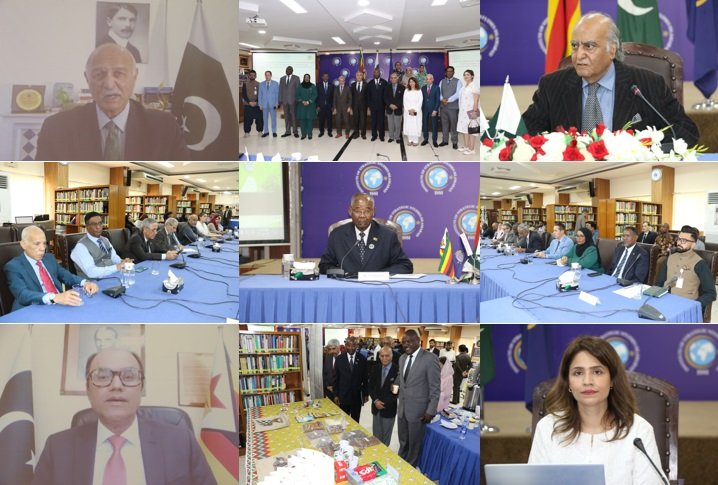
Islamabad – 27 April, 2026 (Adnan Hameed) : The Centre for Afghanistan, Middle East & Africa (CAMEA) at the Institute of Strategic Studies Islamabad (ISSI), in collaboration with Pakistan Africa Institute for Development and Research (PAIDAR), organized an event to commemorate Zimbabwe’s National Day. The proceedings, which began with the national anthems of Pakistan and Zimbabwe were moderated by Dr. Amina Khan, Director CAMEA. Speakers included Ambassador Khalid Mahmood, Chairman, BoG, ISSI; T.M.J Abu-Basutu, (RTD) Air Marshal, Ambassador of Zimbabwe to Pakistan; Muhammad Amjad Aziz Qazi, Ambassador of Pakistan to Zimbabwe. The Chief Guest on the occasion was Senator Mushahid Hussain Sayed, President PAIDAR.
Ambassador Khalid Mahmood highlighted the significance of Zimbabwe’s National Day, marking its independence on April 18, 1980, and paid tribute to its resilience and struggle for sovereignty. He underscored the strong Pakistan–Zimbabwe relationship, rooted in mutual respect and South–South cooperation, and recalled Pakistan’s consistent support for Zimbabwe’s independence. He noted ongoing collaboration in defence, education, agriculture, health, and capacity building. He emphasized the potential to expand trade and economic cooperation, particularly in agriculture, textiles, and light engineering, under Pakistan’s ‘Engage Africa’ policy, says press note. He also reaffirmed the importance of stronger institutional linkages and highlighted ISSI’s role, through CAMEA, in promoting dialogue, research, and engagement with Africa.
In her remarks, Dr. Amina Khan highlighted the significance of the National Day of the Republic of Zimbabwe, paying tribute to the courage and resilience of its people. She underscored that Africa remains a key pillar of Pakistan’s foreign policy and noted CAMEA’s efforts under the ‘Engage Africa’ policy to promote meaningful engagement through initiatives such as National Day and Africa Day commemorations. She emphasized the importance of building practical partnerships and strengthening people-to-people and institutional linkages.
Senator Mushahid Hussain Sayed highlighted that Pakistan’s relationship with Zimbabwe dates back to its nationalist struggle, when Pakistan was among the first countries to extend political, diplomatic, financial, and material support against British colonial rule. He noted that the partnership, strengthened through leadership-level engagement, continued after independence, with Pakistan among the first to recognize Zimbabwe in 1980, reflecting deep mutual trust and solidarity. He highlighted cooperation in defence, trade, and people-to-people contacts, as well as the role of the Pakistani diaspora and early cultural and sporting exchanges, including cricket ties in the 1990s. He stressed the importance of amplifying the voices of developing countries and the potential for deeper cooperation in a changing global order. He further pointed to the shifting global balance from West to East, linking it to Afro-Asian solidarity rooted in the Bandung spirit, and expressed confidence that relations can grow further through expanded people-to-people and business-to-business linkages, reaffirming Pakistan’s commitment to Africa solidarity.
Ambassador T.M.J Abu-Basutu, in his remarks, appreciated the ISSI for organising the celebration of Zimbabwe’s 46th National Day and highlighted the longstanding, brotherly ties between Zimbabwe and Pakistan. He acknowledged Pakistan’s consistent support since Zimbabwe’s independence, particularly in defence cooperation and the training of Zimbabwe’s Air Force. Emphasising the need to expand bilateral ties, he pointed to the untapped potential in sectors such as trade, mining, tourism, and infrastructure, and called for greater collaboration between the governments and private sectors of both countries to foster economic growth and deepen the partnership.He highlighted Pakistan’s longstanding role in training the Zimbabwe Air Force and ongoing cooperation through institutions such as the National Defence University and Foreign Service Academy, underscoring strong bilateral ties across defence, education, and sports. Emphasizing “Unity and Development towards Vision 2030,” he called for collective efforts to build a prosperous and modern Zimbabwe, expressed optimism about its economic prospects, and reaffirmed Pakistan’s continued support, including for its UN engagements and bid for a non-permanent seat on the UN Security Council (2027–2028).
Ambassador Amjad Qazi said that Pakistan and Zimbabwe enjoy cordial relations and support each other at multilateral forums, including the United Nations. He noted that an MoU on bilateral cooperation will be signed, with defence cooperation as an important aspect of ties. He also highlighted education linkages, with Zimbabwean students studying in Pakistan and efforts underway to enhance university-to-university collaboration. He further stressed the need to strengthen business-to-business connections. In particular, he underscored greater engagement between the chambers of commerce.