



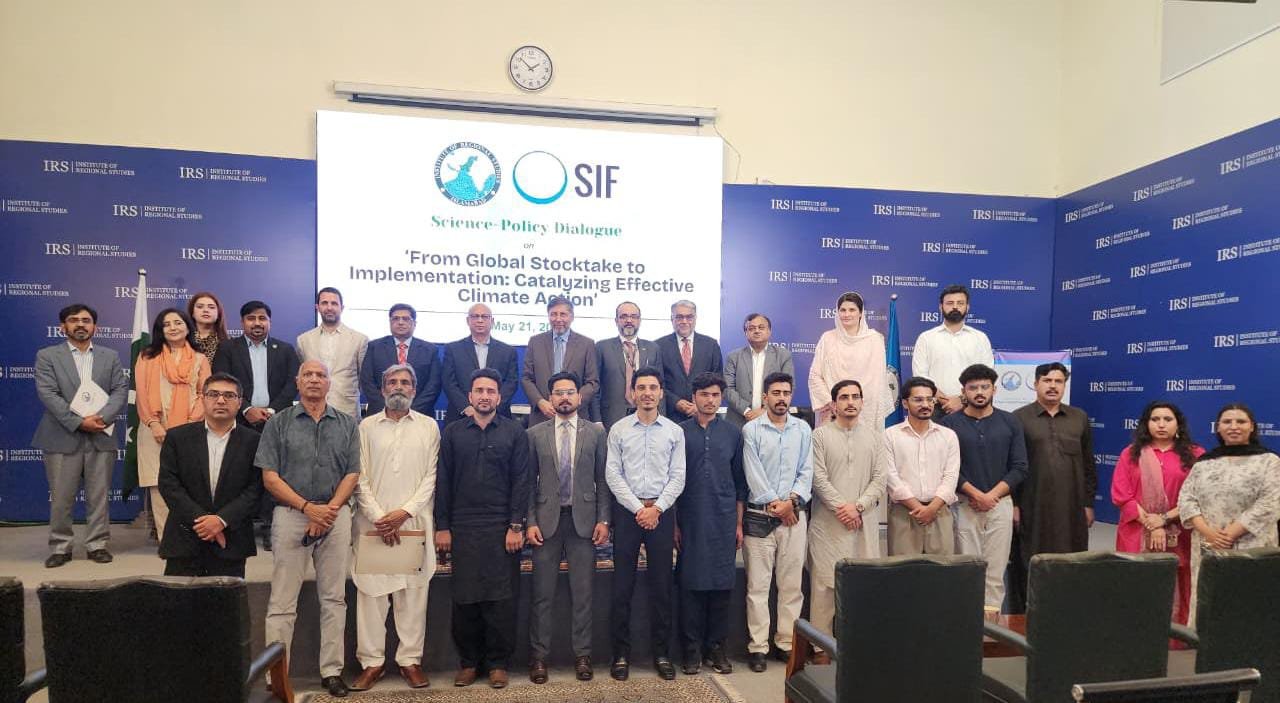
IRS-SIF holds high-level dialogue on examining ‘Climate Change Strategies’
Islamabad – 1st June 2026 (Adnan Hameed) : The Institute of Regional Studies (IRS), in collaboration with Secours Islamique France (SIF)-Pakistan, organized a high-level Science-Policy Dialogue titled “From Global Stocktake to Implementation: Catalyzing Effective Climate Action” to examine pathways for translating global climate commitments into practical and regionally relevant implementation strategies.
The dialogue brought together representatives from international organizations, government institutions, development agencies, academia, and civil society to deliberate on the evolving climate governance landscape following the first Global Stocktake (GST) under the Paris Agreement and subsequent international climate negotiations.
Speaking at the event, Ambassador Jauhar Saleem, President IRS, highlighted the urgency of climate action, noting that Pakistan remains highly vulnerable to climate-induced disasters despite its minimal contribution to global emissions, says press note. He stressed that climate change, water scarcity, environmental degradation, population growth, and sustainable development are interconnected challenges requiring a comprehensive national strategy. He also emphasized stronger climate financing, resilient infrastructure, public awareness, and coordinated governance to build long-term resilience.
Mr. Shiraz Shah, Assistant Resident Representative, UNDP Pakistan, emphasized translating policy commitments into effective delivery mechanisms and resilient governance systems for long-term climate adaptation and sustainable development. He highlighted stronger institutional coordination, locally driven solutions, integrated policy frameworks, and partnerships among governments, development institutions, and communities to advance inclusive climate resilience. Mr. Thomas Conan, Deputy Country Director, WFP Pakistan, highlighted growing climate threats to food security and stressed resilient food systems, climate-smart agriculture, anticipatory action, and stronger social protection mechanisms to address vulnerabilities affecting agriculture, livelihoods, and supply chains.
Mr. Muhammad Arif Goheer, Executive Director, GCISC, outlined Pakistan’s climate vulnerabilities, including extreme weather events, glacial melt, water stress, and rising temperatures. He emphasized science-based planning, stronger climate data systems, research, and institutional capacities for informed policymaking and long-term adaptation. Mr. Amir Khan Goraya, CEO, NDRMF, underscored the importance of risk financing, institutional strengthening, and innovative financing mechanisms to scale climate resilience. He stressed sustained investments in preparedness, disaster risk reduction, community-level adaptation, and stronger coordination among public institutions, development partners, and financial actors.
Concluding the session, Dr. Altaf Abro, Head of Mission, SIF Pakistan, stressed enhanced climate governance, innovative risk financing, and stronger partnerships to address humanitarian and environmental challenges. He called for integrated efforts among government institutions, academia, development partners, the private sector, and local communities, while underscoring the importance of green technologies and practical climate solutions.
Dr. Anjum Rasheed, Head of the Climate Resilience Program at IRS, noted that the first Global Stocktake concluded at COP28 in 2023 marked a historic assessment of collective climate progress. She observed that the world remains off-track in limiting warming to 1.5°C, with widening adaptation gaps and inadequate climate finance for vulnerable countries. She stressed the need to accelerate implementation, strengthen NDCs, scale up climate finance, and enhance international cooperation.