




Is living alone becoming the new expression of personal freedom, or does the growing number of single-person households expose a deeper economic and social transformation? From changing marriage patterns to urban housing markets, the rise of solo living is redefining how people organise their lives, consume resources and relate to society.
For generations, the traditional household was built around the family: two parents, children and, in many societies, extended relatives sharing a home. This arrangement represented more than a domestic structure; it was an economic partnership, a social safety net and a source of cultural continuity. Today, however, this traditional model is increasingly sharing space with a different reality: the single-person household.
Across the developed world, millions of people are choosing, or finding themselves compelled, to live independently. Young professionals are establishing households before marriage, divorced individuals are rebuilding their lives separately, and older people are spending their later years alone. Delayed marriage, longer life expectancy, changing gender roles and urbanisation are contributing to this transformation.
Solo living is no longer an unusual lifestyle associated exclusively with affluent professionals. It has become a significant demographic and economic development, with implications for housing, consumer markets, public services and social policy.
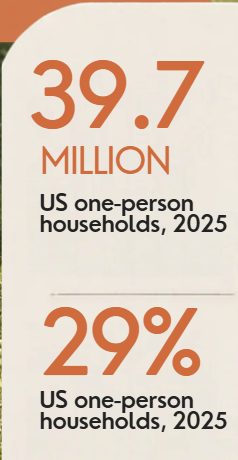
The scale of this transformation is increasingly visible in national statistics. According to the US Census Bureau, the United States had approximately 39.7 million one-person households in 2025, representing 29 per cent of all households. In 1975, the proportion was around 20 per cent. The United Kingdom presents a similar picture. Its Office for National Statistics estimated that 8.6 million people lived alone in 2025, equivalent to 29.5 per cent of all households. Almost half of those living alone were aged 65 and above, highlighting the relationship between solo living and population ageing. The reasons differ across generations. For younger adults, independent living may represent a deliberate decision to prioritise education, career development and personal freedom. For older people, it may result from widowhood, separation or the migration of adult children. Research by sociologist Philip N. Cohen, examining household structures across 75 countries, identified increasing non-marriage, later marriage, divorce, longer life expectancy and individual autonomy among the factors contributing to the growth of one-person households. Although the trend is more pronounced in Europe and North America, changing household arrangements are also becoming increasingly relevant in emerging economies.
- Changing Marriage / Relationships
One of the strongest drivers of solo living is the changing nature of marriage and relationships. Marriage is increasingly becoming a decision that people postpone rather than an immediate expectation following education or employment. Across OECD countries, the average age at first marriage has risen considerably over recent decades. Economic uncertainty, higher education costs, insecure employment and expensive housing have influenced how younger generations approach long-term commitments. Changing gender relations have also expanded opportunities for independent living. Greater female participation in education and professional employment has enabled more women to make decisions about where and how they live. Marriage is no longer the only route to financial stability or social recognition for many women. Divorce and separation contribute to this development as well. A relationship ending can create two separate households where previously there was one.
However, it would be misleading to interpret every one-person household as evidence of a conscious preference for solitude. Some people live alone because they cannot find suitable partners, cannot afford shared accommodation or have lost family members. The distinction between chosen independence and circumstances-driven isolation is essential to understanding this trend.
Living alone is not always a choice. It’s a reflection of many life paths.
2. The Economies of Living Alone
Living independently carries a financial cost that is often underestimated. Larger households can distribute expenses across several members. Rent, electricity, internet, groceries and household appliances can be shared. A single-person household must absorb most of these costs independently, even when its income is considerably lower than that of a multi-income family.
This creates what may be described as the solo-living premium: the additional financial burden of maintaining a household without the economies of scale enjoyed by larger families. Housing is particularly significant. A single professional seeking accommodation in a major city may require a separate apartment, but the cost of a suitable property does not necessarily decline in proportion to the number of occupants.
Property markets are responding through studio apartments, compact residential developments, co-living arrangements and serviced residences. Businesses are also adapting, with smaller food packages, single-serving meals, compact appliances, subscription entertainment and home-delivery services targeting individual consumers. While this creates commercial opportunities, it also raises questions about affordability. Convenience services may improve the quality of life for higher-income individuals while making independent living increasingly expensive for those with modest earnings.
Pakistan: A gradual transition
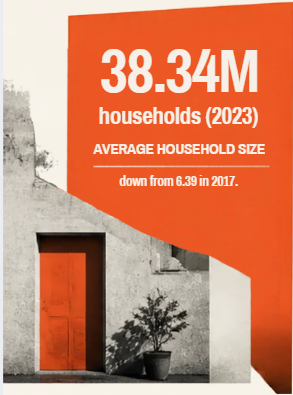
Pakistan offers an interesting contrast to Western societies. The joint family system remains deeply embedded in its social and cultural fabric. Multiple generations frequently share residential space, while family networks provide financial assistance, childcare and support for older relatives. Nevertheless, urbanisation, employment opportunities, internal migration and rising living costs are gradually reshaping household arrangements. According to the Pakistan Bureau of Statistics, the 2023 Population and Housing Census recorded 38.34 million households, compared with 32.19 million in 2017. Average household size declined from 6.39 to 6.30 persons during this period.
Urbanisation is another important factor. The movement of young people towards Islamabad, Lahore, Karachi and other urban centres for education and employment is creating demand for different forms of accommodation.
However, Pakistan’s transition should not be confused with the Western model of solo living.
The hidden cost of loneliness
Financial considerations are only one part of the debate. Solo living also raises questions about emotional wellbeing and social connection. Living alone does not automatically mean being lonely. Many individuals maintain active social lives, professional networks and meaningful relationships while enjoying the privacy of their own homes. For others, however, physical separation can increase vulnerability to loneliness, particularly in old age. The distinction between living alone and experiencing social isolation is important. A person may live independently while remaining socially connected, whereas someone in a crowded household may experience profound loneliness. Ageing societies will increasingly need to rethink how care is delivered. As younger generations migrate for employment and household sizes decline, traditional family-based support systems may become less reliable. Community centres, accessible healthcare, professional home-care services and neighbourhood support networks will consequently become more important.

Rethinking the future household
The rise of solo living requires a broader rethink of urban development and economic planning. Housing policies must move beyond the assumption that every household consists of a couple with children. Cities need affordable studios, secure rental accommodation, accessible transport and neighbourhood facilities that support independent residents. Businesses must also recognise the individual consumer as an increasingly important economic category. However, policymakers must ensure that independence does not become a privilege reserved for higher-income groups.
Ultimately, the emergence of solo households cannot be explained through a single social or economic narrative. It represents a combination of individual autonomy, changing relationships, demographic ageing and financial pressures. The traditional family remains an important source of social stability, particularly in countries such as Pakistan. Yet recognising its importance should not prevent societies from acknowledging that household structures are changing. The success of modern society should not be measured by whether people live alone or together. It should be measured by whether individuals can make that choice without sacrificing financial security, dignity or human connection. Solo living may become one of the defining household trends of the coming decades. The real test will be whether economies, cities and social institutions can adapt to a world in which independence is increasingly common, but the need for belonging remains universal.