



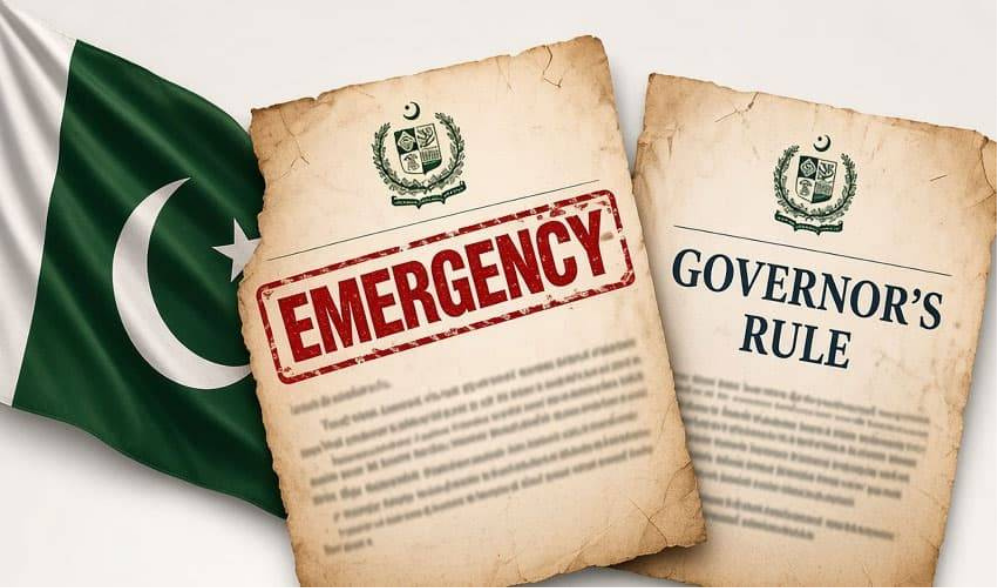
On 11 October 2026, President Asif Ali Zardari approved the imposition of a state of emergency and Governor’s Rule in Khyber Pakhtunkhwa (KP), acting on the advice of Prime Minister Shehbaz Sharif. The federal government invoked Articles 232 and 234 of the Constitution, citing escalating militant violence, deteriorating law and order, and what it described as the provincial administration’s inability to respond effectively. The decision transferred provincial executive authority to Governor Faisal Karim Kundi, while the Chief Minister and provincial cabinet ceased to exercise their offices under the proclamation.
The decision followed an increasingly strained relationship between Islamabad and the Pakistan Tehreek-e-Insaf (PTI)-led provincial government. The federal government maintained that extraordinary intervention was necessary to protect citizens and restore administrative control. PTI, mean-while, rejected the measure as an assault on its electoral mandate and provincial autonomy.
The debate over Governor’s Rule in KP raises fundamental questions about federalism, constitutional safeguards and the balance of power between Islamabad and the provinces. Beyond the immediate political confrontation, the issue concerns the constitutional limits of federal intervention and the future of provincial autonomy in Pakistan.
On 16 October, a joint sitting of Parliament approved separate resolutions endorsing the emergency and Governor’s Rule for an initial two-month period, but it did not remove the possibility of judicial scrutiny. On 21 October, a petition challenging the constitutional validity of the measures was filed in the Federal Constitutional Court, arguing that the intervention lacked lawful authority and violated constitutional protections.
The significance of this development raises a fundamental question about Pakistan’s federal structure: under what circumstances can the centre intervene in an elected provincial government, and where must the constitutional limits of that intervention be drawn?
Article 234: Exceptional powers, not ordinary political authority
Article 234 provides the constitutional basis for Gover-nor’s Rule when the President is satisfied, on receiving a report from the provincial Governor, that a situation has arisen in which the government of a province cannot be carried on in accordance with the Constitution.
Under this provision, the President may assume provin-cial executive functions or direct the Governor to exer-cise them on the President’s behalf. The provision also permits Parliament to exercise the powers of a provincial assembly, subject to the constitutional conditions.
However, Article 234 is not an unrestricted instrument of federal administration. It contains important procedural and temporal safeguards. A proclamation must be placed before a joint sitting of Parliament and expires after two months unless approved. Once approved, it can be extended through further parliamentary resolu-tions, but its total duration cannot exceed six months. The authority of the High Court cannot be assumed by the President or Governor under this provision.
These limitations are central to understanding the constitutional character of Governor’s Rule. It is desig-ned as a temporary response to a breakdown of con-stitutional machinery, not as an alternative means of governing a province whenever political relations between Islamabad and a provincial administration deteriorate.
A disagreement over security policy, administrative prio-rities or political leadership does not automatically esta-blish constitutional failure. The relevant test is whether the provincial government has become incapable of functioning within the framework of the Constitution.
That distinction matters particularly in a parliamentary federation, where governments are expected to disagree and operate with different political mandates.
Article 232 and the distinction between emergency and Governor’s Rule
Article 232 deals with the proclamation of an emergency in circumstances involving war, external aggression or internal disturbance beyond the power of a provincial government to control. It enables the federation to exercise certain additional powers in response to a grave threat to national security and public order.
Article 234, by contrast, concerns the failure of constitutional machinery within a province.
The two provisions therefore address different constitutional circumstances. Article 232 is concerned with an exceptional security emergency; Article 234 is concerned with the inability of a provincial government to function in accordance with the Constitution. Although their effects can overlap, one cannot automatically establish the legal grounds required for the other.
This distinction is particularly relevant to KP, where the security situation is undeniably serious, but the constitutional question is whether the provincial government has lost the capacity to discharge its responsibilities in a manner that satisfies Article 234.
The presence of militant violence, attacks on security personnel and administrative difficulties may establish the gravity of a security challenge. It does not, by itself, settle whether the constitutional machinery of an elected government has broken down.
The federal government must therefore demonstrate that the conditions specified in each constitutional provision have independently been met. The legitimacy of the intervention ultimately depends not only on the seriousness of the circumstances but also on the constitutional evidence supporting the measures adopted.
Provincial autonomy and the legacy of the 18th Amendment
The controversy cannot be understood without examining the Eighteenth Constitutional Amendment of 2010, which fundamentally reshaped relations between the federation and the provinces.
The amendment abolished the Concurrent Legislative List, transferring a substantial range of legislative and adminis-trative responsibilities to the provinces. It strengthened provincial authority over areas including education, health, culture and several aspects of social and economic deve-lopment. It also reinforced the role of the Council of Com-mon Interests (CCI), providing an institutional mechanism for resolving disputes and coordinating policies between the federation and the provinces.
Provincial autonomy, however, does not mean that a pro-vincial government operates outside the national consti-tutional framework. The federation retains responsibility for national security, defence, foreign affairs and other constitutionally assigned matters. Equally, provinces re-main responsible for exercising their constitutional powers and maintaining law and order through their institutions.
Provincial autonomy does not mean separation from the national constitutional framework; it means exercising constitutionally assigned powers without arbitrary interference.
The difficulty arises when these responsibilities overlap or when federal and provincial authorities disagree over the appropriate response to a security crisis. KP illustrates this tension particularly clearly. Its security challenges have national and regional implications, but the administration of the province remains a constitutional responsibility of its elected government unless a lawful constitutional mechanism provides otherwise.
Governor’s Rule therefore raises a question larger than the transfer of administrative authority: can exceptional fed-eral powers be exercised without weakening the federal principles that the Eighteenth Amendment sought to strengthen? The answer depends on the strict observance of constitutional limits, parliamentary oversight and judi-cial independence.
The lessons of 1994
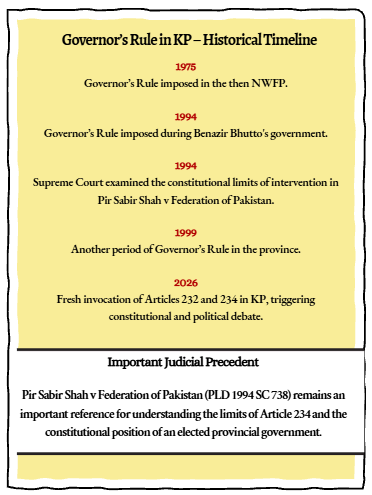
The 1994 episode is particularly instructive. The federal government of Prime Minister Benazir Bhutto imposed Governor’s Rule in the province, then governed by Chief Minister Pir Sabir Shah. The proclamation was challenged before the Supreme Court in Pir Sabir Shah v Federation of Pakistan (PLD 1994 SC 738).
The judgment established an important constitutional principle: Article 234 could not be used to permanently dismiss a chief minister and provincial cabinet beyond the authority granted by the Constitution. The Court examined the relationship between emergency powers and the constitutional procedure governing a chief minister’s tenure, including the requirement to establish whether the chief minister commanded the confidence of the provincial assembly.
The ruling remains relevant because it demonstrates that even when the exercise of exceptional powers is constitutionally permissible, the scope of those powers remains subject to judicial interpretation. A proclamation cannot become a legal instrument for permanently extinguishing an elected provincial administration.
This precedent is significant for the present situation. The constitutional framework allows temporary federal inter-vention, but it does not provide an unrestricted route to replace the democratic mandate of a provincial elect-orate. When the proclamation expires, the constitutional position of the provincial government must be assessed in accordance with the Constitution rather than political convenience.
The security imperative and the question of responsibility
No serious assessment of Governor’s Rule in KP can disre-gard the province’s security environment. The resurgence of militant violence, attacks on law enforcement person-nel, threats to public infrastructure and the continuing ins-tability along the Afghanistan border have placed consi-derable pressure on provincial and federal institutions.
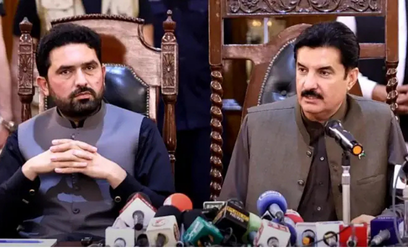
The federal government’s argument is that terrorism is not merely a provincial administrative concern. Its consequ-ences extend to national security, border management, economic activity and Pakistan’s international standing. From this perspective, a coordinated national response is necessary, particularly where militant networks operate across administrative and geographical boundaries.
However, the central question is whether transferring provincial executive authority to the Governor will address the structural causes of insecurity. Counterterrorism requires intelligence coordination, effective policing, functional prosecution systems, border management, local governance and public confidence. These responsi-bilities cannot be fulfilled through administrative orders alone. Nor can a change in political authority substitute for a comprehensive security strategy.
The province’s elected representatives also have a legitimate constitutional role in determining how security policies are implemented within their jurisdiction. Exclud-ing provincial institutions from meaningful decision-making risks creating a gap between national security planning and the communities expected to support it.
A sustainable approach would require federal and provincial institutions to cooperate on clearly defined responsibilities, measurable security objectives and transparent accountability. The constitutional intervention may alter the administrative chain of command, but it cannot eliminate the need for political ownership and public participation.
Parliament and the judiciary: The constitutional checks
The parliamentary approval of the proclamations on 16 October represents an important constitutional step. Article 234 requires parliamentary endorsement within the stipulated period, while the emergency provision under Article 232 also carries its own approval requirements.
Nevertheless, parliamentary approval should not be confused with an absolute determination of constitutional validity. The legislature’s responsibility is to scrutinise the grounds, scope and necessity of extraordinary measures. The judiciary, meanwhile, retains the responsibility of examining whether the constitutional requirements have been fulfilled.
The challenge before the Federal Constitutional Court is therefore an important development. The petition filed on 21 October seeks to question the legality of the proclama-tions and their compatibility with constitutional rights. Its filing does not establish that the measures are unlawful; equally, parliamentary endorsement does not make judicial scrutiny irrelevant.
An independent judicial assessment should consider the material supporting the Governor’s report, the constitu-tional basis for declaring a failure of machinery, the rela-tionship between Articles 232 and 234, and whether the measures adopted are consistent with the limitations imposed by the Constitution.
Transparency is equally important. The public should be able to understand the reasons for the intervention, the authority being exercised, the administrative arrangements established and the benchmarks against which the extraordinary measures will be evaluated.
Restoring constitutional normalcy
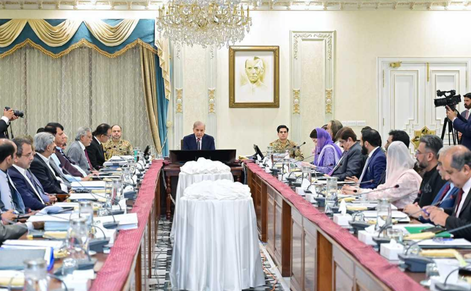
The most consequential question is not simply how Governor’s Rule begins, but how it ends. Article 234 places a six-month ceiling on the proclamation, with extensions requiring parliamentary approval. This limitation is desi-gned to prevent temporary federal intervention from becoming an indefinite arrangement. It also reinforces the principle that the province’s constitutional institutions cannot be displaced permanently through emergency provisions.
The period of intervention should therefore be accomp-anied by a clearly articulated plan for restoring normal constitutional government. Such a plan must address security concerns, administrative continuity, the function-ing of public services and the eventual restoration of elected executive authority.
The Council of Common Interests, comprising the Prime Minister, provincial chief ministers and federal represen-tatives, also offers an established constitutional forum for addressing federal-provincial disagreements. Its mandate under Articles 153 and 154 includes policy coordination and oversight of matters falling within Part II of the Fed-eral Legislative List. Greater use of such institutions can help prevent political disagreements from escalating into constitutional confrontations.
Pakistan’s federal structure depends on more than the formal distribution of powers. It requires trust between governments, respect for electoral mandates, institutional accountability and the willingness to resolve disagree-ments through constitutional mechanisms.
The limits of extraordinary power
Governor’s Rule in Khyber Pakhtunkhwa presents Pakistan with a significant constitutional and political challenge. While the province’s security situation demands an effective response, the federal government must exercise its authority within constitutional boundaries. The Eighteenth Amendment established provincial autonomy as a cornerstone of Pakistan’s federal structure, while Articles 232 and 234 provide for federal intervention under exceptional circumstances. The challenge is to reconcile national security responsibilities with the constitutional rights and authority of elected provincial institutions.
The real danger lies in allowing extraordinary powers to become instruments of routine political administration. Disagreements between elected governments should not automatically be treated as constitutional breakdowns, as doing so risks weakening federalism and undermining democratic institutions. Ultimately, the success of the intervention must be measured not by the authority trans-ferred to the Governor, but by improvements in security, the preservation of institutional legitimacy and the timely restoration of elected provincial government. The larger test for Pakistan is whether its federal system can accommodate political differences while safeguarding national cohesion and provincial autonomy.