


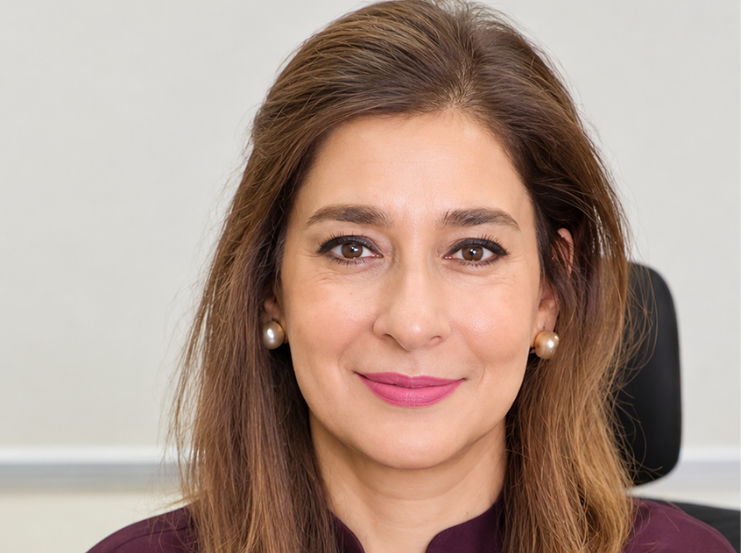
An Interview with Ms Ayesha Raza Farooq, Prime Minister’s Focal Person on Polio Eradication
In exclusive conversation with Ms Ayesha Raza Farooq discusses Pakistan’s progress, the challenges ahead, the sacrifices of frontline workers and why sustained national commitment is essential to achieving a polio-free Pakistan.
Pakistan has reduced its polio cases by 99.8 per cent over the decades, bringing the virus down from nearly 20,000 cases annually in the 1990s to just five reported cases in the current year. Yet, the final stage of eradication remains difficult. Security threats, cross-border transmission, community resistance and gaps in routine immunisation continue to challenge the programme.
Q: Pakistan has been fighting polio for decades. Millions of children have been vaccinated, yet the last mile towards eradication has proved particularly difficult. Why has it been so challenging to eliminate this disease?
Ayesha Raza Farooq: Pakistan has its own unique set of challenges, and no other country has faced them to the extent and scale that we have. Before discussing those challenges, I would like to point out that Pakistan has come very close to eradicating polio twice before: once in 2018 and again in 2021. Unfortunately, we lost ground on both occasions for different reasons.
More recently, in 2021, complacency began to set in. When you are close to achieving your goal, there is a tendency to feel that the job is almost done. But that is precisely when vigilance and sustained effort become most important. Any relaxation in a country facing Pakistan’s challenges can have serious consequences.
If we look at our journey, Pakistan recorded nearly 20,000 polio cases annually during the 1990s. Over the decades, we have reduced the disease burden by 99.8 per cent. We went from 74 cases two years ago to 31 last year and just five cases so far this year. We have also managed to geographically contain the virus in a few key areas.
At present, our main reservoirs are in southern Khyber Pakhtunkhwa, particularly Bannu division, which accounts for four of the five reported cases. The remaining case was reported from Sujawal, Sindh.
However, several challenges remain. Security-related inaccessibility is one. In some areas, we encounter comm-unity resistance driven by misinformation. There are also demand-based refusals, where communities question why vaccination teams come only to administer polio drops when they also need clean drinking water, roads and other basic services.
Their demands may be entirely justified, but these issues fall outside the direct mandate of the polio programme. We try to explain that legitimate demands for public services should not come at the expense of a child’s health.
This is one reason we are increasingly integrating polio eradication with essential immunisation and other basic health services. In hard-to-reach areas of Bannu, for example, we are working to build community trust through water, sanitation and hygiene initiatives, nutrition, maternal and child health services, essential immunisation and other health interventions.
The objective is to strengthen children’s immunity to the level required for eradication, so that even if the virus is imported from across the border or elsewhere, our children remain protected.
Communities question why vaccination teams come only to administer polio drops when they also need clean drinking water, roads and other basic services.
We have also struggled in the past to reach every child in every part of the country consistently. Polio does not recognise provincial or district boundaries. It is essential to continue administering two drops of the vaccine to every child until transmission has been interrupted throughout the country.
Weak routine immunisation coverage compounds the problem. While national and provincial figures may appear encouraging, coverage varies considerably at the district and union council levels. We must address these gaps alongside sanitation and other underlying public health challenges.
While national and provincial figures may appear encouraging, coverage varies considerably at the district and union council levels.
Pakistan has also faced threats and attacks against polio workers and the security personnel deployed to protect them on a scale that few countries have experienced. Another major challenge is the risk of virus importation from Afghanistan.
In 2021, after Pakistan had remained free of human polio cases for 14 to 15 months, the virus was imported from Afghanistan, triggering another outbreak. We are now seeing a positive trajectory again. My hope is that we do not become complacent, but maintain momentum and consistency at every level of the programme until Pakistan is polio-free.
Q: The frontline workers who go door to door have faced considerable resistance and, at times, serious security threats. How do you maintain their morale?
Ayesha Raza Farooq: Our polio workers are our real heroes. I repeatedly tell my team and our frontline workers that if Pakistan is to eradicate polio, it will be because of their hard work, commitment and tireless efforts.
They face extraordinary challenges when they leave their homes. They knock on doors across Pakistan to ensure that children remain protected from a debilitating disease that can cause lifelong paralysis. I salute them. Almost all the progress Pakistan has made in this campaign has been possible because of their dedication.
Their stories are deeply inspiring. Some of our workers are polio survivors themselves. They have experienced the consequences of the disease but continue to protect other children from it.
We have women frontline workers who are cancer survivors. One such worker continues to report for duty and walk from door to door while fighting her own illness. There are also families in which one polio worker has been martyred, yet another sister from the same family continues the work.
…major challenge is the risk of virus importation from Afghanistan.
These stories demonstrate extraordinary courage and commitment. Of course, when we engage with our workers, they also share their concerns. One of our objectives is to ensure that they remain motivated, supported and provided with a safe and enabling working environment.
Recently, the polio programme increased their incentives by 28 per cent. Inflation had significantly affected their take-home earnings, and we recognised the need to address this.
We have also established and upgraded team support centres across the country. These provide workers with a better environment where they can rest, work together and take breaks before or during their assignments.
Another important area is professional development. Our workers have repeatedly asked us to help enhance their skills. We have begun initiatives in selected areas under which some are being trained as digital champions. Through digital platforms, they can become more effective and trusted members of their communities, communicate better and feel empowered.
We are doing everything possible to support them. But I can say with complete conviction that Pakistan would not have come this far in its fight against polio without these workers.
Q: Polio clearly transcends geographical boundaries. Given the regional tensions and the situation in Afghanistan, how can Pakistan achieve complete eradication?
Ayesha Raza Farooq: Pakistan and Afghanistan are considered one epidemiological block when it comes to polio. There is considerable cross-border movement, although it is much lower than it was a few years ago.
As we speak, the virus is circulating in Afghanistan, including its southern and northern corridors and eastern region. Our surveillance activities have identified environmental samples in Pakistan that are genetically linked to the virus across the border.
Irrespective of government-to-government relations, the two polio programmes coordinate their activities reasonably well. We synchronised the campaign conducted in mid-September, and we plan to coordinate our next large-scale campaign, beginning on 2 December.
The objective is to ensure that children and families on both sides of the border are adequ-ately vaccinated, particularly when there is cross-border movement.
There is certainly room for better coordination. We hope the Afghanistan Polio Programme will also conduct high-quality campaigns so that children there remain protected. This is important for Pakistan as well, because ideally we want to eliminate the risk of virus importation.
However, Pakistan’s responsibility is to interrupt transmi-ssion within its own borders. We are working to raise the immunity levels of our children to the point where the virus can no longer circulate.
It is important to understand that we are not running a disease-control programme. If that were our objective, we could say that we had already achieved considerable success. We are working towards interruption of trans-mission, which is considerably more difficult. In this effort, even one case is too many, whether it is a human case or a positive environmental sample.
The trajectory is encouraging, but I approach it with caution. We have been in a similar position before. This time, our programme is stronger and we have made important systemic improvements. Nevertheless, we still need to strengthen our epidemiological surveillance and address the remaining operational gaps before we can confidently celebrate success.
Q: Could you explain environmental surveillance? How frequently is it conducted, and where are the samples collected?
Ayesha Raza Farooq: I say this with considerable pride, Pakistan today has one of the largest polio surveillance networks in the world.
Our surveillance system is highly sensitive and serves as our eyes and ears. It helps us identify risks, stay ahead of the virus and understand where it is circulating and how it is moving and respond in advance.
We conduct surveillance through two main mechanisms. The first is acute flaccid paralysis surveillance. We collect stool samples from children experiencing paralysis to determine whether the condition is related to poliovirus. We have strict surveillance indicators, which, thankfully, we meet across the country.
The second mechanism is environmental surveillance. We currently have 127 sampling sites across Pakistan where sewage samples are collected and tested to detect the presence of poliovirus.
We are seeing positive developments here as well. The geographical footprint of the virus has reduced, and the positivity rate is declining. However, our objective is to bring it down to zero.
Another important factor behind the programme’s progress is political ownership. This is one public health initiative that enjoys strong political commitment at the highest level. The Prime Minister personally oversees the programme.
A typical national campaign mobilises more than 450,000 frontline workers. The scale of this effort, and the level of coordination involved, is extraordinary.
If a campaign is unsuccessful or a polio case emerges in a particular area, accountability cannot rest with one institution or one government. It is a shared responsibility involving federal and provincial governments, district administrations, development partners, the health sector and, importantly, communities themselves.
Parents, caregivers, teachers, religious scholars and community influencers all have a role to play. Eradication requires an all-of-government approach and a genuine national commitment.
We must continue until we reach the finish line. Pakistan needs to remain free of both human cases and positive environmental samples for three years before the World Health Organisation can certify it as polio-free.
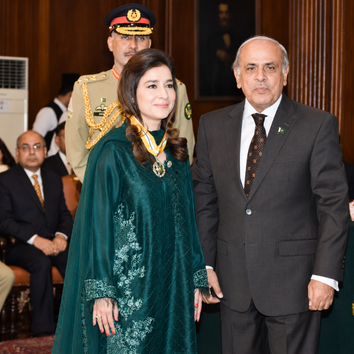
Q: You received the prestigious Sitara-e-Imtiaz and dedicated the award to your team. Is there a particular story involving a polio worker that has stayed with you?
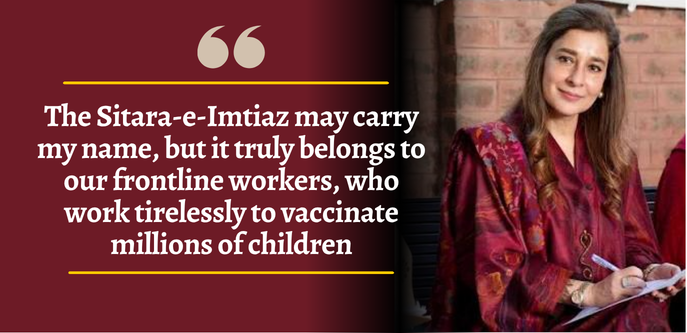
Ayesha Raza Farooq: The Sitara-e-Imtiaz may carry my name, but it truly belongs to our frontline workers, who work tirelessly to vaccinate millions of children. A national campaign in Pakistan reaches approximately 45 to 48 million children.
There is no single story I can choose. There are thousands of inspiring stories. Some workers are cancer survivors who continue to serve despite fighting their own health battles. Others have lost family members in terrorist attacks. Some are polio survivors themselves, with limited mobility, yet they still come forward to help protect other children.
There are also single parents who leave their own children in someone else’s care so that they can go out and protect the children of others. What could be more inspiring than a single mother leaving her young child with a neighbour to help protect millions of other children from a disease like polio?
I always say that there is no shortage of capacity or motivation in Pakistan. What we need is for every component of the programme to come together and sustain the effort.
This means continuing high-quality vaccination campaigns while simultaneously improving essential immunisation, nutrition, access to clean drinking water, water and sanitation services. All these interventions must work together to strengthen children’s immunity.
It is embarrassing when we attend international forums and Pakistan is identified as one of only two countries where polio remains endemic. Many other countries have successfully interrupted transmission. It is not easy to defend your country in such circumstances, particularly when you are representing the national eradication programme.
Q:There is considerable discussion about vaccine hesitancy and misinformation. Some parents also wonder whether repeated doses are necessary, particularly if their children have already been vaccinated. What would you tell them?
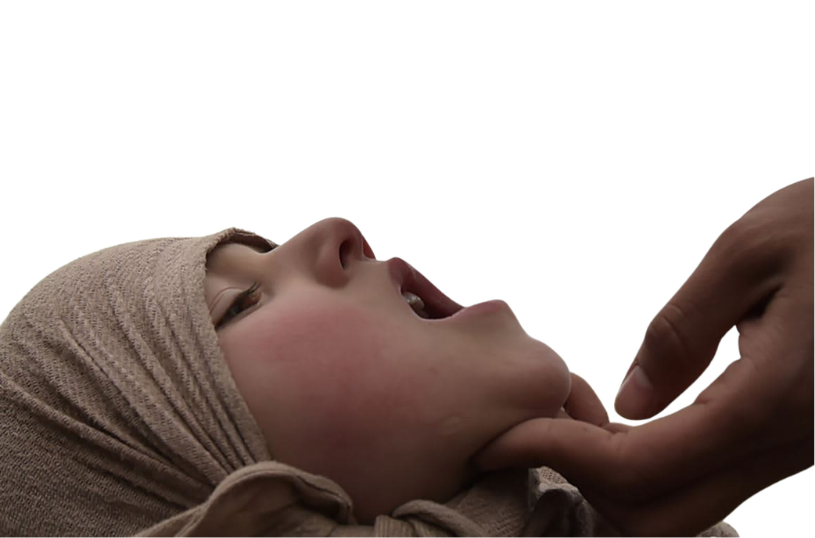
Ayesha Raza Farooq: As long as poliovirus is present anywhere in Pakistan, it is extremely important to give children two drops of the polio vaccine during every campaign.
Receiving the vaccine several times does not necessarily mean that a child has developed complete immunity. A child may have received five, six or even seven doses, but it is still possible that their immunity has not reached the level required for full protection. Several factors can influence how effectively a vaccine is absorbed and how the body responds.
That is why we recommend that parents allow vaccination teams to administer two drops whenever they visit during a campaign. Polio vaccination is safe, and there is no scientific evidence that it causes infertility. Such claims are misinformation.
Even if no poliovirus has been detected in a particular neighbourhood, vaccination remains important. People move between provinces, districts and communities, and the virus can travel with them.
A healthy-looking child can also carry the poliovirus without showing visible symptoms. Such a child may still contribute to the spread of the virus in the surrounding environment, putting other children at risk.
Repeated vaccination helps protect the child and prevents transmission to others in the home, neighbourhood and school.
The Road to Eradication
Pakistan’s progress against polio demonstrates what sustained public-health mobilisation can achieve, even under difficult circumstances. Yet, as Ms Ayesha Raza Farooq makes clear, reducing the number of cases is not the same as interrupting transmission. The final stage requires consistent vaccination, stronger routine immunisation, effective surveillance, secure access to vulnerable communities and cooperation across borders.
The programme’s success ultimately depends on more than government institutions and vaccination teams. Parents must trust the vaccine, communities must cooperate, and public authorities must respond to the wider needs that shape health outcomes.
For Pakistan, the challenge is no longer simply to demonstrate progress. It is to sustain that progress until the virus is eliminated. The dedication of hundreds of thousands of frontline workers has brought the country closer to that objective. Ensuring that their efforts translate into lasting eradication will require an equally determined national commitment.