


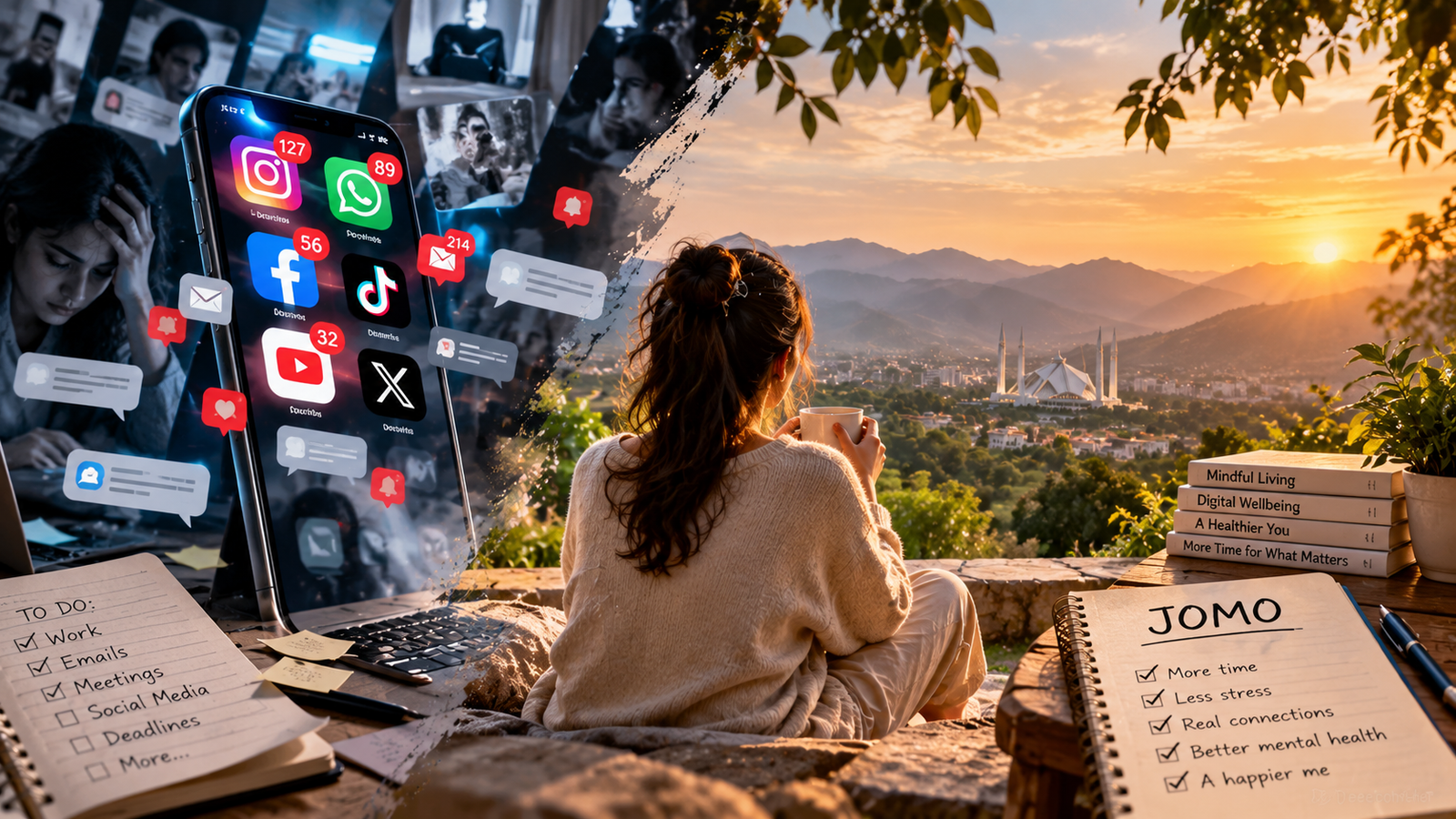
There was a time when missing an event simply meant missing it. You did not know what you were missing unless someone told you. Today, a person can be sitting quietly at home and still feel as though the rest of the world is moving ahead without them.
A glance at Instagram reveals a dinner they were not invited to. WhatsApp shows friends gathering somewhere else. LinkedIn presents another professional achievement. News alerts announce another development. A message arrives while another conversation is already taking place. The result is a peculiar modern condition: although technology has made it easier than ever to remain connected, it has also made it harder to feel satisfied with where we are.
This is where JOMO, the Joy of Missing Out enters the conversation.
The term is generally credited to technology writer Anil Dash, who wrote about the “Joy of Missing Out” in 2012, describing the pleasure of consciously choosing not to participate in something and being content with that decision.
JOMO is not simply the opposite of attending parties, leaving social media or becoming disconnected. At its heart, it is about **regaining control over attention**. It asks a deceptively simple question: *Do I actually want to be doing this, or do I merely feel that I should?*
From FOMO to JOMO
The psychological idea behind JOMO becomes clearer when contrasted with FOMO — the Fear of Missing Out.
Research published in *Computers in Human Behavior* in 2013 developed and evaluated a measure of FOMO. The researchers found that FOMO was associated with lower satisfaction of psychological needs, lower mood and life satisfaction, and greater social-media engagement. It was also associated with behaviours such as using social media during lectures and distracted driving.
The significance of FOMO is that it does not require an actual loss. A person may not even want to attend the dinner, conference or gathering they see online. Yet seeing other people participate can create the impression that they are missing an important part of life.
Social media magnifies this effect because it offers a continuous stream of other people’s selected experiences.
The issue is not that social media is inherently harmful. It can help people maintain relationships, find communities, access information and participate in public life. The problem begins when connection becomes compulsion.
Recent data illustrate just how deeply digital connectivity has entered everyday life. Pew Research Center’s 2025 survey of U.S. adults found that 90% used the internet daily, including 41% who said they were online “almost constantly.”
The figures are from the United States and should not be treated as a direct measurement of Pakistani behaviour. But they demonstrate the scale of the broader digital environment in which JOMO has emerged.
The Attention We Give Away
One of the least discussed costs of constant connectivity is not necessarily the amount of time spent online, but the fragmentation of attention.
In a 2015 experiment published in the *Journal of Experimental Psychology: Human Perception and Performance*, researchers at Florida State University examined what happened when participants received mobile-phone notifications during an attention-demanding task.
The important finding was that participants did not necessarily have to pick up the phone for their attention to be affected. Notifications themselves disrupted performance, even when participants did not directly interact with the device.That finding has an important everyday implication.
A phone sitting beside us can become a silent invitation to divide our attention. A vibration during a meeting, a notification while reading or a message appearing during dinner may take only seconds to check. But the interruption can change the mental state of the moment.
JOMO therefore begins with something more fundamental than deleting an application: protecting the ability to be fully present.
Reading a book without checking the phone. Having coffee without photographing it. Walking without listening to notifications. Having a conversation without repeatedly looking at a screen.
These may appear to be small acts. Collectively, they represent a different philosophy of attention.
What Does the Research Say About JOMO?
The scientific literature on JOMO itself is still relatively young, and this distinction matters.
A 2023 study published in *Telematics and Informatics Reports* examined JOMO in two adult samples comprising 507 and 488 participants. The researchers found relationships between JOMO and factors including life satisfaction, mindfulness, social anxiety, social-media use and FOMO. However, the findings were mixed. The researchers cautioned that JOMO may represent different experiences for different people: for some it may reflect positive self-perception and satisfaction, while for others withdrawal may be connected with social anxiety.
JOMO should not become another lifestyle label that automatically equates solitude with wellbeing.There is a difference between choosing solitude and experiencing isolation.
Someone who declines an invitation because they genuinely need rest may experience JOMO. Someone who stays away because they feel unwanted, anxious or disconnected may be experiencing something entirely different.
The World Health Organization’s 2025 Commission on Social Connection makes this distinction particularly important. WHO estimates that approximately one in six people globally — 15.8% — report experiencing loneliness. Among adolescents, the proportion is around 21%, while approximately 24.3% of people in low-income countries report loneliness, compared with about 11% in high-income countries.
JOMO, therefore, should never be interpreted as a celebration of permanent withdrawal. The goal is not less human connection.It is more intentional connection.
The Case for a Digital Pause
Research into digital detoxification offers some evidence that deliberately reducing digital exposure can be beneficial, although the results are not uniformly positive.
A 2024 systematic review and meta-analysis examined 26 eligible studies, with 18 included in the meta-analysis and a combined sample of 8,147 participants. The researchers found that digital-detox interventions were associated with improvements in subjective wellbeing and psychological wellbeing. For subjective wellbeing, the estimated effect was statistically significant, although the studies showed substantial variation in their results.
Another 2024 experimental study examined what happened when participants abstained from selected social-media platforms for 14 days. The researchers found reductions in screen time and body-image dissatisfaction among the abstinence group. However, improvements in depression, anxiety, loneliness and FOMO over the study period did not differ significantly between the abstinence and control groups.
There is no scientific basis for claiming that deleting Instagram for two weeks will automatically make someone happier. Instead, the emerging evidence suggests something more practical: changing digital habits can influence certain aspects of wellbeing, but the effects depend on the individual, the type of intervention and what replaces the time spent online.
That last point may be the most important.Simply putting the phone down does not automatically create a better life. What happens after the phone goes down matters.
What Happens When We Miss Out?
Imagine declining an invitation to spend an evening scrolling through other people’s lives.
Instead, you cook dinner. You read, take a walk, call an old friend, sit with your family or do nothing. The last option may be the most difficult.
Modern culture has become uncomfortable with doing nothing. Every empty moment can be filled with a screen. Waiting for a meeting can become scrolling. Sitting in a car can become checking messages. Standing in a queue can become watching videos.
JOMO challenges the assumption that every empty space needs to be occupied. It gives boredom a place.It gives silence a place.It gives reflection a place. And perhaps most importantly, it gives people permission to say: I do not need to be everywhere.
JOMO in Professional Life
The idea is particularly relevant to professionals whose working lives increasingly extend beyond office hours. Email, WhatsApp groups, video meetings and social platforms can create an expectation of permanent availability. The distinction between “being reachable” and “being required” becomes blurred.
JOMO does not mean ignoring professional responsibilities. It can mean establishing boundaries around them. Not every message requires an immediate response. Not every meeting requires attendance. Not every industry conversation needs to be followed in real time. Not every professional opportunity is an opportunity worth pursuing.
There is also a hidden benefit to selective participation: attention becomes more valuable when it is deliberately allocated. Instead of asking, “What am I missing?” a person can ask, “What deserves my attention?”
The Art of Choosing
The mature version of JOMO is not anti-social, anti-technology or anti-ambition. It is pro-choice. Choose the dinner because you genuinely want to be there. Skip it because you need rest.
Attend the conference because it matters. Decline another because it does not. Use social media to maintain a meaningful relationship. Close it when it becomes a source of comparison.
In this sense, JOMO is less about missing out than about deciding what not to pursue.
The distinction may seem subtle, but it is increasingly important in a world where technology continually presents us with more possibilities than any human being can realistically experience.
We cannot attend every event.Read every article. Answer every message. Follow every development.Watch every film.Travel everywhere. And we were never meant to. Perhaps the real freedom is accepting that fact.
A Different Definition of Being Connected
The irony of the digital age is that we have never had so many ways to connect yet loneliness remains widespread.
The WHO’s 2025 report on social connection stresses that healthy connection is not simply about the number of interactions. Social connection includes the structure, function and quality** of relationships. A person can therefore be digitally surrounded and still lack the relationships that provide genuine support and belonging.
This is where JOMO should ultimately lead us: not away from people, but toward better choices about how we spend our limited attention.The objective is not to disappear from the world. It is to stop allowing the world to constantly interrupt us. Perhaps JOMO’s greatest lesson is therefore surprisingly simple: Missing out is not always a loss. Sometimes it is the space in which a more meaningful life begins.