



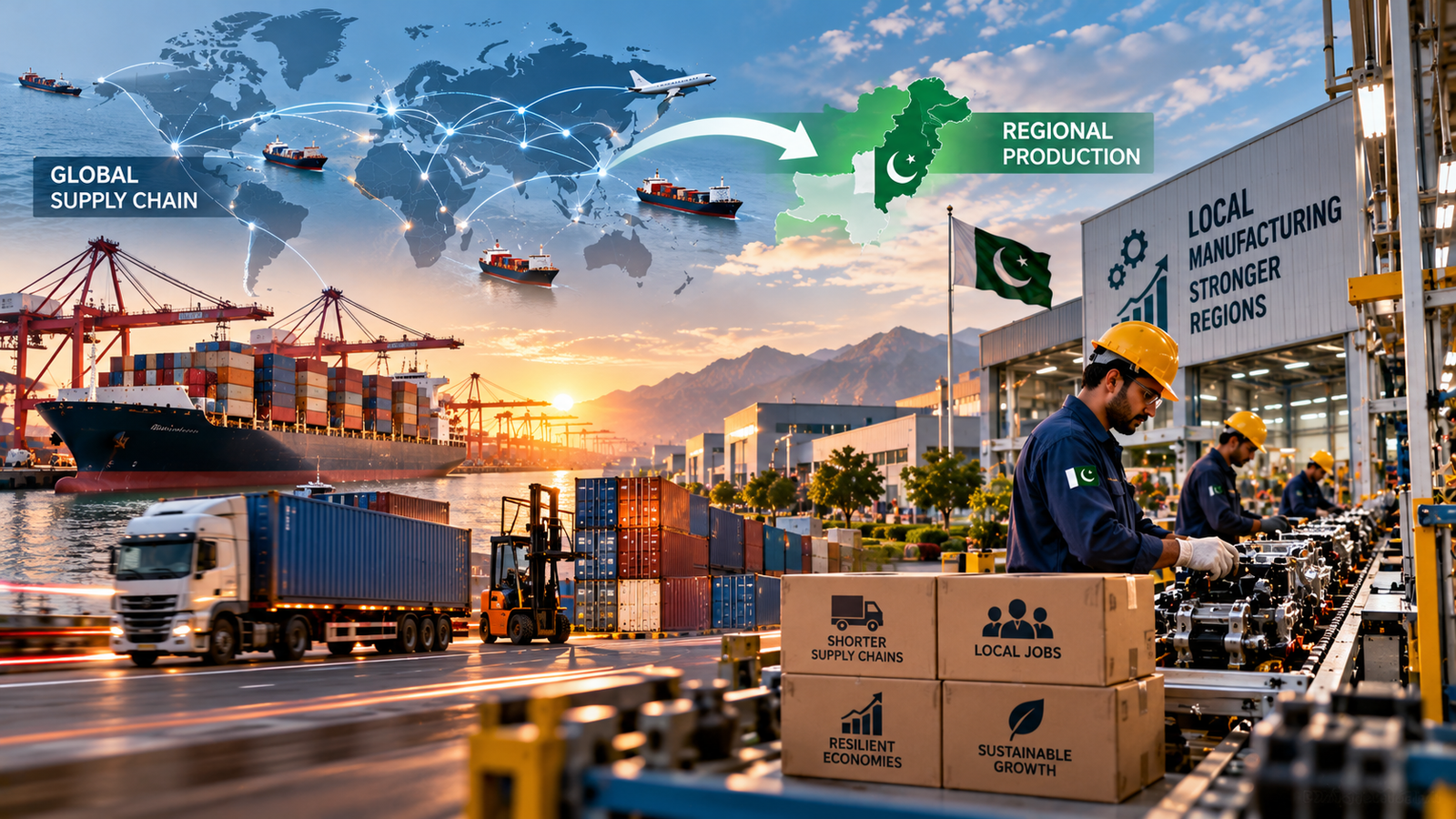
For decades, globalization has impacted our world in every aspect possible: socially, culturally, linguistically, and economically. Most importantly, it has impacted how multinational corporations design and manage their supply chains. Companies increasingly spread production across countries and various regions, allocating resources from one country, manufacturing in another, and distributing in another based on wherever costs were the lowest and efficiency was highest. This model helped companies reduce production costs, expand international trade, and give consumers access to a wider range of affordable products.
However, the global supply chain is undergoing a significant transformation amidst a range of geopolitical tensions, trade disputes, pandemics, transportation disruptions, and concerns over national security. Given the multitude of reasons, Multinational corporations (MNC’s) have since been more inclined to reconsider their dependence on fragmented international networks. Rather than abandon globalization altogether, which would prove to be impossible given the scarcity of the means of production in one country, many companies are moving towards regionalization, nearshoring, and reshoring. These strategies that bring production and sourcing closer to markets where the products are being consumed is ultimately opted for.
This shift represents an important change in the field of international business. Cost efficiency remains important, but it is no longer the only consideration. Resilience, security, supply-chain visibility, political stability, and proximity to customers are becoming equally significant factors in corporate decision making.
From Globalization to Supply Chain Interdependence:
Globalization of supply chains mainly came as a consequence of the desire of efficiency. Advances in transportation, communication, information technology, and trade liberalization allowed companies to coordinate production across multiple countries.
This created a system known as ‘just-in-time’ production. Instead of maintaining large inventories, companies relied on suppliers to deliver components when they were needed. This approach reduced storage costs and allowed businesses to change efficiently in response to consumer demand. For MNCs, the advantages were substantial. Countries with lower labour costs became major manufacturing centers, while specialized production developed in specific regions. East Asia, for example, became central to the global production of electronics, machinery, textiles, and clothing.
Yet the same interconnectedness that produced efficiency also created vulnerabilities. When one part of the system was disrupted, the effects could rapidly spread across borders.
The Pandemic and How it Exposed Vulnerabilities:
The Covid 19 pandemic represented a major turning point in corporate thinking about supply chains. Factory shutdowns, border restrictions, labour shortages, shipping disruptions, and sudden changes in consumer demand exposed the cracks in the wall of globalized supply chains. Heavy dependance on distant suppliers, and highly concentrated manufacturing locations led to huge losses during the pandemic.
Shortages of medical equipment, semiconductors, automobiles, household products, and other goods demonstrated that companies could not always assume that international suppliers would remain accessible. Even when a factory itself was operating, disruptions in ports, transportation networks, or upstream suppliers could prevent products from reaching customers.
The pandemic did not create the idea of supply chain resilience but it emphasized the importance of it. Companies began asking questions that went beyond traditional cost calculations: What happens if a critical supplier becomes unavailable? How quickly can production be shifted to another location? How much inventory is necessary to protect against disruption? Should essential components be produced closer to the company’s main markets?
Such questions accelerated interest in reshoring and regionalization.
Geopolitics Reshaping Corporate Decisions:
The current geopolitical climate of the world has provided companies with yet another incentive to invest in regionalization, nearshoring, and to reconsider the globally dispersed production.
Growing strategic competition between major powers has increased uncertainty around trade, investment, technology transfers, and access to critical resources. Trade restrictions, tariffs, and, and trade route disruptions have made certain international businesses more complicated than they were during the peak of globalization.
The Russia-Ukraine War also highlighted the economic consequences of geopolitical conflicts. The war not only impacted energy markets and commodity supplies, but also transportation routes and food systems. Businesses were reminded that geopolitical events can transform the economic viability of particular supply routes.
At the same time, governments increasingly view certain industries, including semi-conductors, telecommunication machines, energy technologies, pharmaceuticals and defense related products, as strategically important. Policies designed to encourage domestic manufacturing and reduce dependence on foreign suppliers are therefore influencing corporate investment decisions.
This concludes that supply chains are increasingly becoming not only a matter of private business and corporate strategy, but also an economic and national security concern.
What is Reshoring?
Reshoring refers to bringing production or sourcing activities back to a company’s home country after those activities had previously been abroad. A company that once manufactured products overseas might, for instance, establish a new factory domestically or encourage domestic suppliers to produce critical components.
Reshoring can provide several potential benefits. Domestic production can shorten transportation distances, improve oversight, reduce exposure to international disruptions, and potentially create greater control over quality and intellectual property. It can also help companies respond more rapidly to consumers in their home markets.
However, reshoring is not necessarily cheap. Manufacturing in higher-wage economies can increase and operating costs. Companies may also face shortage of skilled workers, higher regulatory expenses, and significant capital requirements when establishing new domestic facilities.
For this reason, many companies are not choosing complete reshoring. Rather, they are adopting a more flexible, hybrid model.
The Rise of Regionalization and Nearshoring:
Regionalization involves organizing supply chains around major geographic markets rather than relying on one global production network. A company may develop separate or partially independent supply-chains for North America, Europe, and Asia, for example.
Nearshoring is closely related to this concept. It involves moving production or sourcing to a geographically closer country rather than bringing it completely back to the country’s home market. An example would include a U.S company sourcing more components from Mexico instead of East Asia. This model attempts to balance efficiency with resilience. Companies can retain some of the cost advantages of international production while reducing transportation distances and geopolitical closures.
Regionalization is particularly an advantage for industries where speed matters. Producing closer to customers can shorten delivery times, reduce shipping risks, and allow companies to respond more quickly to changes in demand. It can also make supply chains easy to monitor. The result is not necessarily a world without globalization. Instead, globalization is becoming more geographically diversified and strategically segmented.
The Role of Technology in Making Reshoring more Feasible
One of the important factors supporting reshoring is technological change, Automation, robots, AI, advanced manufacturing systems, and digital supply-chain management are changing the economics of production.
Historically, companies often moved factories overseas because labour represented a large proportion of the manufacturing costs. Automation can reduce the importance of labour costs in some industries by allowing companies to produce more with fewer workers. Digital technologies also make it easier to monitor supply chains. Companies can use data analytics, sensors, AI, and cloud-based systems to track inventories, forecast demand, identify disruptions, and coordinate suppliers.
Advanced manufacturing therefore gives companies greater flexibility in deciding where production should occur. A factory does not necessarily need to be located in the lowest-cost labour market if automation can narrow the cost difference.
Nonetheless, technology does not eliminate the advantages of global production. Complex industries still depend on specialized suppliers, raw materials, engineering capabilities and established industrial ecosystems. Consequently, reshoring is likely to be strongest where technology, government incentives, and strategic consideration make domestic or regional production economically viable.
Semiconductors: A Strategic Example
The semiconductor industry illustrates the changing approach particularly clearly. Modern economies depend heavily on semiconductors for automobiles, smartphones, computers, industrial equipment, AI systems, and defense technologies.
The concentration of advanced semiconductor manufacturing in a relatively small number of locations has raised concerns among governments and companies about supply security. Disruptions can have consequences far beyond the technology industry because semiconductors are essential inputs for numerous other sectors.
As a result, governments in several major economies have introduced policies designed to encourage domestic semiconductor production. Companies are responding by investing in manufacturing capacity in multiple regions.
The rational behind this is not necessarily complete self-sufficiency. Semiconductor production remains highly international, involving specialized equipment and materials, as well as manufacturing expertise. Instead, the emerging strategy is greater geographic diversification and the development of additional regional production capacity.
The Economic Costs of Regionalization
The shift towards regional supply chains also involves trade-offs; giving up one thing for another becomes inevitable. Globalization allowed companies to take advantage of differences in labour costs, resources, infrastructure, and specialized expertise. Fragmenting production into multiple regional networks can reduce some of these efficiencies.
Manufacturing closer to consumers may involve higher wages and higher capital costs. Maintaining multiple suppliers or factories can also increase complexity and require greater investment. Companies may need to hold larger inventories to protect against disruptions, moving away from the ultra-lean supply-chain models that characterized earlier globalization.
Consumers could ultimately face some of these costs through higher prices. Businesses, therefore, have to determine how much resilience they are willing to pay for. Thus, the emerging supply chain strategy can be boiled down to the simple phenomena of balancing efficiency and resilience; and, preventing a disruption in one country or region from bringing the entire system to a standstill.
The shift also represents a change in corporate risk management. Before, supply chain questions were often dominated by questions of cost and efficiency. Today, executives must consider geopolitical risk, climate-related disruptions, cyber security, regulatory changes, trade restrictions, and national security concerns alongside traditional economic factors.
Conclusion
The movement towards reshoring and regionalization reflects a fundamental reassessment od how MNCs manage global production. The highly interconnected supply chains created during the rapid era of globalization generated enormous economic benefits, but recent disruptions have demonstrated the risks associated with excessive concentration and dependence.
The pandemic, US-Iran War, economic sanctions, and technological competition have all contributed to a new corporate emphasis on resilience and strategic autonomy. As a result, companies are increasingly bringing selective activities back home as a safety net. Nevertheless, the future is unlikely to be characterized by complete economic localization. Instead, the emerging model is most likely a hybrid one; combining international sourcing with flexible networks.
For MNCs, the central question is no longer just ‘Where can we produce most cheaply?’ It is increasingly ‘where can we produce reliably, securely, and competitively?’ This change in priorities is reshaping investment decisions, manufacturing geography, international trade, and the broader architecture of the global economy.