


When Monetary Tightening Meets Supply-Side Pressure
For millions of Pakistanis, inflation is not an abstract economic statistic. It is visible in the grocery bill, the cost of commuting, electricity and gas charges, and the price of goods moving through the country’s supply chains.
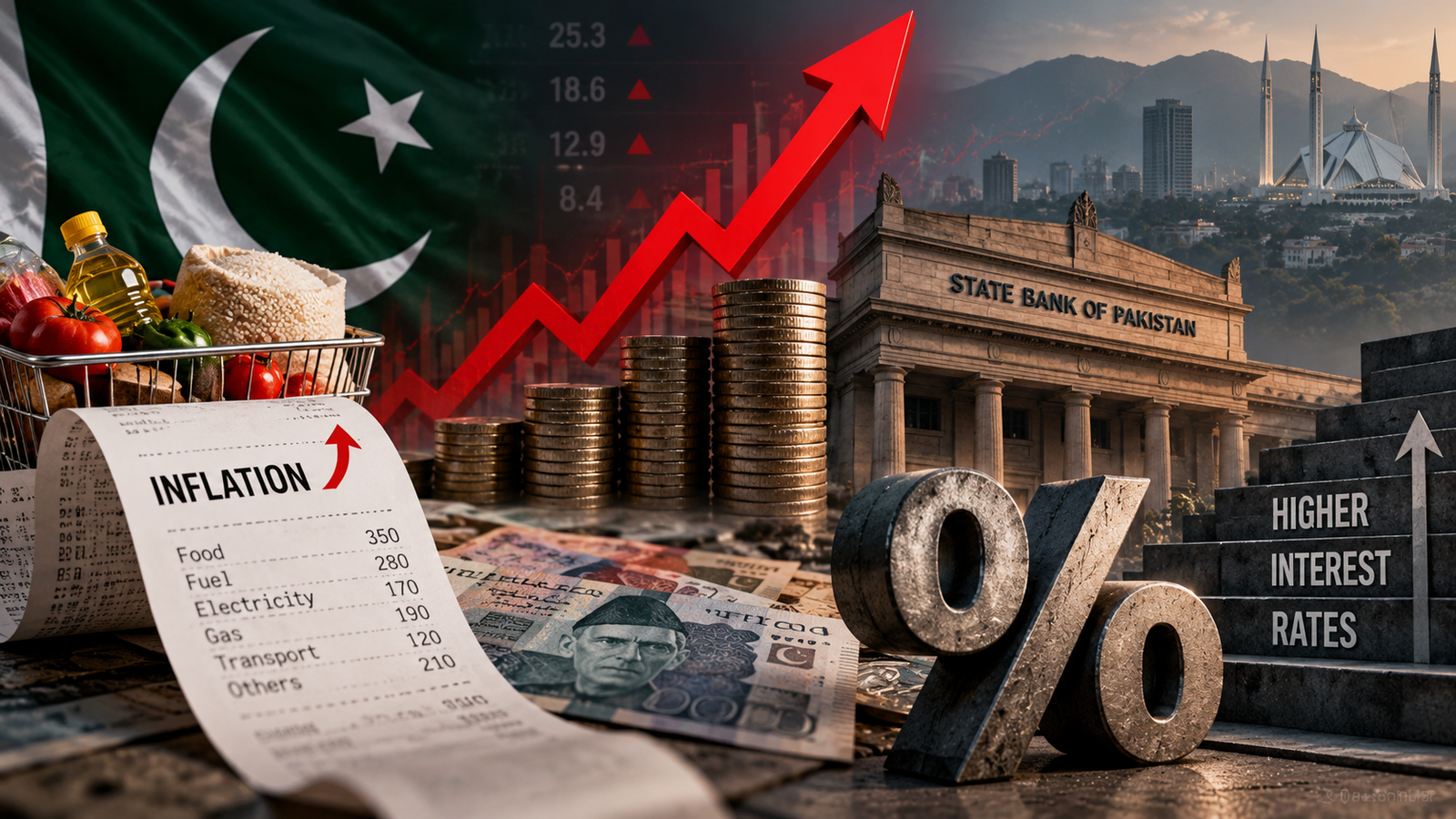
After easing substantially from the exceptionally high levels seen in previous years, inflation has accelerated again. Pakistan’s Consumer Price Index (CPI) inflation rose to 11.1% year-on-year in August 2026, compared with 9.2% in July. Urban inflation reached 10.4%, while rural inflation climbed to 12.2%. Wholesale Price Index inflation also rose to 11.8%, indicating that the pressure was extending beyond retail prices.
At the same time, the State Bank of Pakistan (SBP) has kept its policy rate at 11.5%, most recently maintaining it on September 14, 2026.
This creates an important economic question: why is inflation rising again while interest rates remain high?
The answer is that inflation is not generated by a single force. Demand matters, but so do food supplies, energy prices, transport costs, global commodities, exchange-rate movements and disruptions across domestic and international supply chains.
In other words, Pakistan’s current inflation problem cannot be understood through the interest-rate channel alone.
Why Is Inflation Increasing in Pakistan?
Inflation can accelerate when demand becomes excessive, but it can also rise when production becomes more expensive or supplies become constrained.
Pakistan’s latest numbers contain elements of these different pressures.
The August CPI increase was broad enough to be visible across both urban and rural economies. The higher rural inflation rate is particularly relevant because food, agricultural inputs, transport and energy costs can have significant effects on rural household budgets. Meanwhile, the rise in WPI inflation suggests that pressures are also appearing further up the production and distribution chain.
This makes the current episode more complicated than a simple story of excessive consumer demand.
Food: The Price Pressure Households Feel First
Food is where inflation becomes most visible.
A rise in the price of wheat, vegetables, cooking ingredients or other staples can quickly affect household budgets, particularly for lower- and middle-income families that spend a relatively large share of their income on necessities.
Food prices can rise for several reasons: reduced supply, weather-related disruptions, higher agricultural input costs, transportation expenses, storage constraints and changes in wholesale and retail margins.
These pressures cannot all be addressed through monetary policy.
A higher interest rate may eventually moderate demand, credit growth and inflation expectations. It cannot, however, immediately increase the supply of wheat, vegetables or other food commodities.
That distinction is important when assessing the effectiveness of monetary tightening.
Fuel and Transport: How Oil Prices Move Through the Economy
Fuel is another major inflation channel.
When petrol and diesel become more expensive, the impact does not stop at the filling station. Transport operators face higher operating costs. Trucks carrying food and manufactured goods become more expensive to run. Businesses then face higher distribution expenses, and some of those costs can eventually reach consumers.
The result is a chain extending well beyond the energy sector.
For a country such as Pakistan, which relies heavily on imported energy, international oil prices can have a particularly significant domestic effect. A geopolitical disruption that raises global energy costs can therefore become an inflationary pressure inside Pakistan even when domestic demand has not increased.
This is one reason external developments remain important to Pakistan’s inflation outlook.
Electricity and Gas: The Cost That Reaches Every Sector
Energy prices have an unusually broad economic impact.
Electricity and gas are household expenses, but they are also essential production inputs. Factories require energy. Shops require electricity. Farms depend on fuel and power. Cold-storage facilities, transport networks and food-processing businesses all face energy-related costs.
When energy prices rise, businesses have several choices: absorb some of the increase, reduce margins, cut costs or pass part of the additional expense on to consumers.
This is the classic cost-push inflation channel — inflation generated when the cost of producing and supplying goods and services increases.
It also explains why headline inflation can rise even when monetary policy is relatively tight.
Imported Inflation and the Rupee
Pakistan’s inflation story cannot be separated entirely from the international economy.
The country imports energy, machinery, industrial inputs and a wide range of intermediate and finished goods. When international prices increase, Pakistani importers can face higher costs.
The exchange rate adds another dimension.
A depreciation of the rupee can make imported goods and production inputs more expensive in local-currency terms, even when their dollar prices remain unchanged. Those additional costs can then move through businesses and supply chains to wholesalers and, eventually, consumers.
The transmission can be illustrated simply
Global prices → import costs → production and transport costs → wholesale prices → retail prices
Oil is particularly important because energy is embedded in so many parts of the economy.
Why High Interest Rates Cannot Fix Every Inflation Problem
This is the key to understanding Pakistan’s current situation.
Interest rates primarily influence financial conditions and aggregate demand. When rates are high, borrowing becomes more expensive. Consumers may postpone some purchases, businesses may delay investment, and credit growth can slow. Over time, these effects can reduce demand-side inflationary pressure.
But supply shocks operate differently.
If imported fuel becomes more expensive because of an international geopolitical crisis, a higher interest rate in Pakistan does not reduce the international oil price.
If agricultural production is disrupted, monetary tightening does not immediately create additional crops.
If transport costs rise because diesel becomes more expensive, a higher policy rate does not directly reduce the price of diesel.
This does not mean monetary policy is ineffective. It means its transmission mechanism is different and takes time.
The SBP itself notes that monetary policy does not affect the economy instantaneously and that the full effects of interest-rate changes on inflation can take several quarters to materialise.
The distinction, therefore, is not between monetary policy and “no policy”. It is between **demand management and supply-side solutions**.
So What Is the SBP Doing?
The SBP has maintained its policy rate at 11.5%, with the latest decision taken on September 14, 2026.
The central bank’s primary monetary-policy responsibility is price stability. Its medium-term inflation target is 5–7%.
But monetary policy necessarily involves trade-offs.
Keeping rates high can help contain demand and inflation expectations. At the same time, expensive credit can raise financing costs for businesses and households, potentially discouraging investment and economic activity.
Reducing rates too quickly could have the opposite problem: it could stimulate demand before inflationary pressures have sufficiently weakened.
This is why a central bank cannot base monetary policy simply on the latest monthly CPI figure. It has to assess the direction and persistence of inflation, underlying price pressures and the broader economic environment.
What Would Create Room for Rate Cuts?
The question of whether the SBP will eventually reduce interest rates is likely to remain important for businesses, investors and households through the remainder of 2026.
A more useful question is: What conditions would create room for monetary easing?
Several indicators will matter:
- The direction of headline inflation
- Core inflation
- Food and energy prices
- Global oil and commodity markets
- Exchange-rate stability
- Inflation expectations
- External financing and foreign-exchange reserves
- Economic activity
- Credit growth
The relationship between these variables is more important than any single indicator.
For example, a temporary fall in headline inflation caused by one favourable food-price movement would provide a different policy signal from a sustained decline in underlying inflation accompanied by stable exchange-rate conditions and contained external pressures.
The SBP’s medium-term framework is therefore focused not simply on today’s inflation number but on the expected trajectory of prices and the risks surrounding that trajectory. Its stated inflation target remains 5–7%.
What Does Inflation Mean for Ordinary Pakistanis?
Behind every inflation percentage is a household making choices.
When food prices rise, families may change what they buy. When transport becomes more expensive, commuting consumes a larger share of monthly income. Higher utility bills leave less money available for education, healthcare, savings or discretionary spending.
Interest rates create another pressure point.
People borrowing for homes, vehicles or businesses can face higher financing costs. Businesses may postpone investment when credit becomes expensive. At the same time, savers may receive higher nominal returns on some deposits and fixed-income instruments, although the real benefit depends on whether those returns exceed inflation.
This is why inflation and interest rates should not be viewed as separate economic stories.
They affect the same household from different directions.
The Policy Challenge Beyond Interest Rates
Pakistan’s current inflation episode illustrates a broader economic reality: controlling inflation requires more than monetary policy.
Interest rates matter, but so do food supply, energy security, transport costs, exchange-rate stability, fiscal decisions, agricultural productivity and the resilience of domestic supply chains.
A durable reduction in inflation therefore depends partly on addressing the underlying costs that repeatedly push prices higher.
That requires attention to supply as well as demand.
Better agricultural supply chains can reduce food-price volatility. More predictable energy pricing can improve business planning. Greater exchange-rate stability can reduce uncertainty for importers. Improved logistics and storage can reduce losses and distribution costs.
Monetary policy can create the conditions for price stability, but it cannot substitute for reforms in these areas.
The Road Ahead
The August inflation figure of 11.1% is more than another monthly statistic. It demonstrates how quickly earlier progress can be challenged by new domestic and international pressures.
For policymakers, the challenge is to contain persistent price pressures without unnecessarily weakening economic activity. For households, the immediate concern is much simpler: how far their income will stretch.
The months ahead will depend on several forces moving together — domestic supply conditions, energy prices, the rupee, global commodity markets, inflation expectations and monetary policy.
The central question, therefore, is not simply whether Pakistan’s interest rates are high enough.
It is whether the wider economy can become stable enough for monetary policy to work effectively.
Magazine Sidebar: Pakistan Inflation 2026 — At a Glance
- CPI inflation, August 2026: 11.1% year-on-year
- CPI inflation, July 2026: 9.2%
- Urban inflation, August: 10.4%
- Rural inflation, August: 12.2%
- WPI inflation, August: 11.8%
- SBP policy rate: 11.5%
- Latest SBP decision: September 14, 2026
- SBP medium-term inflation target: 5–7%
Source: Pakistan Bureau of Statistics and State Bank of Pakistan.