



by Rayaan Khan
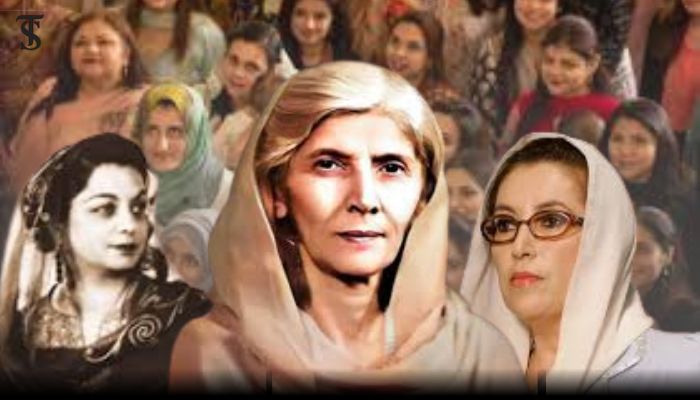
The feminist movement in Pakistan has never been a simple, single-issue campaign. It has grown out of the country’s political history, from the post-Partition struggle to the battles against military rule, discriminatory laws, and deeply rooted patriarchy. Its origins lie in the urgent need to protect women’s social welfare after 1947, but it gradually developed into a broader demand for legal rights, public participation, and political power. At various times, Pakistani women have served as reformers, organisers, lawyers, writers, and political leaders. Figures such as Begum Ra’ana Liaquat Ali Khan, Fatima Jinnah, Asma Jahangir, Hina Jilani, Benazir Bhutto, and Farida Shaheed all represent different stages of this struggle. Together, they show that feminism in Pakistan has been both national and political: it has fought not only for women’s rights, but also for the kind of country Pakistan wanted to become.
The earliest organised expression of this movement can be seen in the years immediately after Partition, when women’s activism was tied to refugee relief and social reconstruction. Begum Ra’ana Liaquat Ali Khan founded the All Pakistan Women’s Association (APWA) in 1949, and APWA itself describes the organisation as one of the oldest and largest women’s welfare NGOs in Pakistan. It was created in response to the trauma of Partition, when many women had been displaced and left vulnerable. APWA’s work combined welfare with empowerment: it set up schools, health centres, and programmes for legal awareness and skills training, while also encouraging women to enter public life. This mattered because it turned women’s suffering into public action. APWA treated women as citizens whose education, labour, and dignity were central to the nation’s future.
Among the earliest and most important women associated with this broader feminist tradition was Fatima Jinnah. She became a symbol of female political presence in Pakistan, especially when she later challenged Ayub Khan in the 1965 presidential election. Her candidacy was important not only because she was politically significant in her own right, but because it directly challenged the idea that women should remain outside the highest levels of politics. Alongside her stood Begum Ra’ana Liaquat Ali Khan, whose role in founding APWA gave women’s activism an institutional base. APWA’s own historical background notes that women leaders inspired by the freedom struggle worked in refugee camps, established family health centres, and set up schools and industrial homes for women. In other words, Pakistan’s early feminist history was not just about protest; it was also about building practical structures that allowed women to live with greater independence and security.
The movement became far more confrontational during General Zia-ul Haq’s Islamisation era, when women’s rights were directly threatened by restrictive laws. This period produced one of Pakistan’s most important feminist organisations, the Women’s Action Forum (WAF), which was established in Karachi in 1981. WAF emerged as a response to discriminatory legislation, especially the proposed Law of Evidence and the Hudood Ordinances. Asma Jahangir and Hina Jilani were central to this resistance. They helped found Pakistan’s first all-women law firm, and they also played a part in forming WAF. Their activism shows that Pakistani feminism was not only a moral or cultural movement; it was also legal and constitutional. Inclusion was no longer being requested. They were challenging the state, the courts, and the assumptions that made unequal treatment seem normal.
Asma Jahangir became one of the clearest public faces of this struggle. She was a fierce critic of the Hudood framework and other discriminatory legal structures, and her work in the 1980s made her one of Pakistan’s most important human rights defenders. The 1983 women’s march in Lahore, led by WAF and the Punjab Women Lawyers Association, was a defining moment: women protested against the discriminatory Law of Evidence and the Hudood Ordinances, and they faced police repression. This matters because it shows feminism in Pakistan as courageous and visibly political. Hina Jilani’s work reinforced the same message from another angle. She helped found Pakistan’s first all-female legal aid practice and later the country’s first legal aid centre, making feminist activism practical as well as ideological. Together, these women demonstrated that the movement was not confined to slogans. It was a sustained attempt to change the law, defend victims, and create institutions women could actually use.
Benazir Bhutto represents a different but equally important stage in this history: the movement’s move into formal political power. She became Pakistan’s first female prime minister on 1 December 1988, and she was the first woman to lead a Muslim nation in modern history. Her election mattered enormously because it shattered a symbolic barrier. At a time when women were still being told that power was masculine, Pakistan placed a woman at the head of government. That achievement gave feminism both national and international significance. Benazir’s government did take steps that suggested concern for women’s safety and visibility, but her record was also limited because many of the discriminatory laws of the Zia era remained in place. Even so, her premiership proved that women could occupy the highest office in the state, and that fact alone altered the political imagination of Pakistan.
The importance of Benazir Bhutto lies not only in the fact that she was prime minister, but also in the way she changed what was politically imaginable. Her rise showed that Pakistan could produce women who were not merely activists or campaigners, but national leaders. At the same time, her legacy also exposes the limits of symbolic progress. A woman in office does not automatically dismantle patriarchy in society. Women still faced violence, inequality, and barriers to education and employment. This is why the feminist movement in Pakistan continued after her. Farida Shaheed is a useful example of the later generation. The UN describes her as the executive director of Shirkat Gah, Pakistan’s leading gender justice organisation, and as a former member of the National Commission on the Status of Women. Her career shows how the movement moved from street protest to policy work, research, and international advocacy. Pakistani feminism thus became broader, more sophisticated, and more durable over time.
Among these figures, Malala Yousafzai is just as prominent. She represents the contemporary face of Pakistan’s feminist struggle, especially the fight for girls’ education. After speaking publicly about the Taliban’s ban on girls’ schooling in Swat, she survived an assassination attempt in 2012 and continued her activism on a global scale. Her advocacy earned her the Nobel Peace Prize in 2014, making her the youngest recipient of the award. The Malala Fund describes her mission as ensuring that every girl has the opportunity to learn and choose her own future, which makes her an important symbol of how Pakistani feminism has expanded beyond legal reform into education, human rights, and international advocacy.
The feminist movement in Pakistan began as a response to social need after Partition, with foundations laid prior to Partition itself, but it quickly became a larger struggle over law, social conscience, and power. The movement’s history also shows a pattern: progress often came through resistance, and every advance had to be defended against backlash. That is why the feminist movement in Pakistan remains significant today. It is not merely a story of women asking for rights; it is a story of women reshaping the nation itself.
The writer is a student at ISOI and can be reached at rkhan05112009@gmail.com