



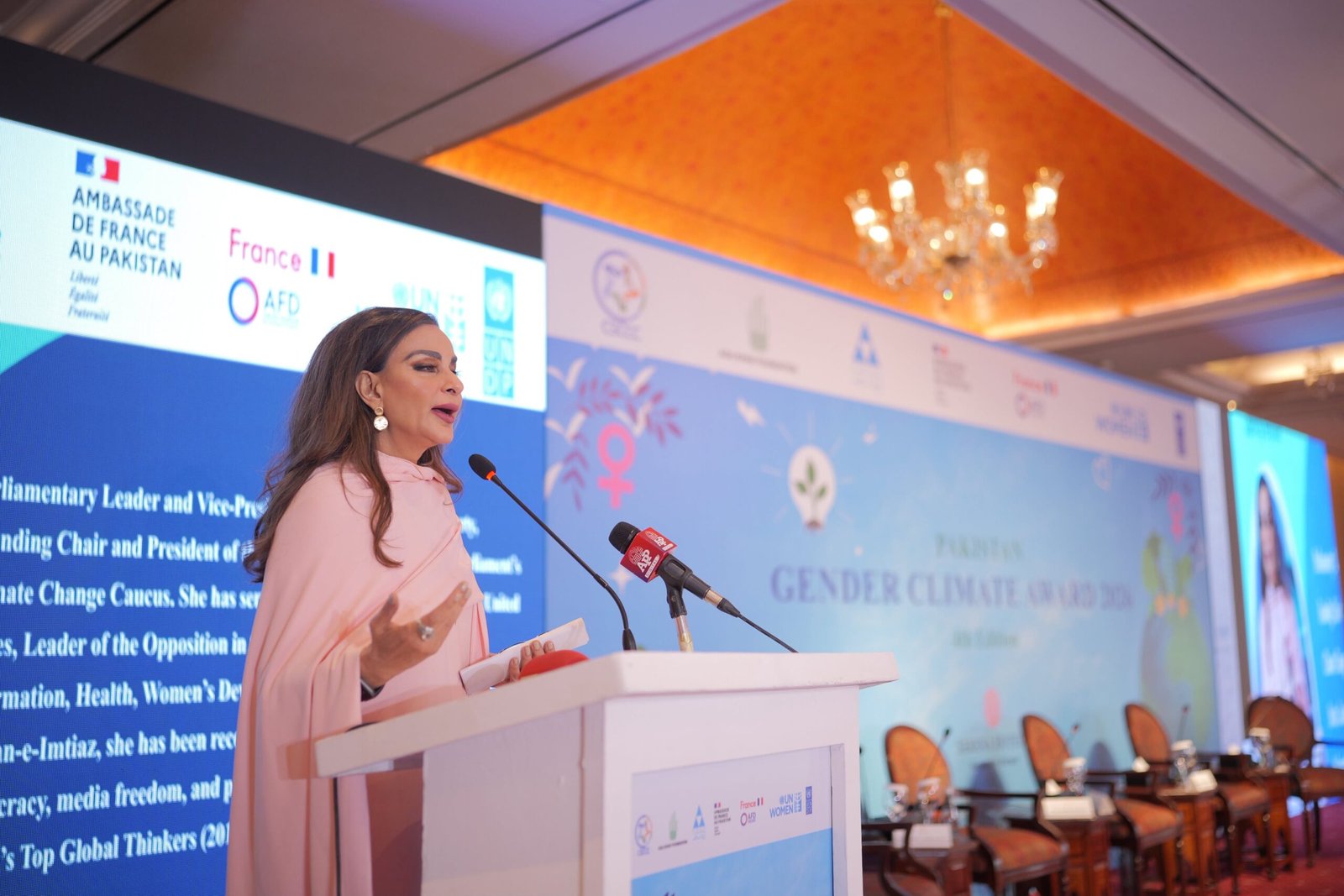
Sherry Rehman Calls Women the “Last-Mile Managers of Resilience” at the 4th Gender Climate Awards
Islamabad, 3rd June 2026 (MT Team) : Senator Sherry Rehman delivered the keynote address at the 4th Gender Climate Awards, jointly organized by the Civil Society Coalition for Climate Change (CSCCC), the Embassy of France in Pakistan, UN Women, and UNDP, celebrating women climate leaders and grassroots champions who are advancing resilience and sustainable development across Pakistan.
Senator Rehman described the awards as a powerful recognition of the women who are quietly transforming some of Pakistan’s most climate-vulnerable communities.
“These Gender Climate Awards are a wonderful reminder that women are the last-mile managers of resilience,”
Senator Rehman said. “Women are the primary caregivers, resource managers, and first responders within households during climate emergencies. While men often engage with institutions and authorities, women manage resources at home and make critical decisions about food allocation, water use, healthcare, and family survival.”
Highlighting the gendered dimensions of climate change, Senator Rehman noted that the United Nations estimates that 80 percent of people displaced by climate change are women and girls, who face heightened vulnerabilities due to unequal access to resources, healthcare, information, and decision-making structures.
“There is a whole world facing deep climate stress in Pakistan that often remains unseen. Women are working against all odds in communities that do not always work with them. They face development deficits and social constraints, yet they continue to lead adaptation efforts and build resilience where it is needed most,” she said.
Drawing attention to the disproportionate burdens borne by women, Senator Rehman noted that 72 percent of women in many rural communities spend up to three-quarters of their day collecting water and managing household water needs, a challenge made increasingly difficult by climate-induced water scarcity.
“These women are carrying the heaviest burdens of climate change long before disasters make headlines. They are walking longer distances for water, managing shrinking resources, coping with declining agricultural productivity, and ensuring the survival of their families despite mounting pressures,” she said.
Calling climate change a polycrisis, Senator Rehman stressed that communities on the frontlines are grappling with interconnected challenges affecting water security, food systems, public health, livelihoods, and social stability.
“This is the scarcity century,” she remarked. “Everything is connected. Climate change impacts water, food, agriculture, health, and economic security. Communities are dealing with a polycrisis whose effects are being felt every day.”
Reflecting on the devastating 2022 floods, Senator Rehman recalled how one-third of Pakistan was submerged under water, exposing women and girls to disproportionate risks and hardships.
“More than 650,000 pregnant women were affected by the floods. Many struggled to access healthcare, and some were forced to give birth in boats. Nearly 1,000 health facilities were damaged or destroyed. Millions of women and girls lost access to hygiene products, sanitation facilities, and maternal healthcare services. Economic distress also contributed to an estimated 18 percent increase in child marriages in affected communities.”
She noted that many of the burdens faced by women during the floods remain undocumented and insufficiently understood.
“When a woman experiences a climate catastrophe, the impacts extend across every dimension of her life. The consequences are felt by her children, her family, and entire communities. Women face heightened risks of displacement, exploitation, violence, and economic insecurity, yet they continue to hold families together and lead recovery efforts.”
Senator Rehman emphasized that women are not merely victims of climate change but are among its most effective responders.
“The battle is already being fought in villages, farms, households, and communities across Pakistan. Women are heroes of change. They are sowing the seeds of resilience at the grassroots level and finding solutions despite power constraints, social barriers, and limited resources.”
Reflecting on her tenure as Federal Minister for Climate Change, Senator Rehman noted that climate discussions have evolved significantly over the past decade.
“When I first entered these conversations, much of the focus was on climate finance and de-risking investments. Today, we are reframing the concept of resilience itself. What empowers real resilience is opportunity—access to resources, access to income, access to assets, and access to decision-making.”
She stressed that investing in women produces transformative and lasting returns for communities.
“When you invest in a woman, you often see a ten-fold return in community wellbeing and resilience. Women reinvest in their families, children, food security, education, and livelihoods. They are among the most effective agents of sustainable development.”
Highlighting successful examples of gender-responsive policies, Senator Rehman pointed to initiatives that place assets and resources directly into the hands of women, including land ownership programmes and social protection schemes.
She cited resilient housing initiatives in Sindh that provide women with legal land titles, helping strengthen both economic security and climate resilience. She also praised the role of the Benazir Income Support Programme (BISP) in empowering women through direct financial support.
“Giving women access to assets changes outcomes. Whether it is a land title, a housing grant, or a BISP payment, women invest and reinvest in the future. When a woman receives ownership of land, she thinks about crop rotation, food security, family wellbeing, and long-term sustainability. These investments create resilience that benefits entire communities.”
Referring to the intensifying climate impacts across Pakistan, she underscored extreme temperatures in parts of southern Pakistan that are increasingly exceeding 50 degrees Celsius, warning that many people still do not fully appreciate the extent to which climate change is driving these unprecedented weather patterns.
“Heatwaves, water scarcity, changing rainfall patterns, and declining crop yields are no longer future risks. They are today’s realities. Crops do not grow the way they used to, and vulnerable communities are paying the price.”
Senator Rehman further underscored the largely invisible care economy sustained by women across Pakistan, describing it as one of the country’s most under-recognized contributions to social and economic development.
“These women are the backbone of rural communities. Much of their labour remains undocumented, uncompensated, and undervalued. Yet they continue to nurture families, sustain livelihoods, and strengthen community resilience.”
Calling for continued support for women-led climate action, she urged governments, development institutions, civil society organizations, and development partners to invest in women from both northern and southern Pakistan who are seeking opportunities to improve their communities.
“We must continue to invest in women who are searching for solutions, even when they do not know where to find opportunities. Women are at the centre of social development. They are the custodians of community resilience and among the strongest agents of positive change.”
Concluding her remarks, Senator Rehman warned that emerging climate patterns, including the anticipated impacts of El Niño and other climate disruptions, could intensify pressures on vulnerable populations in the years ahead.
“The warning signs are clear. We must prepare for what lies ahead. Climate patterns matter, and resilience matters. The women we honour today are already building the walls of protection that communities need. They are not only responding to climate change—they are leading the way toward a more resilient future.”