


The Afghanistan–Pakistan borderlands remain one of the world’s most entrenched narcotics corridors, where the drug economy and armed conflict have evolved in a mutually reinforcing cycle. Afghanistan has long been the largest producer of illicit opium, and decades of war from the Soviet invasion to the post-9/11 insurgency have transformed poppy cultivation into a survival economy for thousands of rural households.
The 2,640 km-long porous border with Afghanistan, coupled with a 1,046 km coastal belt, provides traffickers with multiple avenues to exploit, making enforcement an ongoing battle against smuggling networks.
Afghanistan positioned as the epicentre of heroin production, supplying almost 90 per cent of the world’s opioids. According to data from the United Nations Office on Drugs and Crime (UNODC), around 40 per cent of Afghan-produced heroin transits through Pakistan, making its way to lucrative markets in the Gulf Cooperation Council (GCC) countries, Europe, and beyond.
Narco-Politics
Emerging in the 1970s, from localized cultivation and trafficking networks, illicit trade of Cocaine trade has evolved into a transnational enterprise, scale and influence of which is equalling the formal state economies. With expansion that now stretch across Continents, the drug cartels have been exploiting institutional weaknesses, corrupting public officials, and carving out trafficking corridors. In fact, the line between criminal enterprise and political authority has steadily blurred.
The term “Narco-Politics” has gained currency to describe this phenomenon, a condition in which illicit economies do not merely co-exist with the state but become embedded within its power structures. Latin America’s experience offers a clear warning: when narcotics seep into governance, the consequences extend far beyond crime, eroding institutions, distorting policy priorities and destabilizing entire regions.
Venezuela at the Crossroads of Trafficking & Power
Venezuela’s geography in Latin America along with its political trajectory situates it squarely within this transformation. The extensive Caribbean Coastline, its proximity to major transit routes, and protracted spells of governance stress, make Venezuela an attractive corridor for Cocaine shipments, which are destined towards North America and Europe. International monitoring bodies and investigative journalists have often been raising concerns about the penetration of drug trafficking networks into segments of the Venezuelan State.
It is against this historical and structural backdrop that the arrest of Venezuelan President Nicolás Maduro in early January 2026, needs to be seen. U.S. authorities allege that Maduro and his inner circle, oversaw the so-called “Cartel of the Suns,” facilitating the movement of hundreds of tons of Cocaine over two decades, while simultaneously engaging in weapons smuggling and related criminal activities. International media outlets have described the development as extraordinary: a sitting head of state detained on charges of “Narco-Terrorism”. Concurrently, Pakistan’s domestic media has also echoed similar framing, highlighting both the severity of the allegations and the broader geopolitical implications.
Geopolitical Convergence with Narcotics
Beyond the criminal charges, analysts also point out to a wider strategic context. Venezuela’s vast oil reserves, its contested political legitimacy and its strained relations with Washington suggest that narcotics, energy security and geopolitics remain to be tightly interwoven. The Maduro episode underscores a reality that can no longer be ignored: drugs are no longer a peripheral law-and-order issue. These have become instruments of shaping international alignments, triggering unilateral action and redefining the boundaries of sovereignty.
Afghanistan’s War Economy and the Drug Surge
The narcotics-economy of Afghanistan is an outcome of the decades of war, internal discord, widescale dis-placement and economic collapse across Afghanistan. This cumulatively created an environment, where illicit drug markets began to thrive. Provision of alternative livelihood means, disarmament, demobilization and re-integration into society was needed to reverse the tide, while implementing a sustained counter-narcotics stra-
tegy. However, in a milieu, where former combatants continue to lack alternate livelihood
means and wea-pons remain accessible to them, drug trafficking under official patronage of Afghan Taliban, stays as an income stream as well as a source of influence for a common Afghan trafficker.
According to UNODC assessments, Afghan opium production surged by nearly 40 percent in 2025, while Methamphetamine (Ice) output also expanded rapidly, driven by industrial chemicals, which are easier to transport and conceal.
The narcotics-economy of Afghanistan is an outcome of the decades of war, internal discord, widescale dis-placement and economic collapse
Pakistan Facing the Spillover Effects
For Pakistan, these global developments resonate with particular urgency. Owing to the geo-proximity of Afghanistan, few countries have experienced as directly as Pakis-tan, the intersection of narcotics, conflict and regional instability. Positioned along major trafficking routes from Afghanistan the world’s largest producer of opiates Paki-stan absorbs the spillover effects of Afghanistan-based transnational drug economy. These effects manifest in risi-ng domestic addiction, entrenchment of organized criminal networks in the society, and the diversion of illicit proceeds towards fanning militancy and violence. For a country, which is already managing fragile border dynamics and economic pressures, such unwarranted trends represent a persistent security challenge with international con-sequences. Notwith-standing above-mentioned challenges, Pakistan follows a comprehensive counter-narcotics policy, which is not limited to enforcement alone but effectively circumscribes governance reforms, institutional interdictions, and social advocacy. Concurrently, it aims for dismantling the Drug Trafficking Organizations (DTOs) at their roots.
ANF: Pakistan’s Operational Spearhead
At the operational core of Pakistan’s counter-narcotics (CN) efforts stands the Anti-Narcotics Force (ANF), which is the premier CN law enforcement agency (LEA) of Pakis-tan, having a modest force size of about 3,100 personnel. ANF operates through 33 police stations situated in 24 districts of Pakistan. ANF bears on its ambit the coverage of coastal areas, border terminals, airports, seaports, motorways, highways and the dry ports. Towards the rehabilitation and awareness side, ANF runs seven Model Addiction Treatment & Rehabilitation Centers (MATRCs) across Pakistan. ANF also figureheads Inter Agency Task Force (IATF), which is a consortium of 33 federal and provincial LEAs and departments that have counter narcotics on their assigned mandates. In recent years, this slim, efficient & highly motivated force has demonstrated commendable performance.
Record Seizures & Domestic Campaigns
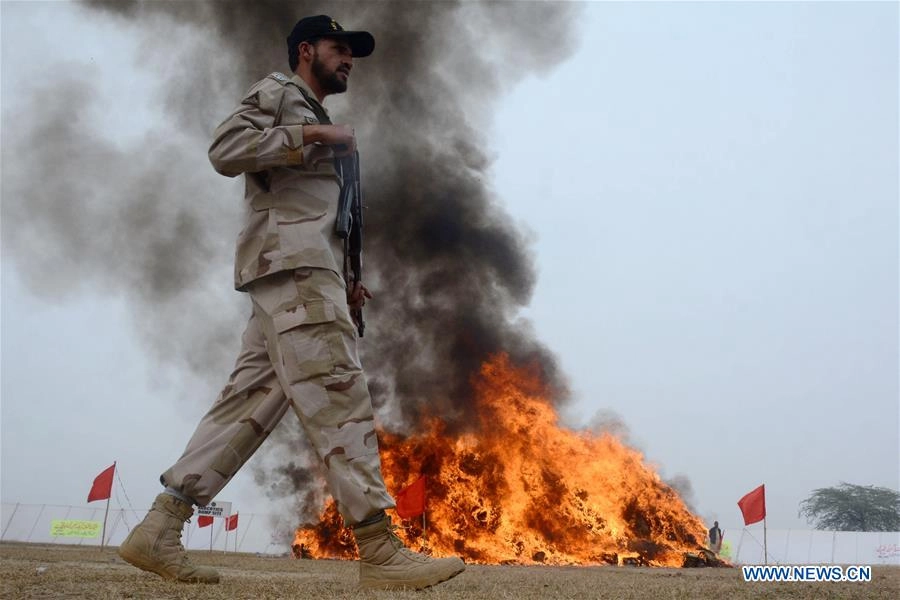
In global fight against drugs, Pakistan bears impressive achievements to its account. In 2025 alone, Pakistan seized close to 300 tons of narcotics, valuing tens of billions US dollars in the international drug markets. 29 x Drug Trafficking Organizations (DTOs) were busted out of which 8 were the international DTOs. ANF as the lead CN agency contributes nearly 60% of the national seizure. Other than the annual CN campaign, Pakistan is also pursuing special campaign against synthetic drugs particularly Ice and educational institutes-centric CN campaign. These parallel campaigns afford depth to the annual CN campaign of the country. Additionally, Poppy Erad-ication Campaign is run each year to maintain Poppy Free Status of the country, which is retained since 2001. In 2025, another important activity was the burning of drugs by ANF in an environmentally friendly manner, using the industrial incinerators. Four such ceremonies were held at Hub, Sheikhupura, Risalpur and Quetta, resulting in the destruction of over 120 metric tons of seized narcotics, besides reinforcing the transparency and fulfilling the environmental responsibility.
Global Cooperation & Treaty Commitments
Pakistan’s contributions extend beyond national borders. Through intelligence sharing and operational coordination, ANF of Pakistan has participated in over 60 successful internationally coordinated operations, leading to 153 arrests and the seizure of close to 60 metric tons of drugs in the foreign jurisdictions. Such commendable efforts align with Pakistan’s obligations under key international conventions, including the 1961 Single Convention on Narcotic Drugs, the 1971 Convention on Psychotropic Substances and the 1988 Convention against Illicit Traffic, as well as initiatives such as the Paris Pact and UNODC-led Container Control Programs. In an era, which is characterized with selective enforcement and declining trust, Pakistan’s impeccable cooperation with the international partners markedly substantiates its credibility, as a responsible and resilient nation.
Demand Reduction & Societal Co-operation
Cognizant of the fact that enforcement alone is not sufficient, Pakistan invests in prevention and drugs demand reduction (DDR) interventions as well. In 2025, awareness campaigns across 273 universities and hundreds of schools and colleges have resulted in engaging thousands of students, faculty members and the allied staff. Targeted operations within educational institutions resulted in the seizure of con-siderable quantity of narcotics with close to 600 arrests.
Pakistan’s role as frontline state in global combat against drugs is distinct and noticeable. Due to the zero tolerance policy of Government, Pakistan stands tall as a bulwark against Afghan-origin drugs and substances.