


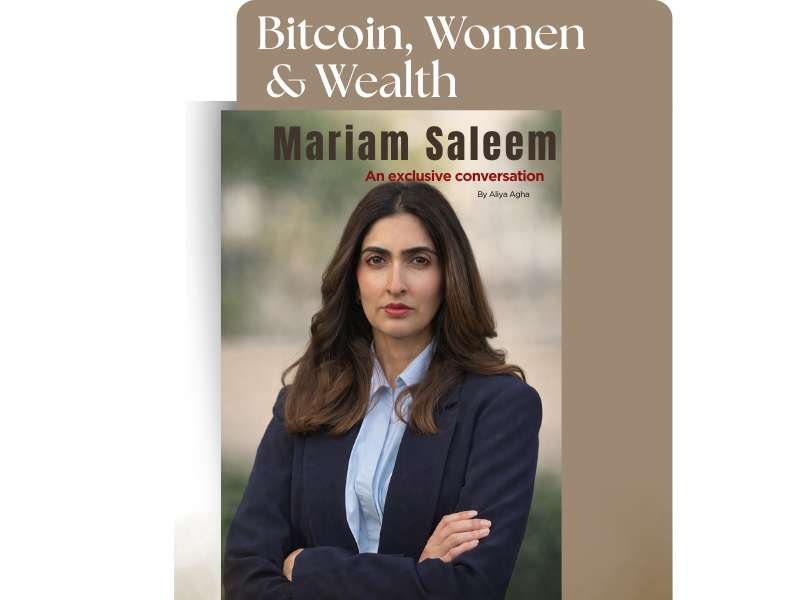
As global finance shifts toward digital ecosystems, conversations around women’s financial empowerment are becoming more nuanced and urgent. In this special feature for Margalla Tribune, we present an expanded interview with Mariam Saleem, a legal expert in the financial and technology sectors, who recently spoke on the MT Out Loud Podcast
A graduate of King’s College London, Mariam began her career at aw firms, where she rose to partnership. With increasing focus on digital regulation and virtual assets, she shares her perspective on Bitcoin, women’s financial autonomy, and the evolving regulatory environment in Pakistan.
MT: Tell us about your journey into law. What inspired you to pursue this field?
Mariam Saleem: I graduated from King’s College London in 2005 and returned to Pakistan immediately to begin my legal practice. Interestingly, I did not come from a family of lawyers, so this wasn’t a traditional path for me. It was simply a subject I felt intellectually drawn to.
Once I began studying law, I discovered that I genuinely enjoyed interpreting legislation, analyzing complex issues, and constructing arguments. Over time, I realized that law is not just about statutes and cases, it’s about understanding systems and navigating them strategically. That realization kept me deeply engaged and passionate about the profession.
MT: Law is often seen as intimidating, particularly for women. What has your experience been?
Mariam Saleem: Law can seem intimidating because it demands discipline, precision, and confidence. However, the training it provides is incredibly empowering. It teaches you how to think critically, question assumptions, and articulate your position clearly.
For women especially, these skills are transformative. Once you develop the confidence to analyze situations and assert your rights, that confidence extends beyond courtrooms or contracts into everyday decision-making whether in business, family matters, or financial planning. In that sense, studying law equips women with tools that go far beyond the profession itself.
Traditionally, this has meant gold, property, or stocks but these avenues often require large capital or intermediaries. That is where digital assets like Bitcoin enter the conversation.
MT: When discussing women’s empowerment in Pakistan, what do you believe are the most crucial elements?
Mariam Saleem: Often, discussions about women’s empowerment revolve around constitutional protections or legal reforms. While these are undeniably important, true empowerment begins internally. A woman must first believe that she deserves autonomy and respect.
In my view, empowerment rests on two pillars: self-belief and economic independence. Without belief in oneself, even the strongest legal protections remain underutilized. And without financial independence, exercising autonomy becomes significantly more difficult. When a woman controls her own financial resources, she gains decision-making power and that shifts dynamics in profound ways.
MT: Many women in Pakistan are savers rather than investors. Why is this a concern?
Mariam Saleem: Saving money is commendable, and women often manage household finances very responsibly. However, keeping savings in cash presents a major challenge: inflation steadily erodes its value.
When governments increase money supply or inflation rises, the purchasing power of cash declines. This creates a constant struggle to maintain financial stability. Instead of merely saving, women should consider investing in assets that preserve or grow value over time. Traditionally, this has meant gold, property, or stocks but these avenues often require large capital or intermediaries. That is where digital assets like Bitcoin enter the conversation.
MT: For readers unfamiliar with it, how would you explain Bitcoin?
Mariam Saleem: Bitcoin is a decentralized digital asset built on blockchain technology. Unlike traditional currencies, its supply is fixed only 21 million Bitcoins will ever exist. This scarcity is embedded into its code and cannot be altered by governments or central banks.
Currently, around 19 million Bitcoins have been mined through a process that involves solving complex mathematical equations using significant computational energy. Once the full supply is reached, no additional Bitcoin can be created. This limited supply makes Bitcoin fundamentally different from fiat currency, which can be printed in unlimited quantities. That scarcity is one reason many view it as a hedge against inflation.
MT: You’ve mentioned Bitcoin offers specific advantages for women. Could you elaborate?
Mariam Saleem: Yes, I believe three characteristics make Bitcoin particularly appealing for women.
First, privacy. A woman can invest without requiring approvals or disclosures, which can be significant in environments where financial autonomy is questioned.
Second, control. Bitcoin is self-custodied meaning you can hold it directly rather than through a bank. This eliminates dependence on institutions. Third, inflation protection. Because its supply is capped, it resists devaluation caused by excessive money printing.
For women seeking discreet, autonomous wealth-building tools, these features can be empowering.
MT: What is the regulatory status of cryptocurrency in Pakistan?
Mariam Saleem: In earlier years, cryptocurrency existed in a regulatory gray area in Pakistan. However, in 2025, the government introduced the Virtual Assets Ordinance, signaling a move toward formal recognition and regulation.
While the ecosystem is still developing, regulatory clarity is emerging. International platforms such as Binance and Coinbase allow users to purchase Bitcoin, and wallets like MetaMask can be used for storage.
As regulatory frameworks mature, we can expect more localized and licensed platforms in Pakistan.

Currently, around 19 million Bitcoins have been mined…Once the full supply is reached, no additional Bitcoin can be created. This limited supply makes Bitcoin fundamentally different from fiat currency
MT: How much should someone invest to get started?
Mariam Saleem: One of Bitcoin’s advantages is divisibility. You don’t need to purchase an entire coin. You can buy fractions known as Satoshis based on your budget. Even modest, consistent investments, for example, allocating a fixed amount monthly can accumulate over time. The key is discipline and a long-term perspective rather than attempting to time the market perfectly.
MT: Bitcoin is known for volatility. Should that deter investors?
Mariam Saleem: Volatility is inherent to emerging assets. Bitcoin has historically moved in cycles rapid growth followed by corrections. For instance, in late 2025 it reached over $120,000 before experiencing a significant pullback. However, if you examine long-term trends rather than short-term fluctuations, the trajectory has been upward. Investors must understand that this is not a short-term speculative tool but a long-term asset class requiring patience.
MT: Is Bitcoin secure? Can it be stolen?
Mariam Saleem: The blockchain itself is highly secure due to cryptographic protections and decentralized verification. Tampering with the ledger is extraordinarily difficult.The real risk lies in user responsibility. If someone loses their private key which grants access to their wallet recovery is nearly impossible. Therefore, education about digital security is critical.
You don’t need to purchase an entire coin….The key is discipline and a long-term perspective rather than attempting to time the market perfectly.
MT: How much should someone invest to get started?
Mariam Saleem: One of Bitcoin’s advantages is divisibility. You don’t need to purchase an entire coin. You can buy fractions known as Satoshis based on your budget. Even modest, consistent investments, for example, allocating a fixed amount monthly can accumulate over time. The key is discipline and a long-term perspective rather than attempting to time the market perfectly.
MT: Bitcoin is known for volatility. Should that deter investors?
Mariam Saleem: Volatility is inherent to emerging assets. Bitcoin has historically moved in cycles rapid growth followed by corrections. For instance, in late 2025 it reached over $120,000 before experiencing a significant pullback. However, if you examine long-term trends rather than short-term fluctuations, the trajectory has been upward. Investors must understand that this is not a short-term speculative tool but a long-term asset class requiring patience.
If Pakistan adapts proactively, it can position itself competitively within this transformation
MT: Is Bitcoin secure? Can it be stolen?
Mariam Saleem: The blockchain itself is highly secure due to cryptographic protections and decentralized verification. Tampering with the ledger is extraordinarily difficult. The real risk lies in user responsibility. If someone loses their private key which grants access to their wallet recovery is nearly impossible. Therefore, education about digital security is critical.
MT: Where do you see the future of digital finance heading?
Mariam Saleem: Globally, we are moving toward increasingly digital payment systems. Whether through cards, mobile wallets, stablecoins, or cryptocurrencies, financial systems are evolving rapidly. Countries that provide regulatory clarity tend to attract innovation and capital. If Pakistan adapts proactively, it can position itself competitively within this transformation rather than lag behind it.
MT: Your final message?
Mariam Saleem: To investors educate yourselves thoroughly and approach digital assets with a long-term mindset.
To policymakers accelerate thoughtful regulation and public awareness. Technology will not wait. The question is whether we choose to participate actively in shaping the future, or observe it from the sidelines.