



When Heat Becomes a Climate Story
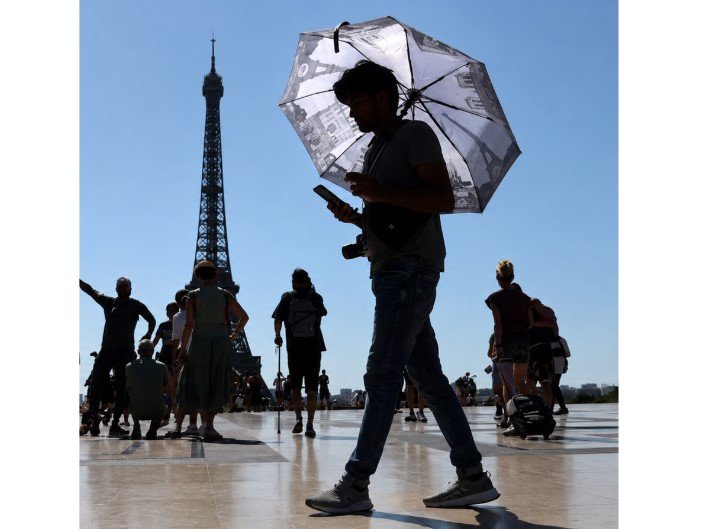
For generations, Europe has been associated with temperate summers, bustling outdoor cafés, and tourists strolling through historic streets under warm but pleasant sunshine. Yet, in the summer of 2026, that familiar image was replaced by one of blazing landscapes, parched rivers, smoke-filled skies, and cities struggling to cope with relentless heat.
Across southern and western Europe, temperatures soared well above seasonal averages, with several regions approaching or exceeding 40°C. Authorities issued widespread heat warnings, schools adjusted schedules, outdoor work was restricted in some areas, and healthcare systems prepared for a surge in heat-related illnesses. Wildfires once again swept through parts of the Mediterranean, forcing evacuations and threatening communities already living on the frontline of climate change.
While extreme heat is not new to Europe, the frequency, duration, and intensity of such events have changed. What was once considered an exceptional occurrence is increasingly becoming a recurring feature of European summers. Scientists caution that these heat waves are no longer isolated weather anomalies; they are unfolding against the backdrop of a warming planet shaped by decades of greenhouse gas emissions.
The European heat wave of 2026, therefore is another reminder that climate change is altering the way extreme weather behaves, with consequences extending far beyond Europe. From public health and agriculture to infrastructure and energy systems, prolonged periods of extreme heat are testing the resilience of modern societies. For countries such as Pakistan, which already experience some of the world’s highest temperatures, Europe’s experience offers important lessons about preparedness, adaptation, and the urgent need to build climate resilience.
Europe’s Summer of Extremes
The 2026 heat wave developed as a persistent high-pressure system settled over much of western and southern Europe. Often referred to as a “heat dome,” this atmospheric pattern trapped hot air near the Earth’s surface while suppressing cloud formation and rainfall. Under clear skies and uninterrupted sunshine, tempera-tures climbed steadily over several days, creating dange-rous conditions across multiple countries Spain, Portugal, France, Italy, Greece, and parts of the Balkans experienced some of the most intense conditions. Several regions recorded temperatures close to or above 40°C, while nighttime temperatures remained unusually high, preventing people and infrastructure from cooling after sunset. Such warm nights significantly increase health risks because the human body receives little oppor-tunity to recover from daytime heat.
Although Europe has experienced devastating heat waves before notably in 2003, 2019, 2022 and 2023 the latest episode reinforced an emerging scientific conse-nsus: extreme heat events are becoming more frequent, lasting longer, and affecting larger geographical areas than in previous decades.
Why Is Europe Heating Up So Quickly?
According to the European Environment Agency and the World Meteorological Organization, average tempera-tures across Europe have risen at roughly twice A the global average over recent decades. This accele-rated warming is the result of multiple interacting factors rather than a single cause.
The most significant driver is human-induced climate change. Due to the burning of coal, oil, and natural gas has released enormous quantities of greenhouse gases into the atmosphere. These gases trap heat that would otherwise escape into space, gradually raising global temperatures. As the Earth’s baseline temperature increases, the likelihood of record-breaking heat also rises.
Europe’s geography further amplifies this trend. Large areas of the continent are located in the mid-latitudes, where shifts in atmospheric circulation can allow hot air masses from North Africa to travel northward more frequently during summer. At the same time, warming seas surrounding Europe including the Mediterranean, provide additional heat and moisture to the atmosphere, reinforcing prolonged hot spells.
Land surfaces also warm faster than oceans. As soils be-come drier during extended periods without rainfall, less energy is used for evaporation and more is converted directly into heat. This creates a feedback loop in which dry ground becomes even hotter, intensifying heat waves and increasing the likelihood of drought and wildfire.
The Science Behind Extreme Heat
Heat waves are often described simply as periods of unusually hot weather, but their formation involves a complex interaction between atmospheric dynamics and long-term climate change.
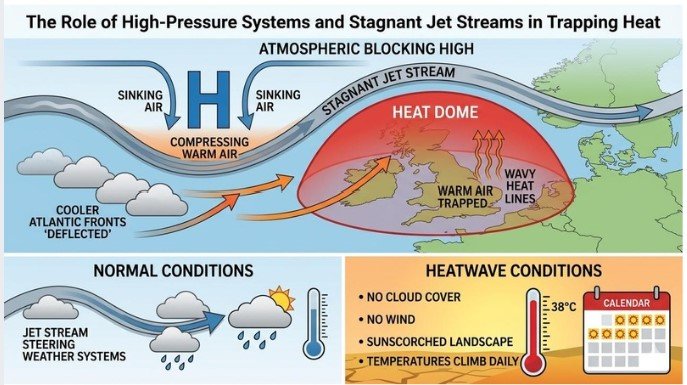
A key mechanism behind many recent European heat waves is the development of a heat dome. A heat dome forms when a strong area of high atmospheric pressure becomes stationary over a region. Air beneath the high-pressure system slowly sinks toward the surface. As it descends, the air compresses and warms, much like the way air inside a bicycle pump heats up when compressed.
At the same time, the high-pressure system suppresses cloud formation. With few clouds to reflect incoming solar radiation, sunlight continues heating the ground day after day. Because the weather pattern remains relatively stationary, the accumulated heat has little opportunity to disperse.
Closely related to this phenomenon is atmospheric blocking, where large-scale weather systems become “stuck” in place for extended periods. Instead of moving across Europe every few days, these systems can persist for a week or longer, allowing extreme temperatures to build.
Climate change does not directly create heat domes or atmospheric blocking, but it makes their consequences significantly more severe. A heat dome occurring in to-day’s warmer climate begins from a much higher temp-erature baseline than it would have several decades ago. In practical terms, this means that weather patterns which once produced temperatures of 34°C or 35°C may now generate conditions approaching or exceeding 40°C.
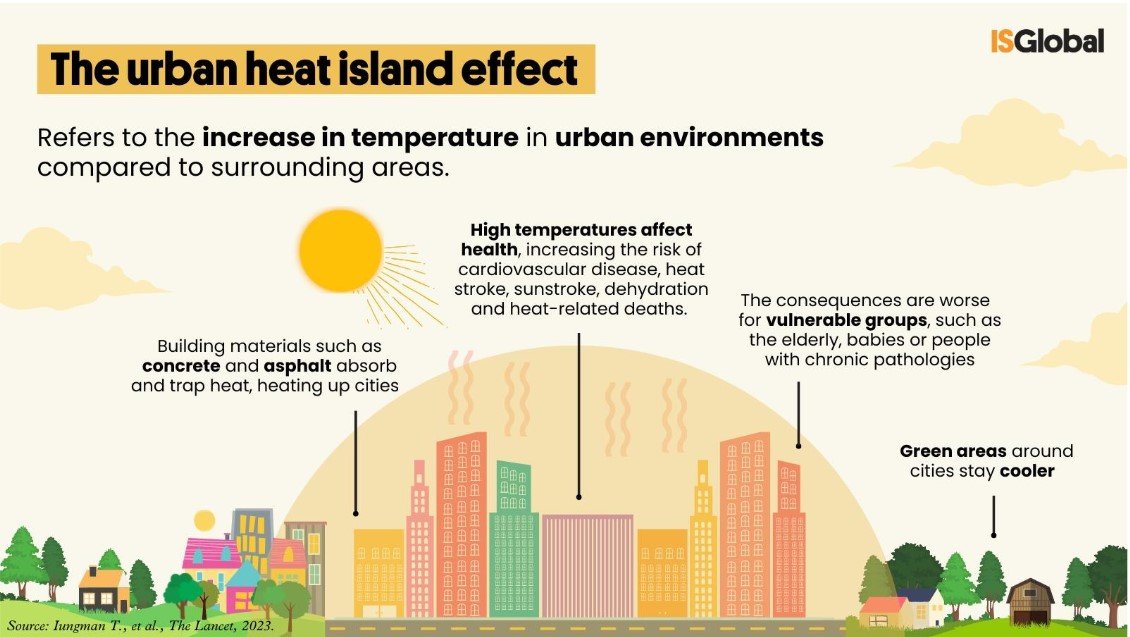
Cities experience an additional burden through the urban heat island effect. Concrete, asphalt, and buildings absorb solar energy throughout the day and release it slowly after sunset. The lack of vegetation, combined with waste heat from vehicles, industries, and air-conditioning systems, keeps urban temperatures noticeably higher than surrou-nding rural areas. Consequently, city residents often en-dure dangerously warm nights, when the body has limited opportunity to cool.
Scientists also emphasise that the most dangerous aspect of heat waves is not always the daytime maximum temperature but the absence of nighttime relief. When temperatures remain elevated around the clock, heat accumulates in buildings, infrastructure, and the human body. This cumulative stress greatly increases the risk of cardiovascular disease, respiratory complications, kidney problems, and heatstroke.
A Shared Climate Future
The 2026 European heat wave is more than a record-breaking weather event. It is another chapter in a broader global story of climate change reshaping the environments in which societies have developed for centuries.
Heat waves are becoming longer, hotter, and more frequent because the planet itself is warming. Scientific evidence leaves little doubt that human activity has increased the probability and severity of many extreme heat events observed today. What were once considered rare occurrences are steadily becoming part of a new climatic reality.
Europe’s experience illustrates both the scale of the challenge and the possibilities for adaptation. Investments in greener cities, stronger public health systems, climate-resilient infrastructure, and evidence-based policymaking can significantly reduce the risks posed by extreme heat. These are lessons that resonate far beyond Europe.
A heat dome occurring in to-day’s warmer climate begins from a much higher temperature baseline than it would have several decades ago.which once produced temperatures of 34°C or 35°C may now generate conditions approaching or exceeding 40°C.
For Pakistan and many other climate-vulnerable nations, the question is no longer whether heat waves will become more severe. The more pressing question is whether societies can adapt quickly enough to protect people, livelihoods, and ecosystems in an increasingly warmer world.
The answer will depend not only on scientific understand-ing but also on political will, thoughtful urban planning, international cooperation, and the collective recognition that climate resilience is no longer an option, it is an essential investment in our shared future.
The writer can be reached at mick66yen@gmail.com