



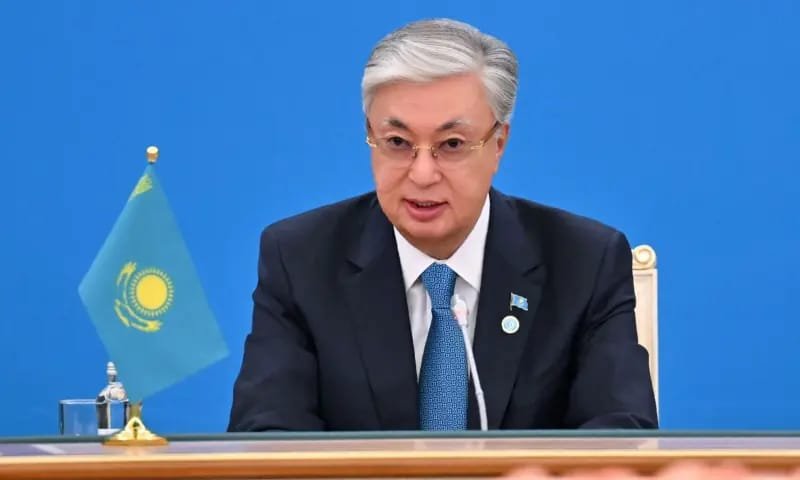
Tokayev Outlines Kazakhstan’s Key Priorities in a New Historical Era
Astana – 28 October 2026 (MT Team) : President Kassym-Jomart Tokayev has outlined Kazakhstan’s key development priorities in his address to the people, titled “Kazakhstan’s Key Priorities in a New Historical Era,” focusing on infrastructure modernization, economic growth, digital transformation, energy security, social development and strengthening national sovereignty.
Addressing the nation, Tokayev said Kazakhstan had entered a new era of national development following significant political reforms and the adoption of a new Constitution. He emphasized that national unity, social cohesion, discipline and responsibility were essential for achieving sustainable progress amid growing global uncertainty.
The president said Kazakhstan must build a strong and competitive economy, develop advanced technologies, strengthen education and science, uphold the rule of law and expand its international influence to leave a prosperous and modern state for future generations.
Infrastructure modernization and economic development
Tokayev announced plans for a large-scale national construction initiative, named Halyqtyq Qurylys (People’s Construction), aimed at modernizing social, transport and engineering infrastructure across the country.
Under the initiative, approximately KZT 6.5 trillion will be allocated from the National Fund by the end of 2029, while KZT 1.5 trillion will be earmarked for launching social projects during the remainder of 2026 and the first two months of 2027.
The programme will prioritize healthcare, education, housing, utilities, roads, railways, airports, cultural institutions and sports facilities. Around 70 healthcare facilities are planned across the regions, alongside approximately 50 educational, sports and cultural facilities.
Tokayev said Kazakhstan’s gross domestic product is projected to approach US$400 billion in 2026, with GDP per capita exceeding US$19,000. He also noted that the combined value of the country’s gold and foreign exchange reserves and National Fund assets had surpassed US$130 billion.
He stressed that public resources must generate tangible economic and social returns and called for greater participation by domestic businesses in infrastructure projects.
Transport and logistics
The president identified transport and logistics development as a strategic priority, emphasizing Kazakhstan’s potential to become a leading Eurasian logistics hub.
He said approximately 85 percent of freight shipments from China to Europe pass through Kazakhstan. Planned projects include the Bakhty–Ayagoz railway line, expected to increase freight transportation capacity between Kazakhstan and China by 20 million tonnes, and the Aral–Caspian highway, which is expected to shorten the Trans-Caspian Corridor by approximately 1,000 kilometres and reduce cargo delivery times by up to three days.
Tokayev also called for the modernization of road infrastructure, reconstruction of road border-crossing points and improvements in roadside services. He instructed the Government, through the Ministry of Transport, to assume responsibility for both national and local roads to ensure higher construction and maintenance standards.
Energy security and nuclear power
Tokayev described electricity availability as a decisive factor in national competitiveness and economic sovereignty, setting a strategic objective for Kazakhstan to achieve a sustainable electricity surplus by 2029.
He called for the construction of new power plants, modernization of existing generation facilities and transmission lines, development of clean coal power generation and greater attention to renewable energy, particularly solar power. The Government was also instructed to update the country’s long-term energy balance through 2035.
The president reaffirmed the importance of nuclear power generation and said Kazakhstan should consider establishing a strategic uranium reserve to meet the needs of its nuclear power plants over the long term.
He also proposed beginning construction of the Balkhash Nuclear Power Plant as early as 2027 and moving forward with a comprehensive cooperation agreement to launch construction of the Moyynkum Nuclear Power Plant.
Industrial development and agriculture
The address emphasized the need to diversify Kazakhstan’s economy through advanced manufacturing, geological exploration, critical minerals processing and the development of domestic production capacity.
Tokayev called for modern technologies to be introduced into geological exploration and urged the Government to establish a national system for managing critical metal reserves. He also stressed the importance of attracting strategic partners and integrating Kazakhstan into global production and value chains.
In agriculture, the president highlighted the sector’s growth of approximately six percent in 2025, with total agro-industrial output reaching KZT 15 trillion. He called for accessible long-term financing for farmers, technological modernization and increased domestic production of advanced tractors and combine harvesters.
Tokayev also supported the use of artificial intelligence in agriculture, improved food processing, modern agricultural logistics and water-saving technologies. He emphasized the need to address water scarcity, reduce losses in distribution networks and complete the National Water Resources Information System.
Digital economy and artificial intelligence
Tokayev called for the development of a people-centred digital economy under the comprehensive Digital Qazaqstan strategy.
He highlighted progress in digital infrastructure, including the launch of two supercomputers, plans for a third high-performance supercomputer and the completion of a fibre-optic backbone cable along the seabed of the Caspian Sea.
The president said digitalization must produce practical economic benefits rather than simply automate existing processes or involve the purchase of expensive software without clear value.
He called for the wider application of artificial intelligence, blockchain technologies, asset tokenization and digital platforms. The Government was instructed to establish a simplified legal framework for digital employment by the end of 2026.
Tokayev also called for pilot digital development projects to help rural producers access markets through partnerships with digital platforms, banks and logistics companies, with successful initiatives subsequently expanded nationwide.
Investment and support for businesses
The president stressed the need for a coordinated national system to attract investment, noting that overlapping responsibilities among government institutions had weakened the effectiveness of investment promotion.
He suggested that Baiterek Holding could play a more active role in managing investment-related matters.
Tokayev also highlighted the contribution of small and medium-sized enterprises, whose share of GDP has reached 40 percent, while their share of investment in fixed capital is approaching 70 percent.
He called for better access to long-term financing, support for technological modernization and greater participation by smaller businesses in public procurement.
The president proposed that the Government and the Kurultai consider introducing another three-year moratorium on inspections of micro and small businesses beginning January 1, 2027. He also called for further decriminalization of economic offences, fair competition and stronger protection for domestic producers.
Macroeconomic stability and taxation
Tokayev identified inflation control and increasing household incomes as major economic priorities. He called on the Government and the National Bank to coordinate their policies to bring inflation down and strengthen the productive capacity of the economy.
He also urged banks to increase investment lending to businesses and called for new mechanisms to mobilize long-term financing through financial institutions, development organizations and capital markets.
On taxation, the president called for targeted amendments to address difficulties faced by businesses in implementing the new Tax Code. He emphasized that tax policy should encourage investment, business growth and job creation.
Tokayev also proposed examining a higher tax rate for individuals with substantial wealth, stressing that the objective was to ensure a fair contribution to national development without restricting legally acquired assets.
Social development, healthcare and education
The address placed significant emphasis on improving living standards and strengthening human capital.
Tokayev instructed the Government to increase the minimum wage from KZT 85,000 to KZT 100,000 from January 1, 2027. The measure is expected to benefit approximately 1.8 million people, including more than 370,000 public sector employees.
He also announced plans to increase the salaries of primary healthcare professionals working in community-based services by up to 40 percent, depending on their length of continuous service, from the same date. More than 77,000 healthcare professionals are expected to benefit.
The president highlighted the need to expand healthcare infrastructure, including eight modern perinatal centres and seven multidisciplinary children’s hospitals in Atyrau, Aktobe, Almaty, Shymkent, Kaskelen, Semey and Aktau, alongside two additional medical facilities in Astana.
He also called for improved infrastructure and specialist services for children with special needs and emphasized that education reforms should reduce teachers’ administrative burdens and protect their professional dignity.
Public administration and long-term national priorities
Tokayev called for comprehensive reform of public administration to improve efficiency, eliminate overlapping responsibilities and reduce bureaucracy through digital technologies and artificial intelligence.
He instructed the Presidential Administration to submit a comprehensive plan for public administration reform by June 1, 2027.
The president also directed relevant institutions to prepare a long-term vision document outlining Kazakhstan’s development priorities within one year.
He proposed declaring 2027 the Year of Nationwide Large-Scale Construction, with construction and renovation projects to begin in regional centres, districts and smaller communities across the country.
Concluding his address, Tokayev emphasized the importance of national unity, law and order, education, science, innovation and responsible citizenship in building a just, strong, clean and progressive Kazakhstan.
He said the country’s future depended on sustained modernization, disciplined work and the ability to turn national development priorities into tangible improvements in the lives of its citizens.