



The River Will Remain but Are We Preparing for a River That May No Longer Behave as We Have Known It?
The Warning from 32 Scientists
In December 2019, an international team of 32 scientists led by Walter Immerzeel and Arthur Lutz published an extra-ordinary global assessment. They examined 78 glacier- and snow-dependent mountain water towers and asked two deceptively simple questions: which matter most to humanity, and which are most vulnerable to the changes ahead?
Their findings, published in Nature, carried particular significance for Pakistan. The Indus emerged as the world’s most important mountain water tower and one of the most vulnerable.
The assessment went beyond glaciers. Its Water Tower Index examined the water-supplying role of mountain systems and downstream dependence, while vulnerability incorporated water stress, governance, hydropolitical tensions and future climatic and socioeconomic change. Collectively, changes in these mountain systems could affect 1.9 billion people living in or directly downstream of them.
Six years later, that warning has acquired greater urgency. New science is revealing the contours of a different Indus one characterised by an uncomfortable hydro-logical paradox: more extreme floods, less ice, earlier flows, greater variability and increasing uncertainty. The Indus is not about to disappear. But the Indus of the past is disappearing.
Pakistan’s water story begins thousands of metres above its plains, farms, barrages and cities. The Hindu Kush Himalaya contains an estimated 54,000 glaciers covering roughly 60,000 square kilometres. Snow and ice constitute natural water infrastructure: they accumulate precipitation at elevation, store it and release water seasonally when downstream demand can be high.
For the Indus, this cryospheric buffering function is exceptionally important. ICIMOD estimates that snow and glacier melt contribute as much as 40% of flow in the Indus River system, with dependence becoming still more important at higher elevations and during drier seasons.
But this natural reservoir is changing. ICIMOD’s 2023 assessment found that HKH glaciers disappeared 65% faster during the 2010s than in the preceding decade. On current emissions trajectories, the region could lose up to 80% of its present glacier volume by 2100. Even at approximately 1.5–2°C of warming, projected glacier-volume losses remain substantial.
The 80% figure requires careful interpretation. It does not mean Indus River flow will decline by 80%. The Indus is a hydroclimatic system fed by snowmelt, glacier melt, rainfall, tributaries and groundwater interactions. The more scientifically defensible warning is not simply less water. It is different water different in timing, provenance, seasonality, extremes and predictability.
When a 20-Year Flood Is No Longer a 20-Year Flood
The newest science makes that distinction even more important. A 2026 study in Communications Earth & Environment projects a substantial increase in flood frequency and intensity in the Upper Indus Basin. Compared with 1981–2020, 10-year floods are projected to become roughly four times more frequent during 2021–2060.
For more extreme events, the finding is striking: a flood historically associated with a 20-year return period could become approximately ten times more frequent during 2021–2060 under the two emissions scenarios examined.
The same research projects earlier flood peaks and faster flood-rise rates as rainfall assumes a larger role, even while snow and glacier melt remain crucial. By 2100, it also projects the frequency with which Tarbela reaches its maximum conservation level to rise by about 2.7 times under the high-emissions scenario, with increasing sediment loads adding pressure on reservoir performance.
This does not mean every kind of flood in Pakistan will increase tenfold. It means something more consequential for planners: the statistical probabilities on which infrastructure, reservoir operations and disaster planning have historically relied are becoming non-stationary. A “20-year flood” may no longer behave like a 20-year flood.
Are our dams, barrages, drainage systems, flood defences and emergency-management protocols being calibrated to the hydrology ahead or the hydrology behind us?
A warming climate can accelerate snow and glacier melt while changing atmospheric circulation and heavier rainfall intensify extremes.
More Floods Today. Less Ice Tomorrow.
There is no contradiction between increasing flood risk and deteriorating long-term water security. A warming climate can accelerate snow and glacier melt while changing atmospheric circulation and heavier rainfall intensify extremes. For a period, additional melting can maintain or increase some upstream flows. But glaciers cannot indefinitely release accumulated ice faster than nature replenishes it.
Across the HKH, glacier runoff is expected broadly to peak around mid-century and then decline, although timing differs considerably among basins. The Upper Indus carries an additional complexity: the Karakoram anomaly, under which parts of the Karakoram historically displayed unusual glacier stability compared with much of High Mountain Asia. That relative stability does not remove the longer-term vulnerability of the cryosphere.
Pakistan may therefore confront three conditions simultaneously: more floodwater, less long-term cryospheric storage and greater usable-water stress. These are not contradictions. Floodwater is episodic; snow and glaciers provide seasonal buffering; usable water depends on timing, storage, reservoir operations, groundwater, irrigation efficiency and demand.
Scarcity can at least be measured and planned for. Uncertainty is far more difficult to govern.
From Natural Regulation to Intelligent Regulation
For centuries, the mountains performed part of Pakistan’s water-management function for us. Snow accumulated. Glaciers stored water. Seasonal warming released it. The cryosphere operated, in effect, as a vast natural reservoir.
As this natural regulatory capacity becomes less depen-dable, Pakistan’s institutional and technolo-gical capacity for regulation must become more sophisticated. That means additional storage where technically, economically and environmentally appropriate but storage alone will not be enough.
It requires integrated glacier and snow monitoring, Earth observation, real-time hydro-meteorological data, impro-ved seasonal forecasting, climate-informed reservoir ope-rations, groundwater recharge and regulation, modern-ised irrigation, adaptive cropping calendars, floodplain manage-ment and early-warning systems capable of con-verting forecasts into anticipatory action.
Pakistan does not merely need more data. It needs Climate Intelligence: an integrated capability to transform observations of glaciers, snow, rainfall, rivers, reservoirs, groundwater, agriculture and demand into timely decisions.
As nature’s capacity to regulate the Indus weakens, Pakistan’s capacity to anticipate, store, regulate and intelligently manage water must become stronger.
As uncertainty grows, predictable rules, transparent information exchange, scientific cooperation and credible dispute-resolution mechanisms become more not less important.
Pakistan does now needs Climate Intelligence, an integrated capability to transform observations of glaciers, snow, rainfall, rivers, reservoirs, groundwater, agriculture and demand into timely decisions.
Climate Change Has Changed the Treaty Equation Too
The transformation of the physical river also has implications beyond Pakistan’s borders. The Indus Waters Treaty was negotiated around the hydrological knowledge and assumptions of another era. Yet the rivers governed under it are entering a period of increasing hydroclimatic variability.
This does not weaken the case for the Treaty. It strengthens it. As uncertainty grows, predictable rules, transparent information exchange, scientific cooperation and credible dispute-resolution mechanisms become more not less important.
The Treaty should therefore increasingly be seen not merely as a water-allocation framework, but as an element of South Asia’s climate-security architecture. The next generation of Indus cooperation will have to contend with changing snow regimes, glacier retreat, altered seasonality, more extreme floods, satellite observation, real-time hydrological intelligence and a river whose historical behaviour may become a progressively less reliable guide to its future. As argued previously in Margalla Tribune, climate change has changed the equation.
Are We Preparing for the New Indus?
The science is now sufficiently compelling that Pakistan must move beyond asking what might happen and begin systematically asking how ready we are. Are reservoir operating rules being stress-tested against future rather than historical hydrology? Are barrages and flood-protection systems being assessed against changing return periods and compound extremes? Can forecasts travel the last mile from satellites and modelling centres to district administrations and vulnerable communities quickly enough to trigger action?
Are cropping calendars and irrigation allocations adapting to changing seasonality? And are aquifers being managed as strategic components of national water resilience? Groundwater already supplies about 70% of Pakistan’s domestic water and more than half of agricultural water.
Up to 80% loss of HKH glacier volume by 2100 on current emissions trajectories. A historically 20-year Upper Indus flood potentially occurring around ten times more frequently during 2021–2060.
There is an interprovincial dimension as well. Pakistan’s water-sharing arrangements operate within the same changing hydrology. Greater variability and more frequent extremes can amplify allocation pressures and percep-tions of inequity. Transparent measurement, trusted data and cooperative federal–provincial water governance will therefore become increasingly important. Climate change must not be allowed to convert hydrological uncertainty into interprovincial mistrust.
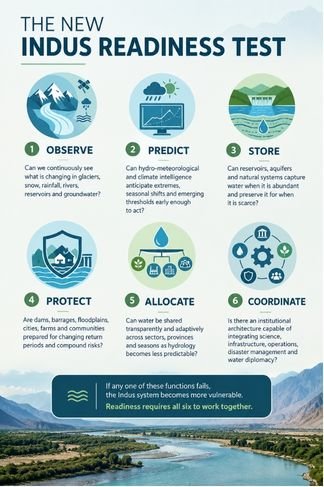
And beneath all these questions lies perhaps the most im-portant one: Which institution sees the whole Indus sys-tem? Water, glaciers, agriculture, energy, climate, ground-water, disasters and infrastructure are still frequently gov-erned through separate institutional windows. The river experiences no such departmental boundaries. That insti-tutional fragmentation may ultimately become as conse-quential as the hydrological disruption itself.
The River Will Remain. Will Our Systems Change?
The Indus should not be given an artificial expiry date. Science does not support one. What science tells us is more consequential. 32 scientists. 78 global water towers. The Indus ranked first in importance. Up to 80% loss of HKH glacier volume by 2100 on current emissions trajectories. A historically 20-year Upper Indus flood potentially occurring around ten times more frequently during 2021–2060.
These are not predictions of the Indus’s death. They are indicators of its transformation. The Indus around which we designed our farms, dams, barrages, cities and institutions and around which South Asia constructed one of the world’s most consequential transboundary water arrangements is changing.
The river will remain. The question is whether our gover-nance, infrastructure and collective imagination will change with it.
The views expressed are those of the author. The writer can be reached at: khalidsa02@gmail.com