


Textile Industry a Key Pillar of Pakistan’s Economic Identity: Haroon Akhtar Khan
LAHORE – 3 October, 2026 (MT Team): Advisor to the Prime Minister for Industries and Production Haroon Akhtar Khan has said that Pakistan’s textile industry is a key pillar of the country’s economic identity, adding that the government is giving special focus to production, investment, productivity, industrial competitiveness and export promotion under the National Industrial Policy.
He said Pakistan must move rapidly beyond the export of raw materials towards finished and value-added products to enhance the value of Pakistani products in international markets and increase the country’s share in global exports.
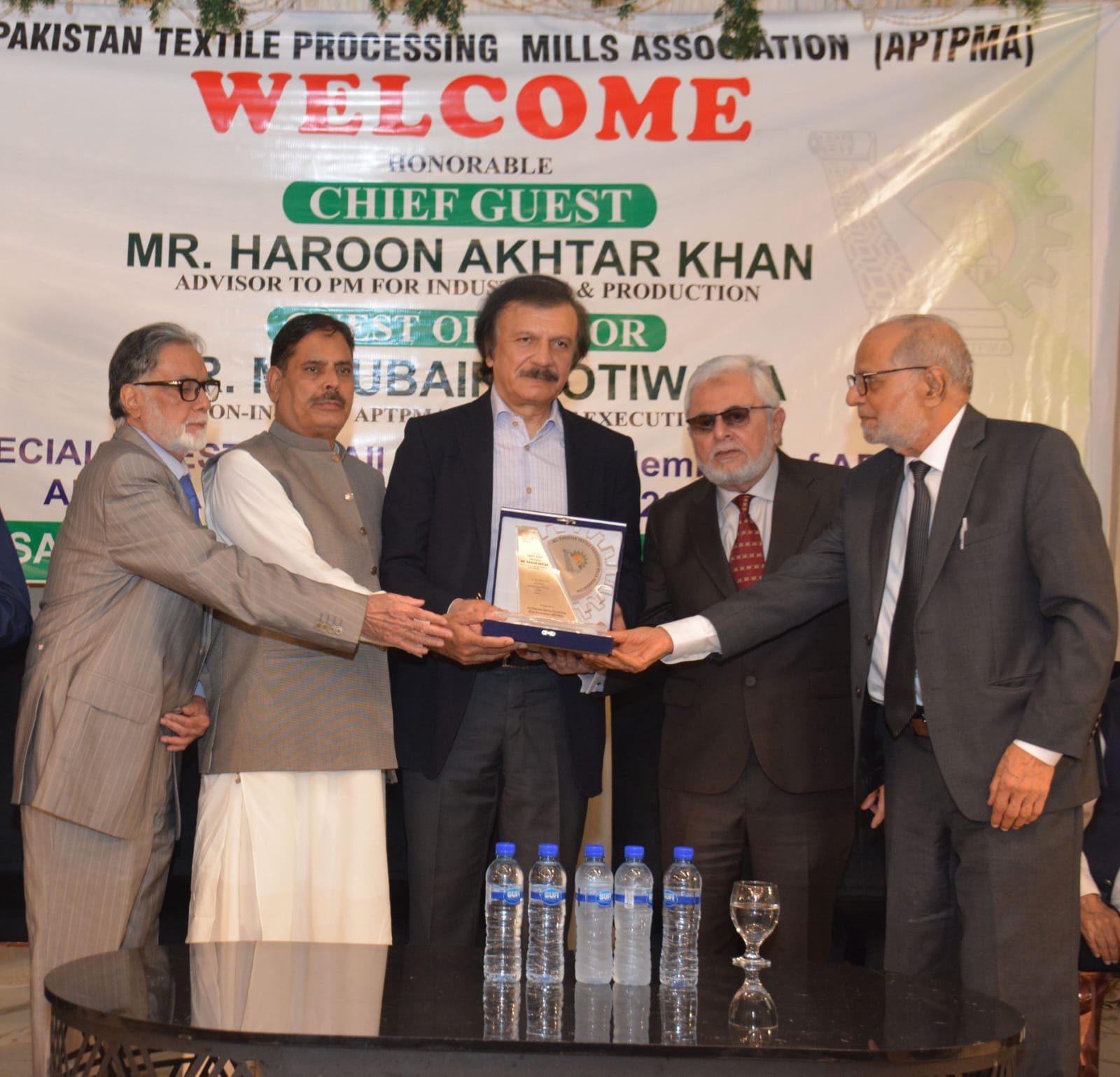
He expressed these views while addressing a function of the All Pakistan Textile Processing Mills Association (APTPMA) here on Saturday. A large number of office-bearers of the association, businessmen, industrialists and representatives of various sectors associated with the textile industry attended the event.
Haroon Akhtar Khan said that Made in Pakistan had already established its presence in international markets, and the need now was to expand that presence and give Pakistani products a stronger identity globally.
“Pakistan needs to produce more, produce better and sell more products to the world,” he said, adding that the country’s economic direction must be centred on production, exports and sustainable growth led by the private sector.
The Prime Minister’s Advisor said that the National Industrial Policy was being built around production, investment, productivity and exports. The government was taking measures to create a conducive environment for the industrial sector that could encourage investment, facilitate the establishment of new industries, support expansion of existing industrial units, create employment opportunities and increase domestic production.
He said the government’s role was not to run businesses but to create an environment in which entrepreneurs could use their capabilities, capital and experience to establish and expand successful businesses.
The government, he added, was working to remove regulatory barriers, facilitate business activity and eliminate unnecessary procedures so that industrialists could focus their time and resources on investment, production, innovation, exports and employment generation rather than permits, complex regulations and unnecessary administrative processes.
He said measures were also being taken to rationalize tariffs and eliminate unnecessary regulations, while the Regulatory Guillotine was being used to remove redundant laws and regulations that created unnecessary burdens for businesses.
Haroon Akhtar Khan said industrialists needed a policy and business environment where decisions were made in a timely manner and unnecessary hurdles did not obstruct the investment process.
“Instead of spending time navigating permits and complicated procedures, businesses should be able to focus on investment, innovation, new product development, improving productivity and accessing global markets,” he said.
He said the government remained in continuous engagement with industry and the business community to address their concerns and remove obstacles to industrial growth.
The Prime Minister’s Advisor said Pakistan’s textile industry could no longer rely solely on low costs to compete in global markets. Quality, modern technology, design, sustainability, innovation and timely delivery must become integral components of its competitiveness strategy.
He said the preferences of global buyers were changing and price was no longer the only decisive factor. Quality, sustainability, product traceability, modern designs, environmental standards and delivery timelines had become increasingly important factors in international trade.
He said Pakistan possessed a complete and integrated textile ecosystem, ranging from cotton production to yarn, fabric, processing, finished garments and other textile products. However, the real challenge was to generate greater value from this existing ecosystem and align it with modern global requirements.
Investment in modern machinery, technology, skilled human resources, research and development and industrial training could significantly enhance the productivity and global competitiveness of Pakistan’s textile industry, he added.
Haroon Akhtar Khan emphasized that Pakistan needed to focus more on exporting finished and value-added products instead of relying primarily on raw material exports.
“Pakistan must not only export cotton, yarn and other basic products but also develop products incorporating greater labour, technology, design and brand value so that Pakistani products command higher prices in international markets and generate greater foreign exchange earnings for the country,” he said.
He said Pakistan must move beyond being merely a supplier to international brands and develop its own Pakistani brands.
“When Pakistani cotton reaches international markets, it should carry with it Pakistani technology, design, manufacturing and brand value as well,” he said.
He added that Pakistan’s textile industry had the potential to develop globally competitive brands, and this potential needed to be strengthened through research, innovation, marketing and quality enhancement.
The Prime Minister’s Advisor said competitive energy prices, taxation, refunds, financing and trade facilitation were among the major concerns of the industrial sector and the government was taking measures to address them.
He said competitive energy pricing was particularly important for industry because production costs had a direct impact on the competitiveness of Pakistani products in international markets. Similarly, timely refunds, accessible financing and trade facilitation played an important role in enhancing industrial production and export capacity.
“Capital goes where there is confidence, and investment takes place where there is policy continuity,” Haroon Akhtar Khan said, stressing the need to provide businesses with confidence that the fundamental principles of policies would not change repeatedly, enabling them to make long-term investment decisions.
He said policy continuity was fundamental to industrial development and the government was working to provide the business community with an environment conducive to long-term planning and investment.
Haroon Akhtar Khan said the government could establish the framework and open doors to international markets, but it was the responsibility of industry to capitalize on those opportunities.
“Government and industry must work together to ensure that Pakistan fully realizes its industrial and export potential,” he said, adding that Pakistan would have to move towards industrial transformation through a partnership between the government and the private sector.
He said the private sector needed to play an increasingly active role in the country’s economic development.
The Prime Minister’s Advisor said changes in global supply chains were creating both challenges and new opportunities for Pakistan. The restructuring of global supply chains was creating space for countries capable of ensuring quality, competitive pricing, timely delivery and sustainable production.
Pakistan, he said, needed to further improve its productive capacity, industrial technology and export infrastructure to benefit from these emerging opportunities.
He reiterated that global buyers now considered not only price but also quality, sustainability, product traceability and speed. Pakistan’s textile industry would have to understand these changing requirements and accordingly shape its production and export strategies.
For this purpose, he said, investment in modern technology, environmentally sustainable production methods, improved quality, contemporary designs and skilled human resources was essential.
Haroon Akhtar Khan said Pakistan’s next textile revolution should be based on productivity, technology and value addition.
“Simply increasing the volume of production is not enough. We must make our production processes more efficient, modern and competitive,” he said.
He said greater emphasis on research and development could help the industry develop new products, reduce production costs and respond more effectively to the changing requirements of global buyers.
He stressed that Pakistan’s textile industry needed to focus not merely on increasing export volumes but on generating greater value for Pakistan from every product.
Converting raw materials into finished products, introducing modern designs, promoting branding and expanding global marketing networks could significantly increase export earnings, he said.
He added that Pakistan needed a coordinated strategy to enhance the identity and value of its products in international markets.
The Prime Minister’s Advisor said Pakistan’s industrial objective should be more investment, more production, more value addition and more exports.
The government, he said, would continue to play its role in improving the policy and facilitation framework for the industrial sector, while industrialists would also need to capitalize on available opportunities by increasing productivity, adopting modern technology, exploring new markets and promoting Pakistani brands.
He said stronger engagement and cooperation between the government and industry could help transform Pakistan into a stronger industrial and export-oriented economy.
“We have to work together to build an industrial system that not only meets domestic requirements but also produces quality products capable of competing in global markets,” he said.
He expressed the government’s resolve to continue taking necessary measures to address industrial-sector issues, improve the business environment and promote exports.
Haroon Akhtar Khan said Pakistan’s textile industry possessed immense potential and its global competitiveness could be further enhanced through greater focus on investment, technology, skilled human resources, research, branding and policy continuity.
He said the government and private sector would have to become partners in building Pakistan’s industrial future and take the country’s industry to new heights through collective efforts.
He said giving Made in Pakistan a stronger global identity was not the responsibility of the government alone but a shared responsibility of the entire industrial community.
“Pakistan has the resources, human capital, industrial experience and an extensive textile infrastructure. What we need is to integrate these strengths with modern technology, innovation and value addition,” he said.
“Let us work together to build Pakistan’s industrial future and further elevate the standing of Made in Pakistan in the world.”