



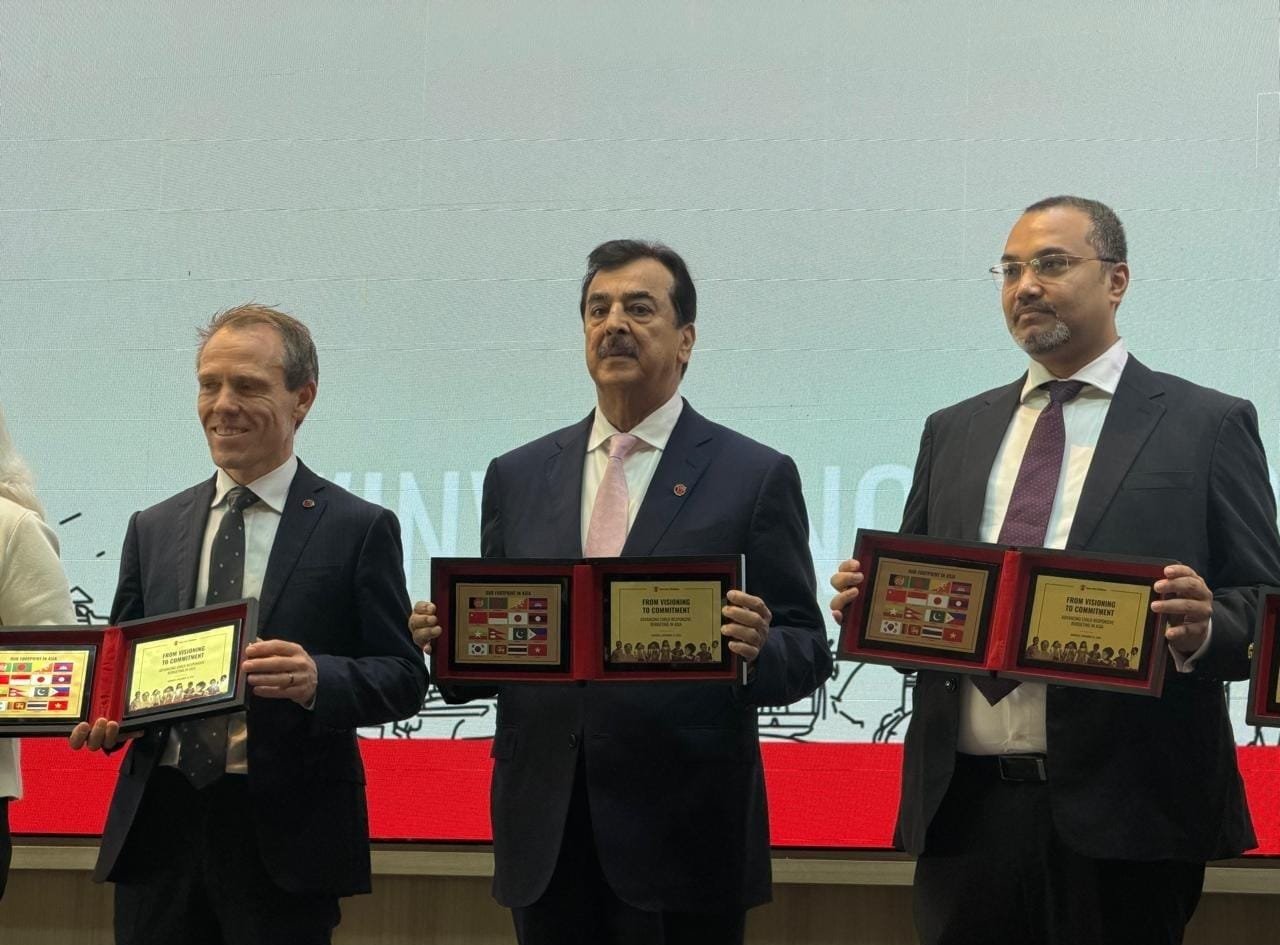
Chairman Senate Calls for Keeping-Children Visible in Asia’s Fiscal-Architecture at Save-The-Children-Policy-Dialogue in Bangkok
Bangkok – 19 November 2026 (MT Te) : The Chairman Senate of Pakistan addressed the Save the Children Policy Dialogue in Bangkok, calling on governments, parliaments and Multilateral Development Banks to align public finances with the rights of children and turn commitments into measurable investments.
Addressing Excellencies, Ministers, Leaders of Multilateral Development Banks, members of civil society and distinguished delegates, the Chairman Senate thanked Save the Children International and its partners for bringing the region together in Bangkok – not just to deliberate, but to align public finances with the rights of children.
*Asia’s Children Must Not Be Left Behind*
The Chairman Senate noted that Asia and the Pacific are home to over one billion children, and the region drives around sixty percent of global growth. Yet their future will not be measured by GDP alone, but by the allocations made today.
He warned that millions of children are already facing widening disparities, bearing the brunt of fiscal tightening, climate shocks, supply chain disruptions and shifting development assistance.
“When fiscal space contracts, social spending must never become an afterthought,” he said.
*Pakistan Puts Its Children First*
Highlighting Pakistan’s progress, the Chairman Senate said that in 2016, Pakistan’s Parliament adopted the Sustainable Development Goals, and since then budget allocations have been aligned with the goals that matter most for children, especially health and education.
*On Health:*
– Immunization coverage increased from *68% to 73%* between 2018-19 and 2024-25
– Neonatal mortality fell from *41 to 35 per 1,000 live births*
– Infant mortality fell from *60 to 47*
– Pakistan was recognized at the Global Caregiver Forum as a country leading Early Childhood Development
– The *Benazir Nashonuma Programme* supports pregnant women and children under two in the first 1,000 days of life
*On Education and Skills:*
– School attendance among those aged 10 and above rose from *61% to 67%*
– Through NAVTTC, the Youth Skills Development Programme, and the Youth Business and Agriculture Loan Scheme, Pakistan is aligning its young population with domestic and overseas opportunities
“These gains are real, but so is the distance still to travel,” he said.
*From Vision to Budget*
The Chairman Senate stressed that the region must move from visioning to commitment – turning ambition into budget allocations, and commitments into institutional systems.
“Child-responsive budgeting must be embedded in national planning. It is our surest safeguard against underinvestment,” he said.
He added that public finance cannot carry this weight alone, and called for blended finance with Multilateral Development Banks, climate finance that protects children’s learning and health during disasters, and corporate sustainability commitments that make supply chains fairer for children and young workers.
As parliamentarians, he said, “Through legislation, oversight and the power of the purse, promises become budgets.”
*Three Imperatives for the Way Forward*
The Chairman Senate proposed three imperatives:
*1.* Shield health, education and child protection from debt pressures through safeguards in budget formulas.
*2.* Exchange experience and good practices towards child-lens public finance among participating countries and multilateral forums.
*3.* As Founding Chairman of the Inter-Parliamentary Speakers’ Conference (ISC), dedicated to peace, cooperation and prosperity, invite parliamentary leadership and multilateral forums to join synergies at the ISC platform to review and expedite progress on children’s budgets.
He also expressed Pakistan’s desire to join hands with Save the Children, governments and parliaments represented at the dialogue, as well as Multilateral Development Banks, to effectively strategize and implement a shared child protection and welfare agenda.
Concluding his address, the Chairman Senate said: “The choices we make will determine how Asia finances its next generation. Let us keep our children visible in Asia’s fiscal architecture, and turn this dialogue into measurable investment in their lives.”