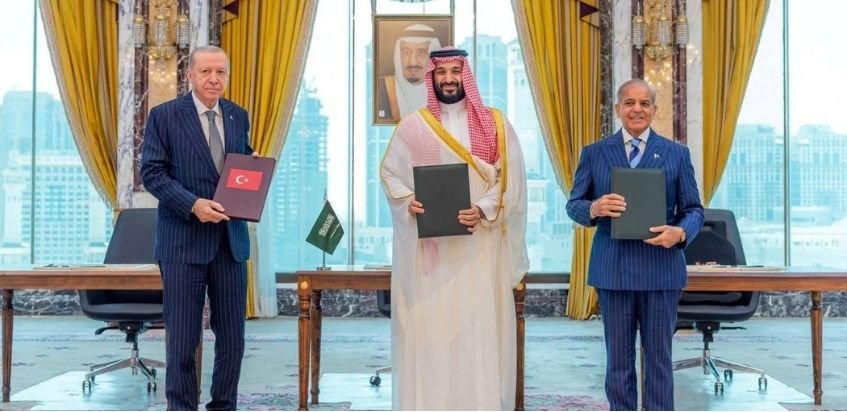



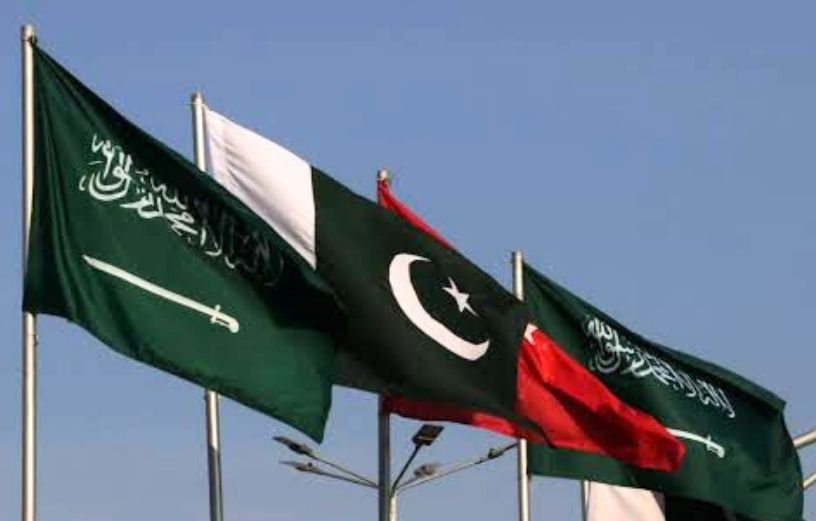
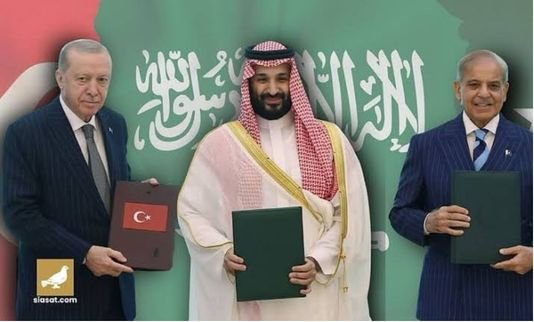
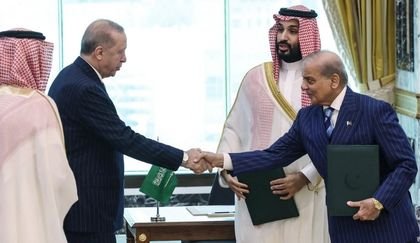
Pakistan, Saudi Arabia and Türkiye signed the Makkah Joint Defence Agreement on August 7, 2026, the significance of the occasion lay less in the ceremony than in the strategic proposition behind it.
The agreement was signed at Al-Safa Palace in Makkah, rather than in the political capital of any of the three countries. The choice of venue carried unmistakable symbolism: the parties were presenting their understanding as something broader than a conventional bilateral defence arrangement. It brought together three Muslim majority states whose sources of power are markedly different Saudi Arabia’s financial and geopolitical weight,
Türkiye’s conventional military and defence-industrial capabilities, and Pakistan’s military experience and nuclear deterrent.
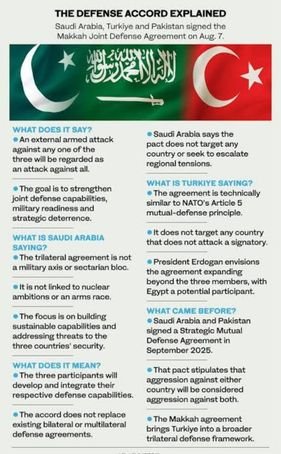
At its core, the agreement establishes a collective-defence principle under which an armed attack against one member is regarded as an attack against all. It also provides for wider cooperation in defence and security.
Islamabad has consistently characterised the arrangement as defensive, aimed at deterrence and collective self defence rather than directed against any particular state.
The Makkah framework is not the birth of a NATO-style military organisation. Nor does the agreement, on the basis of its publicly stated provisions, create an automatic military response to every attack. Its importance lies elsewhere: it has placed Pakistan within an emerging security framework that connects South Asia with the Gulf and Türkiye. For Islamabad, that is potentially a significant shift in strategic geography.
Three States, Three Sources of Power
The strength and perhaps the complexity of the Makkah arrangement lies in the fact that its members do not bring interchangeable capabilities.
Saudi Arabia represents the economic and diplomatic heavyweight. Its financial resources, energy position, geographical location and influence across the Arab and Muslim worlds give Riyadh strategic reach extending well beyond the Gulf. Its role as custodian of Islam’s two holiest sites also gives its security concerns an exceptional political and symbolic dimension.
Riyadh has simultaneously invested heavily in military modernisation, air defence and the development of a domestic defence-industrial base. Its ambition is increasingly moving beyond the purchase of sophisticated foreign weapons towards greater localisation of defence production.
Türkiye brings a different form of strategic weight. As a NATO member with a large conventional military an extensive operational experience, Ankara combines military scale with an increasingly capable indigenous defence industry. Turkish unmanned systems, missiles, armoured vehicles, naval platforms and other technologies have become instruments not merely of defence policy but of foreign policy and strategic influence.
Pakistan represents the third pillar. Its military has decades of experience in conventional operations, counter insurgency and strategic deterrence. It possesses an established defence-production ecosystem and, uniquely within the three-member framework, a nuclear arsenal designed primarily to deter strategic threats in South Asia. The significance, therefore, is not duplication but complementarity.
Saudi Arabia contributes capital, strategic geography and political influence. Türkiye contributes technology, conventional military strength and industrial expertise. Pakistan
contributes military experience, manpower, strategic deterrence and a long established security relationship with Riyadh. Whether those assets can be integrated into a functioning institutional framework, however, remains the central question. An alliance is not created merely by placing three capable states under the same political umbrella. It becomes strategically meaningful when political commitments are translated into military planning, intelligence cooperation, interoperability, industrial partnerships and mechanisms for
crisis decision-making.
Why Pakistan Matters
It would be tempting to define Pakistan’s importance to the Makkah framework primarily through its nuclear capability. Such an assessment would be both incomplete and strategically simplistic.
Pakistan’s relevance to Saudi Arabia predates the new agreement by decades. Defence cooperation between Islamabad and Riyadh stretches back to the 1960s and has included military training, advisory roles, exercises and institutional exchanges. The relationship has
survived substantial shifts in regional politics.
For Saudi Arabia, Pakistan has long represented one of the major military powers of the Muslim world, with substantial conventional capabilities and an established defence
relationship. For Pakistan, Saudi Arabia has remained an important political, economic and diplomatic partner. The Makkah agreement did not create this relationship. It form alised and expanded it within a trilateral strategic framework.
The Makkah framework introduces a different strategic dimension. Pakistan is
now part of a security arrangement linking South Asia, the Gulf and Türkiye. That
does not erase Islamabad’s existing strategic relationships. It adds another
layer to them.
Pakistan’s value lies not simply in the existence of nuclear weapons, but in the accumulated weight of its military institutions, operational experience, defence relationships and geopolitical position.
For decades, Pakistan’s strategic posture was largely interpreted through the India-Pakistan equation and through its relationships with larger powers, particularly China and the United States. The Makkah framework introduces a different strategic dimension. Pakistan is now
part of a security arrangement linking South Asia, the Gulf and Türkiye. That does not erase Islamabad’s existing strategic relationships. It adds another layer to them.
An alliance is not created merely by placing three capable states under the same political umbrella. It becomes strategically meaningful when political commitments are translated into military planning, intelligence cooperation, interoperability, industrial partnerships and mechanisms for crisis decision-making.
From Agreement to Institution
The most consequential development after the Makkah signing may ultimately prove to be institutional rather than ceremonial.
On August 31, foreign and defence ministers and senior military leadership from Pakistan, Saudi Arabia and Türkiye met in Istanbul for the inaugural meeting of the Strategic Political and Defence Committee established under the Makkah framework.
The three countries agreed to further institutionalise cooperation and establish a permanent secretariat in Saudi Arabia. The secretariat is initially to be headed by a
Pakistani secretary-general for three years. The countries also committed themselves to greater defence-industrial cooperation and joint technology development and production.
A permanent secretariat provides continuity. Regular political and military consultations can establish procedures for managing crises. Joint exercises can improve interoperability. Intelligence cooperation can strengthen threat awareness. Defence-industrial projects
can create practical interdependence. The Makkah framework is therefore beginning a transition from declaration to implementation.
The Iran Equation
No serious assessment of the Makkah framework can ignore Iran. That does not make the agreement an anti Iran alliance. Pakistan, in particular, has repeatedly emphasised its defensive character and its preference for diplomacy and de-escalation. But regional security calculations cannot be separated from geography.
If Saudi Arabia comes under attack, Pakistan could face the difficult task of balancing its obligations to Riyadh against its longstanding interest in maintaining stable relations with Tehran.
The recent Houthi attacks on southern Saudi Arabia, including strikes affecting energy infrastructure and military facilities, have brought that question into sharper focus. Pakistan has urged Iran to restrain the Houthis while reiterating its commitment to the Makkah agreement.
Saudi Arabia’s relationship with Iran remains one of the central strategic variables in Gulf security. Türkiye has its own complex relationship with Tehran. Pakistan shares a border with Iran and has consistently sought to avoid being drawn into a broader regional confrontation.
Yet on September 10, Islamabad clarified that no military response under the Makkah pact had been discussed following the attacks. Pakistan reaffirmed its commitment to the agreement while indicating that immediate military action was not under consideration. This is the first serious practical test of the framework.
It demonstrates why collective defence should not automatically be equated with automatic military escalation. An attack on one member may be regarded as an attack on all. But the response can take different forms depending on the nature of the attack, the circumstances, the political calculations of the three governments and the mechanisms available for consultation.
What Pakistan Stands to Gain
For Islamabad, the potential gains are substantial but none are automatic. The first is diplomatic. Pakistan has secured a central position in a trilateral security framework involving two major regional powers.
The second is institutional. The initial appointment of a Pakistani secretary-general gives Islamabad an opportunity to shape the framework’s early institutional culture, agenda and priorities.
The third is economic. If defence-industrial cooperation develops beyond procurement, Pakistani manufacturers, engineers and technology companies could benefit from new partnerships and investment.
The fourth is strategic. Pakistan’s military capabilities can increasingly be viewed within a broader regional security equation rather than exclusively through the India Pakistan lens.
Islamabad must ensure that the Makkah framework becomes an additional strategic instrument rather than a substitute for a coherent foreign policy. Pakistan’s geography makes that imperative. It sits at the intersection of South Asia, Central Asia, the Gulf and Iran. Its relationships with China, Saudi Arabia, Türkiye, Iran and the United States interact with one another. A gain in one relationship can create complications in another. The central diplo-matic challenge will therefore be to expand Pakistan’s strategic options without allowing those options to be-come strategic constraints
The Hauthi Attack
The recent Saudi-Houthi confrontation illustrates the fundamental question confronting the new framework: What does collective defence actually mean when one member is attacked?
The agreement provides the principle. Practice must now define its limits. Collective defence could mean diplomatic coordination, intelligence sharing, air-defence assistance, logistics, surveillance, training or maritime security.
It does not necessarily mean an immediate declaration of war. The September crisis therefore provides the three governments with an opportunity to establish through practice what the agreement means in operational terms. Pakistan’s decision not to discuss an immediate military response does not, by itself, undermine the framework.
Indeed, it highlights one of the most important distinctions in modern alliance management: credible deterrence is not the same thing as automatic escalation.
A successful security framework must deter aggression without creating a mechanism through which every regional confrontation automatically becomes a wider war.
Pakistan is now positioned within an emerging security architecture connecting South Asia with the Gulf and Türkiye. But strategic positioning is not the same as strategic power. Pakistan will have to convert its diplomatic position into durable institutions, industrial partnerships, military interoperability and credible collective deterrence.
Pakistan’s Strategic Moment
The Makkah Joint Defence Agreement should not be reduced to a formula of Saudi money, Turkish technology and Pakistani nuclear weapons. Together, those capabilities create the possibility of something more consequential than another bilateral defence agreement.
For Pakistan, the strategic implications are particularly significant. Its nuclear capability has traditionally been understood through the India-Pakistan deterrence equation. Its military diplomacy has largely been examined through bilateral relationships. The Makkah framework potentially broadens that picture.
The real measure of Pakistan’s strategic rise will therefore not be the ceremony in Makkah, nor the headlines that followed it. It will be whether Islamabad can use this new platform to enlarge its strategic choices without becoming captive to them. The Makkah agreement has created the framework. Its institutions are beginning to take shape. Its first strategic test has arrived. What follows will determine whether the agreement becomes another document in the history of regional diplomacy or the foundation of a genuinely new security architecture.