



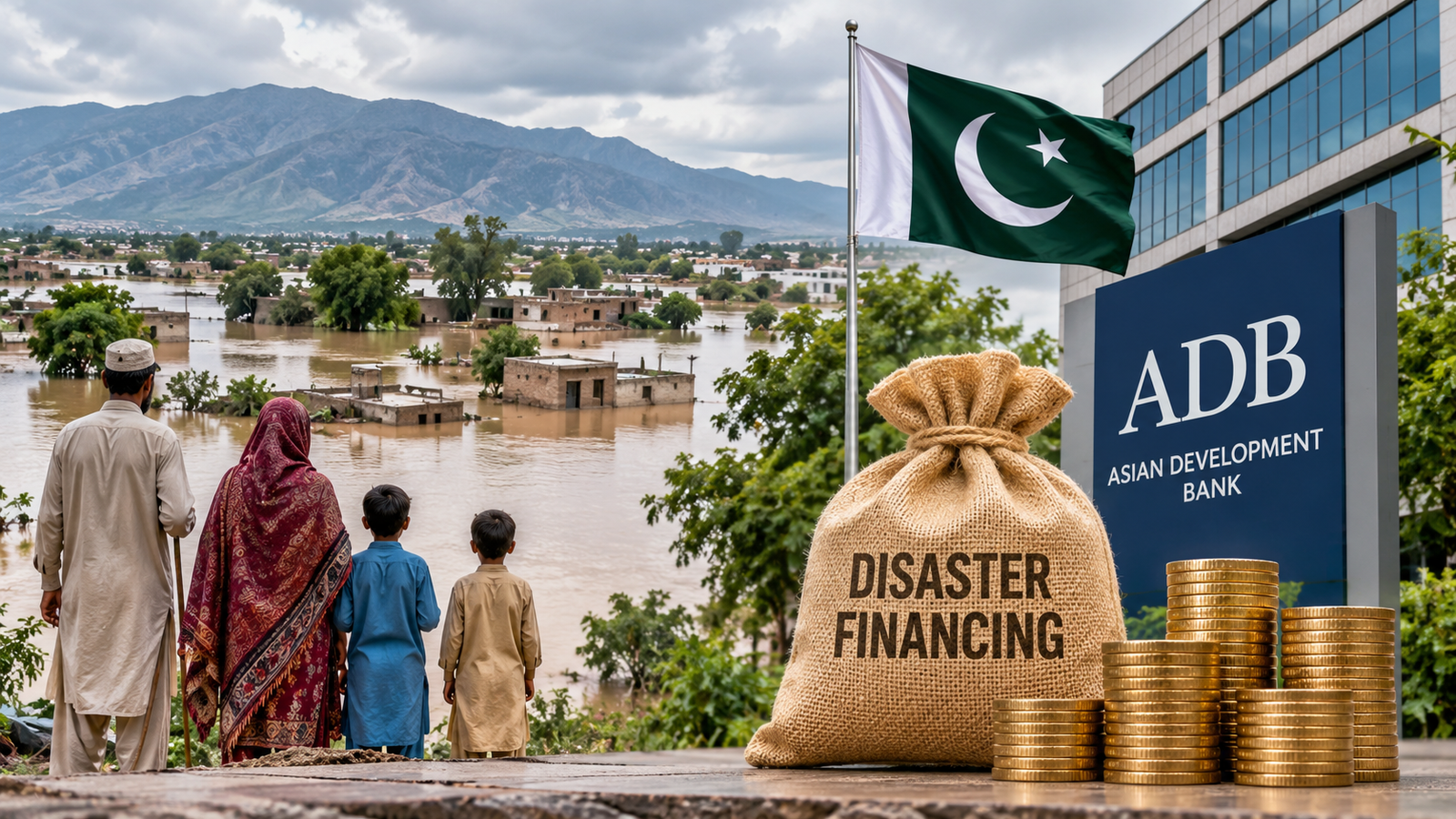
When disaster strikes, two clocks begin ticking. One measures how quickly the government can mobilise money. The other measures how long a family, farmer or shopkeeper must wait for help. For Pakistan, effective disaster financing must address both.
On 11 November 2026, the Asian Development Bank (ADB) announced the approval of $500 million in contingent disaster financing facilities for Pakistan. The financing is designed to provide prompt budget support following eligible disaster events, helping the government manage their economic and fiscal consequences. Approval establishes a financing commitment; it does not mean that funds have already been disbursed or reached affected communities.
The announcement raises a question that extends beyond the size of the package: can Pakistan translate financial preparedness into a faster, more transparent and accountable disaster response?
What is contingent disaster financing?
Contingent disaster financing is funding arranged in advance of an emergency and made accessible when specified conditions are met. In Pakistan’s case, ADB’s facilities are intended to provide budget support following eligible disaster events, including floods and earthquakes.
The $500 million package forms part of the second subprogramme of ADB’s Climate and Disaster Resilience Enhancement Programme. It comprises concessional and ordinary capital resources lending, making it a loan facility rather than grant assistance.
Its practical purpose is to help the government meet sudden expenditure requirements without having to arrange fresh financing after a disaster has already disrupted economic activity. However, financing reaching the national budget and assistance reaching an affected community are separate stages.
That distinction is essential when assessing announcements about climate resilience, flood relief and disaster recovery. Available funding is an important starting point. Its effectiveness depends on the institutional arrangements and delivery systems that follow.
Why Pakistan needs financial preparedness before disasters
Pakistan faces an estimated $2 billion in average annual losses from floods, earthquakes and other disasters, according to ADB. The 2022 floods alone caused approximately $14.9 billion in direct damage and $15.2 billion in economic losses, pushing as many as 9.1 million people into poverty.
These figures illustrate the wider economic consequences of disasters. Public expenditure rises precisely when economic activity, household incomes and government revenue are under pressure. Emergency shelter, damaged infrastructure, interrupted public services and rehabilitation compete for limited resources.
Pre-arranged financing can help narrow this immediate funding gap. It may reduce the need to divert resources from existing development programmes or negotiate additional borrowing during an emergency.
Yet financial preparedness requires more than access to money. Authorities need agreed procedures for assessing damage, establishing priorities, allocating resources and monitoring expenditure. Without these arrangements, delays can occur even after financing becomes available.
The Philippines: From standby financing to disbursement
The Philippines offers a useful comparison because its experience demonstrates how a pre-arranged financing facility can move from approval to actual release.
The World Bank approved a $500 million Disaster Risk Management and Climate Development Policy Loan with a Catastrophe Deferred Drawdown Option (Cat DDO) for the Philippines on 16 November 2023. The instrument was designed to provide rapid access to financing following qualifying disaster events.
After Typhoon Kalmaegi, locally known as Tino, struck the country on 4 November 2025, the government declared a State of National Calamity on 6 November. It subsequently requested access to the facility on 18 November, and the World Bank released the $500 million on 24 November 2025.
The sequence is significant:
- 16 November 2023: Standby financing approved.
- 6 November 2025: State of National Calamity declared.
- 18 November 2025: Government requested access to financing.
- 24 November 2025: World Bank released the funds.
The six-day interval between the government’s request and the World Bank’s release provides a useful institutional reference point. However, it measures the release of financing to the government, not the time taken to deliver assistance to individual households.
The Philippines’ Cat DDO and Pakistan’s ADB contingent disaster financing facilities are comparable in their broad objective of providing access to funds following disasters, although their activation conditions and operating arrangements are not necessarily identical.
For Pakistan, the lesson is not simply to replicate a six-day timeline. It is to establish a publicly traceable process that records when financing is requested, approved, released, allocated and ultimately spent.
What research says about disaster-response governance
An ADB working paper, Enabling Factors for Financing and Implementing Postdisaster Operations, by Junko Mochizuki, Joshua Hallwright and John Handmer, examines the governance challenges associated with disaster response, recovery and reconstruction. Drawing on case studies that include Pakistan’s 2010 floods, the research identifies two broad requirements: institutional structures and plans, including clear roles and procedures, and mutual accountability, knowledge and partnerships among the actors involved.
The findings are relevant to Pakistan’s current financing arrangements. Financial instruments cannot independently resolve uncertainty over who assesses damage, authorises expenditure or coordinates implementation. These responsibilities must be established before an emergency.
Similarly, the World Bank’s 2020 report, Options to Strengthen Disaster Risk Financing in Pakistan, explored ways to improve the country’s financial resilience to natural disasters. It emphasised the need for a comprehensive approach to accessing immediate and longer-term resources, supported by appropriate instruments and the systems required to implement them.
Together, these studies underline a central point: financing and institutional preparedness must advance together.
Three tests for Pakistan’s disaster-financing facility
1. Clear activation conditions
What constitutes an eligible disaster? Who requests access, what evidence is required, and how quickly can the process be completed? Publishing the relevant procedures would help establish expectations and make delays easier to identify.
2. Coordination across government
Federal financing must connect with provincial and district responsibilities. Damage assessments, funding decisions and implementation require clearly identified institutional responsibilities. Each stage should have an accountable decision-maker and an agreed procedure.
3. Transparent spending and measurable results
Public reporting should distinguish between financing approved, funds released, expenditure incurred and assistance delivered. These are different stages of the process and should not be treated as interchangeable measures of success.
Regular reporting on allocations, procurement, service restoration and beneficiaries would allow citizens and independent observers to assess how effectively the financing is being used.
Recovery must include businesses and informal livelihoods
Disaster recovery cannot be measured solely through the reconstruction of roads, bridges and public buildings. Small enterprises, informal workers and home-based businesses also face substantial economic disruption.
A damaged shop represents lost inventory, interrupted earnings and potentially unpaid wages. A home-based business may lose equipment without appearing in conventional assessments of commercial damage. A daily-wage worker can experience severe income losses without owning property that qualifies for reconstruction assistance.
Recovery assessments must therefore account for economic disruption alongside physical destruction. Restoring public infrastructure is essential, but people also need the means to resume earning. The effectiveness of disaster financing should include whether vulnerable households, small businesses and informal workers can rebuild their economic security.
The cost of borrowing and the value of preparedness
Unlike grant assistance, contingent disaster financing creates future repayment obligations. Its economic value must therefore be assessed against the costs of delayed intervention, prolonged disruption and more expensive recovery.
The relevant considerations include the cost of borrowing, the conditions governing access and whether timely financing can reduce the overall fiscal burden of disasters. The availability of credit is important, but its long-term value depends on how effectively it is deployed.
Pakistan’s estimated $2 billion in annual average disaster losses provides a sense of the scale of the challenge. Against this exposure, the $500 million facility represents an important financing instrument, but it cannot substitute for sustained investment in risk reduction, resilient infrastructure, preparedness and institutional capacity.
My assessment is that ADB’s approval strengthens an essential component of Pakistan’s disaster preparedness: access to financing when public expenditure pressures rise suddenly. But the availability of credit is only the beginning of an effective response.
The Philippines demonstrates the value of an established financing mechanism and a publicly traceable activation and disbursement process. Pakistan now needs to make the entire journey of funds equally transparent, from the declaration of an eligible disaster and the release of financing to provincial allocations, expenditure and assistance reaching affected communities.
Ultimately, the effectiveness of the $500 million facility should not be measured by the amount approved or even the speed at which money enters the national budget. It should be measured by how quickly essential services are restored, livelihoods recover and vulnerable households receive support. Disaster financing becomes meaningful when financial preparedness translates into security for people whose lives and incomes are disrupted by the next emergency.