



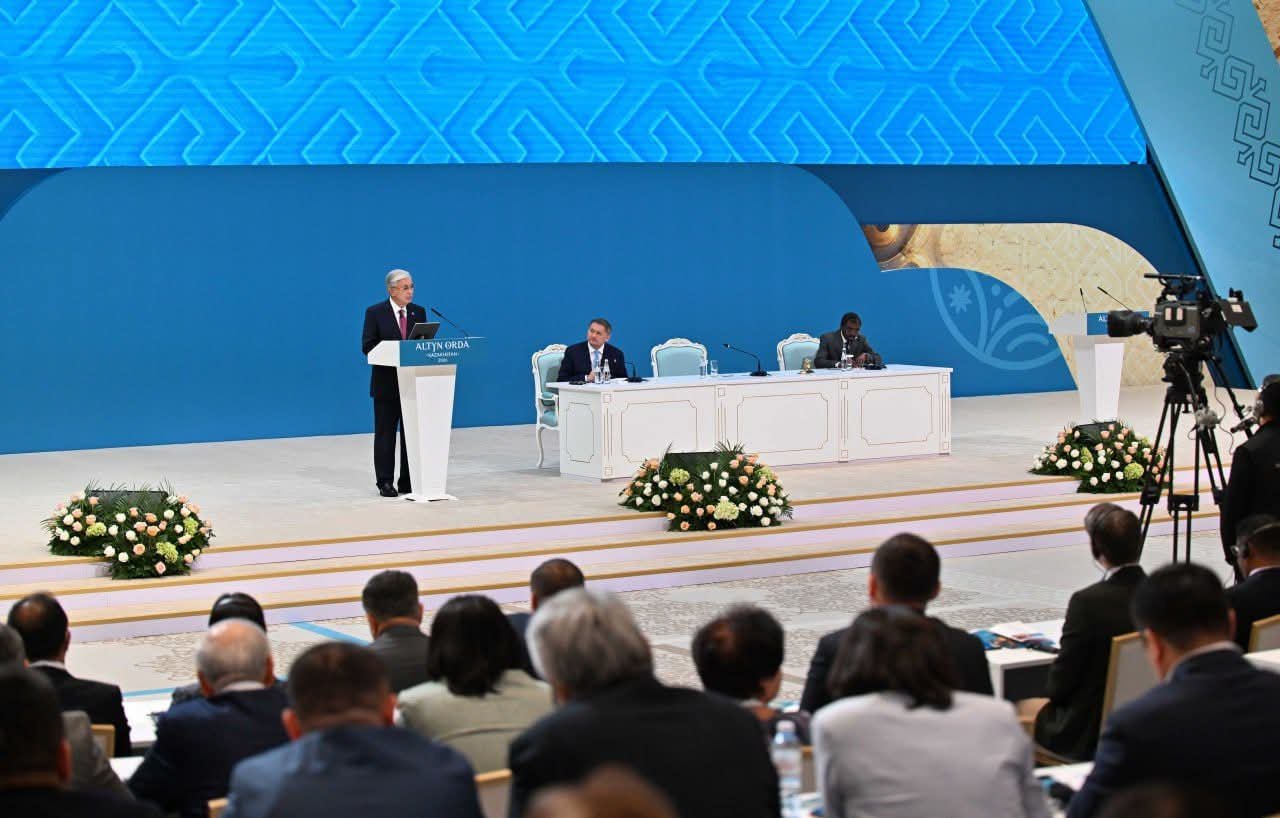
Kazakh President Tokayev addressed the opening ceremony of the symposium in Astana
An international symposium entitled “The Golden Horde as a Model of Steppe Civilization: History, Archaeology, Culture and Identity” is taking place in Astana.
Astana – 20 May 2026 (MT Team) : Kassym-Jomart Tokayev, President of the Republic of Kazakhstan, addressed the opening ceremony of the symposium.
Delegations from more than 20 countries are participating in the event, including historians, archaeologists, orientalists, Turkologists, Mongolists, numismatists, epigraphists, political scientists, cultural experts, art historians, diplomats, and representatives of international organizations.
⚡️Head of State: “The history of the Golden Horde has become the subject of numerous in-depth studies”
“I am pleased to welcome you to the international symposium dedicated to the history of the Golden Horde.
First and foremost, I would like to express my sincere gratitude to all the guests who have arrived in Astana to participate in today’s event. I would also like to thank the speakers who have just addressed the forum, distinguished scholars and representatives of authoritative international organizations, for their substantive presentations.
Today, no historian questions the power of the Golden Horde – an empire that ruled the Great Steppe and stretched across the vast expanses of Eurasia. This is a historical fact.
The empire, which connected East and West and exerted a significant influence on the development of various civilizations and the formation of states, was the largest political structure of its time, and this too is beyond dispute.
That is why the history of the Golden Horde has become the subject of numerous profound studies. This topic remains highly relevant today and, in my view, will never lose its significance.”
⚡️H. E. Mr. Kassym-Jomart Tokayev expressed gratitude to the leadership of UNESCO for supporting Kazakhstan’s initiative
“This represents one of the most important chapters in the history of our country and of humanity as a whole.
The main objective of the symposium, which will continue over the next several days, is to strengthen ties with the global academic community for a systematic, comprehensive, and multidimensional analysis of this issue.
In this regard, I would like to express my deep appreciation to the leadership of UNESCO for supporting the initiative of our country.
I also extend my gratitude to the former Director-General of UNESCO, Ms. Audrey Azoulay, who is attending today’s forum. We highly value your significant contribution to strengthening cooperation between Kazakhstan and UNESCO.
Holding this event under the auspices of such an authoritative international organization underscores the global historical importance of the Golden Horde’s heritage.
Today’s symposium is also attended by a delegation headed by the high-ranking UNESCO representative, Director of the World Heritage Centre, Mr. Lazare Eloundou Assomo.
Thanks to the support of the Organization, our country has implemented many important initiatives. A vivid result of this cooperation has been the inclusion in the UNESCO World Heritage List of such landmark sites as the Mausoleum of Khoja Ahmed Yasawi, the Tamgaly petroglyphs, and a number of ancient settlements.
Extensive work has also been carried out to preserve and promote Kazakhstan’s intangible cultural heritage.
For example, one of the important events of 2025 was the international recognition of the unique manuscript ‘Genealogy of the Khans’. This valuable document contains information about the rulers of the country, including the period of the Golden Horde.
Therefore, we are interested in further expanding our partnership, which serves our common interests and carries great significance.”
⚡️President: “The chronicle of the Golden Horde is part of the shared history of humanity”
“It is important that this symposium has brought together various schools of research specializing in the history of the Golden Horde and the Great Steppe.
It is fair to note here the role of Russian scholars, who for many years have productively studied this vast subject and have succeeded in building an extensive body of academic works that provide broad knowledge about the Golden Horde.
At the same time, the subject of the Golden Horde has gone beyond the boundaries of a single state and has attracted the attention of researchers from China, Mongolia, the United States, India, Pakistan, Japan, Kyrgyzstan, Uzbekistan, Egypt, and a number of European countries. One may say that this topic is confidently advancing across the globe.
Ultimately, the chronicle of the Golden Horde is part of the shared history of humanity.
I am confident that today’s unique symposium will give new impetus to the systematic study of world heritage.
The scholars and experts gathered here are making a significant contribution to achieving this noble goal.
I sincerely believe that your work will yield meaningful results that will enrich our common history and scholarship.”
⚡️H. E. Mr. Kassym-Jomart Tokayev: “In Kazakhstan, the history of the Golden Horde is viewed as a complex and multidimensional period in world history”
“This circumstance should by no means be simplified, as doing so would inevitably lead to a linear interpretation of this unique phenomenon in world history. Such an approach may result in historical distortions that, in turn, could undermine good relations between states and peoples.
Unfortunately, we are already witnessing similar cases related to differing interpretations of major historical events of global importance.
In today’s highly complex and tense geopolitical environment, it is important to be able to identify in the history of humanity convincing and inspiring examples of peacebuilding and the creation of platforms for dialogue, rather than focusing exclusively on the dark chronology of wars.
I understand that this is not an easy task, because the entire chronicle of world history, from ancient times to the present day, abounds in detailed descriptions of wars and armed conflicts.
The reason for this phenomenon is quite understandable: wars, with their inexhaustible confrontational potential, were much easier to describe than the monotonous processes of creation and development during peaceful life.
Incidentally, Leo Tolstoy’s famous novel ‘War and Peace’ is a phenomenal and fundamental depiction more of war than of peace.
Yet it is precisely now, when the international community has arrived at a historical crossroads and faces a civilizational choice, that it is critically important to unite the efforts of authoritative and professional scholars in order to present our common history as a factor of unity among peoples.”
⚡️Head of State: “The principle that ‘history is made only by the strong and written by the victors’ is anti-scientific in nature”
“It is important to understand that historical assessment must be absolutely objective and politically neutral.
The principle that ‘history is made only by the strong and written by the victors’ must be acknowledged as anti-scientific in nature: if victors are never judged, then they are also destined to occupy the most honorable place in world history, where all complimentary assessments by researchers converge.
Meanwhile, small and medium-sized countries, especially those that suffered defeats on the battlefield in the past, are left with the role of historical ‘backbenchers’.
In Kazakhstan, a rather active process has begun to revise outdated dogmas and stereotypes which, in pursuit of political ambitions, reduce once-powerful steppe empires to the status of so-called ‘quasi-states’ and even portray nomadic peoples as a wild and spontaneous force existing outside the historical context.
At the same time, while restoring an objective historical picture, we are far from blindly idealizing the past.
History neither tolerates nor forgives falsehood for the sake of self-glorification, just as it rejects attempts to transform shared heritage into an exclusively national phenomenon.
Claims to a monopoly in interpreting our rich past, with all its contradictions and complexities, represent a dead-end path leading to the degradation of scholarship and the growth of mutual distrust.
Meanwhile, within the professional community of historians there are undoubtedly representatives of effective ‘soft power’ and scientific diplomacy who are capable of building bridges where politicians may erect only walls.
Their mission is especially important in today’s turbulent times.”
⚡️President: “For Kazakhstan, the era of the Golden Horde is a crucial part of national history and a period of civilizational evolution”
“As I have already noted, in the historical memory of most peoples, the military campaigns of rulers and gifted commanders have been preserved more vividly than the painstaking work of reformers and outstanding thinkers.
Indeed, legendary military victories tend to evoke stronger emotional reactions than institutional innovations and progressive ideas, the historic significance of which often becomes fully apparent and properly appreciated only after a considerable period of time.
A vivid example of this is the distorted perception of the history of the Great Steppe, which is still often viewed merely as an endless sequence of battles and wars.
Such a one-dimensional approach significantly simplifies and distorts historical reality, forcing the complex and multilayered existence of the Great Steppe, especially the Golden Horde, into the ‘Procrustean bed’ of a banalміндет емес.