


Explore how Pakistani comic artists are shaping public trust in digital health through satire and storytelling.
Pakistan is rapidly moving toward a digital healthcare future, one defined by artificial intelligence, telemedicine, and data-driven systems. AI promises faster diagnoses. Mobile applications claim to bring doctors into our homes. Paper files are steadily giving way to electronic health records. In policy discourse, the language is confident: efficiency, innovation, transformation.
All of this appears not only promising, but inevitable. Yet beneath this technological momentum lies a quieter, more consequential question: do people trust these changes?
Because the success of digital health depends not on the sophistication of systems, but on whether people trust and adopt them. However advanced the algorithm, however seamless the interface, public confidence remains the decisive factor.
To understand where that trust truly lies, we may need to look beyond policy briefings and technology expos, to more unexpected, everyday spaces. Increasingly, it surfaces in the comic strips and satirical visuals circulating across social media. In Pakistan, cartoons have long done more than make us laugh. They have helped us think.
When Technology Meets Culture
Digital health is often framed as a story of infrastructure faster servers, smarter software, data driven governance. But for citizens, it is a story of lived experience.
Is this app easy to use?
Will my personal data remain secure?
Will technology replace my doctor?
What happens if the system fails?
These are not technical questions. They are questions of trust. And in Pakistan, trust is shaped as much by culture and lived experience as by policy design. Within the country’s dynamic media landscape, cultural negotiation frequently unfolds through satire.
Artists such as Nigar Nazar, Javed Akhtar, and Shahid Mehmood have built enduring careers by translating complex political and social realities into visual narratives. Their work reminds us that public opinion is not shaped by official statements alone, it is also constructed through humor, imagery, and shared recognition. Digital health stops being abstract when it enters their frames. It becomes human.
When Technology Meets Culture
Comics are often underestimated, dismissed as light entertainment or casual commentary. Yet in societies undergoing rapid transformation, satire becomes a powerful analytical tool. Take the legacy of Nigar Nazar. Through character driven storytelling, she has addressed education, gend-er equality, and social reform with remarkable clarity. Her work simplifies complexity without diminishing seriousness it is, in many ways, a form of public pedagogy.
Similarly, Javed Akhtar and Shahid Mehmood have mastered the art of visual compression, distilling systemic dysfunction into a single frame: a dimly lit hospital corridor, a confused bureaucrat navigating a malfunctioning digital interface, a patient overwhelmed by endless app notifications.
In one panel, an entire policy debate unfolds. This is precisely what makes comics uniquely suited to interpreting digital health. Artificial intelligence, data infrastructures, and telemedicine platforms are largely invisible systems. Most citizens cannot see algorithms at work or examine backend systems. But they can interpret symbols. They can understand humor. They can recognize irony. Comics translate the invisible into the visible and the complex into the comprehensible.
Humor as a Bridge Between Fear and Understanding
Artificial intelligence in healthcare evokes both fascination and unease. The idea that a machine can assist in diagnosis raises legitimate concerns about reliability, bias, and accountability. Formal reports offer reassurance through data and projections. A comic, by contrast, may depict a robot hesitating before confirming a diagnosis quietly consulting a human doctor in the background.
Public health strategies often emphasize the dissemination of information. But awareness is not merely about knowledge, it is about belief.
We laugh. But that laughter performs an important cognitive function. It reduces anxiety. It makes unfamiliar systems approachable. It allows individuals to process technological change without feeling overwhelmed. More importantly, humor exposes contradictions.
Telemedicine promises access for remote populations. Yet a cartoon may show a patient climbing onto a rooftop, struggling to find a stable signal before connecting to an online consultation. The exaggeration reveals infrastructural gaps that glossy policy narratives often overlook. Satire is not cynicism. It is reflection.
The Digital Divide Behind the Screen
One of the most persistent themes in digital service satire is the digital divide. While Pakistan’s urban centers increasingly embrace high-speed connectivity, vast segments of the population continue to face unstable networks, limited digital literacy, and restricted access to devices.
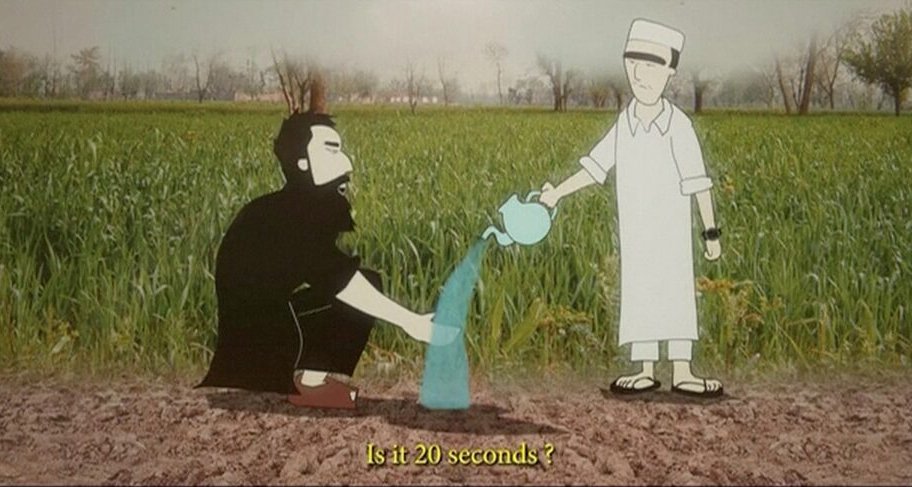
A comic portraying an elderly patient staring helplessly at a complicated health app is humorous but it is also deeply empathetic. It asks a critical question: who are these systems really designed for? Digital health transformation cannot assume a uniform user base. It must contend with linguistic diversity, generational differences, and educational disparities. Comics surface these tensions without requiring lengthy academic explanation. In doing so, they democra-tize critique.
Language, Identity, and Trust
Pakistani comics often weave Urdu and English seamlessly within the same dialogue. Technical terminology appears in English digital records, AI systems, and online portals while emotional reactions and punchlines unfold in Urdu. This linguistic hybridity reflects lived reality.
English signals institutional authority and global connectivity. Urdu conveys cultural nuance and emotional depth. When both coexist within a single frame, they capture the negotiation between global technological narratives and local experience. Digital health, therefore, is not simply imported innovation. It is interpreted through language, identity, and cultural context. And trust grows when communication feels familiar.
Beyond Information: The Question of Belief
Public health strategies often emphasize the dissemination of information. But awareness is not merely about knowledge, it is about belief. A citizen may understand that telemedicine exists. But do they believe it is reliable? Do they feel comfortable using it? Do they trust the institutions managing their data? Comics engage these deeper layers of perception.
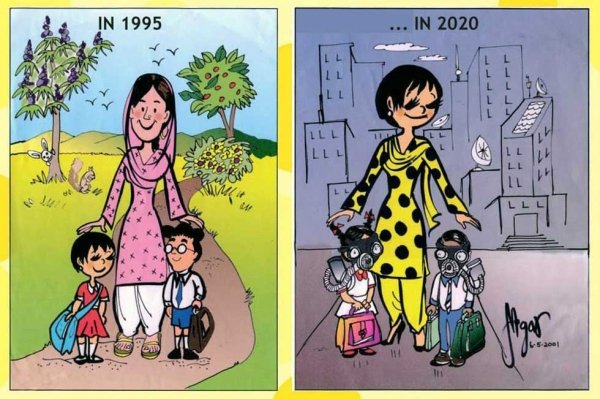
When Shahid Mehmood sketches bureaucratic inefficiencies disrupting digital reform, he highlights the gap between policy ambition and operational reality. When Javed Akhtar illustrates institutional irony, he invites audiences to question power structures. When Nigar Nazar employs narrat-ive storytelling, she demonstrates how education can emerge through cultural expression. These artists, in many ways, function as informal public educators teaching audiences how to think critically about change.
What Policymakers Might Be Missing
Digital transformation strategies tend to prioritize infrastructure, procurement, and capacity building. These are essential but they are not sufficient. Globally, digital health initiatives have repeatedly shown that technological readiness does not guarantee public adoption. Trust deficits remain one of the most significant barriers. If people fear data misuse, they will hesitate to register. If platforms feel inaccessible, they will go unused. If systems appear opaque, skepticism will persist.
Comics, in this context, act as early-warning systems. They reveal where frustration accumulates, where messaging fails, and where public sentiment begins to shift. Rather than dismissing satire as negativity, policymakers could treat it as feedback.
Imagine digital health campaigns developed in collaboration with respected comic artists. Imagine visual storytelling that explains data protection, clarifies the role of AI, and illustrates the benefits of telemedicine in ways that resonate culturally. Communication that respects cultural forms builds stronger trust.
Who Shapes the Narrative?
Every technological transformation is also a contest of narratives. Who defines what digital health means? Is it framed solely as progress? Or is there space to question, critique, and reshape it?
In Pakistan, comic artists ensure that this narrative is not monopolized. Their work creates space for dialogue. A society that can laugh at its reforms is also capable of refining them. And perhaps that is the enduring value of satire, it keeps systems accountable.
From Innovation to Imagination
Digital health transformation is often described as modernization. But modernization is not merely technical advancement it is cultural adaptation. Trust cannot be installed like software. It must be cultivated through transparency, accessibility, and meaningful engagement.
Comics contribute to that process. They make the abstract tangible. They make systems relatable. They make change discussable. In an era of information overload, a single well-crafted panel can cut through complexity with clarity.
Perhaps it is time we recognize that Pakistan’s comic artists are performing essential intellectual work translating the language of algorithms into the language of everyday life.
Because the future of healthcare will not depend solely on code or connectivity. It will depend on whether citizens feel seen, heard, and respected within the transformation. And sometimes, that respect begins with something deceptively simple: A drawing that makes us laugh and then quietly asks whether we are ready to trust the future we are building.
The writer can be reached at sehrish.aslam@s3h.nust.edu.pk