



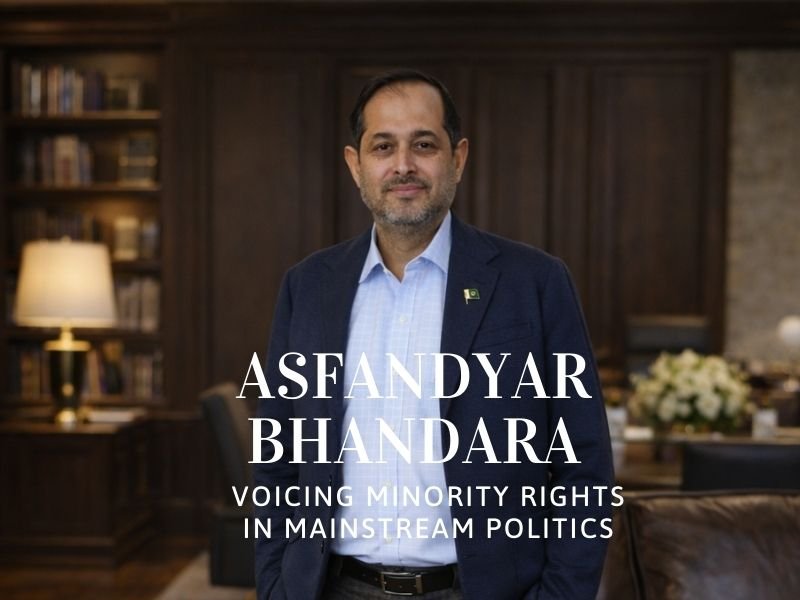
Asfandyar Bhandara occupies a rare intersection of enterprise, public service, and minority representation in the Parliment of Pakistan. As Chief Executive Officer of Murree Brewery Company, one of the subcontinent’s oldest public limited companies, he oversees a historic institution that has navigated colonial rule, inde-pendence, and modern market transitions, balancing continuity with adaptation. His leadership reflects a broader understanding of stew-ardship in an evolving economy.
Beyond business, Mr. Bhandara plays a prominent civic and legislative role.
As President of the Rawalpindi Parsi Anjuman, he rep-resents a community whose contri-butions to Pakistan’s social and economic fabric are significant yet often understated. In Parliament, his work spans the Standing Committees on Defence, Maritime Affairs, and Foreign Affairs, alongside the Parliamentary Minorities Caucus, underscoring a wide-ranging policy engagement.
Together, these roles frame an approach to leadership that is national in outlook, inclusive in spirit, and attentive to governance, security, and minority rights, an approach explored in this exclusive Margalla Tribune interview.
MT: You have inherited a large, generational business empire. What is your leadership philosophy?
Senator: Leadership, in my view, comes through example. It is shaped by the ethos your elders instill in you and you are fortunate if you are able to absorb and uphold those values. For me, the fundamentals are simple: hard work, conducting business transparently in every sphere and remaining strictly above board. At Murree Brewery, one of our guiding principles is to say no to corruption, always. These are the core values that guide how we run our organization.
MT:Are Pakistan’s policies truly unfriendly to growth, based on your experience in both business and policymaking?
Senator: Unfortunately, that assessment is accurate. Pakistan has some of the highest utility costs in Asia, particularly electricity and gas. A few years ago, around three to three-and-a-half years back, we were unable to open Letters of Credit due to pressure on the national exchequer and critically low foreign reserves. Inflation has severely impacted raw material costs, while the depreciation of the rupee against the dollar has added another layer of difficulty.
A newer and deeply troubling challenge is the culture of blocking roads. Over the past 10 to 15 years, this has become increasingly common. In a single calendar year, businesses lose anywhere between 10 to 20 working days due to protests, dharnas, political demonstrations, farmers’ protests, or even international summits. For example, during an FCO summit in Islamabad, we were instructed to shut down operations for three days.
Security concerns are understandable, but shutting down entire cities, or threatening to shut down the country on a particular date, is unacceptable. Pakistan is not a shop where you simply pull down the shutter. No political party, religious group, sect, or movement has the right to paralyze the national economy, even for a single day. When major road like, Faizabad is blocked, the economies of two major cities collapse. When Karachi’s port is shut, the entire country comes to a standstill.
While genuine grievances may exist, turning road blockages into a routine tactic is a dangerous and unacceptable trend. This culture of protest-driven economic paralysis is new and deeply damaging.
MT:When and why did you enter politics?
Asfandyar: Politics was part of my upbringing. My father was deeply involved in politics and served as a minister during General Zia-ul-Haq’s era, and later as an MNA during General Musharraf’s time. From a young age, I was involved in hosting and receiving politicians.
Because of this exposure, I felt it was my duty to contribute to the country, particularly in advocating for minority rights. In 2012, I joined the Pakistan Muslim League (N). I want to state this clearly: I paid zero rupees to join any political party. My entry into politics was based purely on my father’s goodwill and reputation, built over decades of public service under leaders such as Zia-ul-Haq and Nawaz Sharif.
It would be deeply embarrassing for me to buy my way into the National Assembly. I entered on merit, through my family’s name and service record and I am proud of that.
How do you approach inclusion and diversity as an employer?
Senator: I fully support inclusion and diversity. However, Murree Brewery is a blue-collar, factory-based operation. Due to the nature of the work, we employ very few women, currently three. These women were hired under special circumstances after their parents passed away while on duty and they had no male family support.
In terms of minorities, we employ approximately 30–35 individuals from the Christian community, two from the Hindu community and one senior executive from the Parsi community. That said, around 99% of our workforce is Muslim. In business, merit must come first. Faith is the last thing on my mind during recruitment. I will never hire someone simply because they belong to a minority if they do not meet the job requirements. Merit must prevail.
MT:How do you see the future of the Parsi community in Pakistan, given its historic economic role and declining population?
Senator: Frankly, I do not see the future as promising. The term “dwindled” is an understatement. Today, we have only around 700–800 Parsis left in Pakistan. Of these, nearly 70–80% are over the age of 60. The younger generation, those in their 30s and 40s, makes up no more than 5% and many of them are actively trying to leave.
..At the time of Partition, there were roughly 30,000–40,000 Parsis in Pakistan. By 2026, we are down to a few hundred.”
Parsis are inherently peace-loving and deeply uncomfortable with violence, intolerance and fraud. Over the past 20–25 years, rising intolerance has driven many away. Even Muslims of different sects face persecution, so minorities face even greater risks. Historically, Parsis were financially stable, which made emigration easier. I cannot blame them; everyone prioritizes their family’s safety.
MT: You supported the authoring of a book on minorities titled Gems and Jewels. What is its central message?
Asfandyar: The title, “Gems and Jewels” was coined by Mian Abbas Sharif. It reflects the idea that minorities are the “gems and jewels” of Pakistan. Diversity is what makes a society beautiful, like a bouquet of different flowers. A single color, a single creed, or a single belief system lacks richness The book emphasizes that Pakistan’s diversity, religious, cultural and sectarian, is its true strength, yet it is something we have failed to embrace.
MT: Will the National Commission on Minorities help improve tolerance and minority rights?
Asfandyar: We often believe that appointing a leader, minister, or commission will solve everything. That is a misconception. Change must begin at home and in schools. Respect for minorities is taught by parents and teachers, not by commissions.
The laws already exist. Minority protections are enshrined in the Constit-ution and Penal Code. The real problem lies in mindset and education. Children are taught, sometimes explicitly, that non-Muslims are enemies. I have heard educated individuals describe domestic workers as “slaves.” Such thinking is horrifying. No government, prime minister, or MNA can fix this unless societal attitudes change at the grassroots level.
MT: If the laws exist, what is the flaw in our policies regarding minorities?
Senator: The flaw is not in policy, it is in implementation and education. You can create commissions, reserve seats, or pass resolutions, but nothing will change unless people develop respect, tolerance and acceptance. Humanity is disappearing. We are obsessed with labeling others and deciding who goes to heaven or hell.
The curriculum must be revisited, but beyond that, basic human values must be restored, starting at home.
MT: Do initiatives like Sikh religious tourism show that positive change is possible?
Senator: Absolutely. Sikh tourism has improved Pakistan’s image and generated revenue. Sikh visitors are welcomed warmly by ordinary citizens. This proves that acceptance is possible if we choose it.
There are 57 Muslim-majority countries in the world. In most of them, minorities are not even a topic of debate. Pakistan stands out negatively due to false blasphemy Gems and Jewels: The Religions of Pakistan, highlights the country’s rich supported by Muree Berwree accusations, mob justice and vigilantism. These cases are overwhelmingly concentrated here. Blasphemy allega-tions are often used for personal vendettas, property disputes, or jealousy. In Pakistan, people become judge, jury and executioner, on the spot.
MT: You are known for your interest in vintage cars. What draws you towards this passion?
Senator: I love antique cars, particularly vintage Mercedes-Benz models. I grew up in the 1980s, a time when we lived outdoors, not on screens. Collecting vintage cars gives me joy and serves as an emotional outlet amid life’s stresses.
MT: As an employer, what do you look for in young people and what advice would you give aspiring entrepreneurs?
Senator: Discipline comes first: waking up on time, eating on time, sleeping on time, managing studies and sports properly. Time management is the most important skill, followed by persistence.
Young people must understand that interviews are not red-carpet events. Tough questions are part of the process. Today’s youth is overly sensitive and retreats into a shell when criticized. They need thicker skin and greater resilience.
There are no shortcuts to success. In developed countries, becoming a professional takes years of hard work. Do not expect the government to fix your life, that is a losing mindset. Hard work, discipline and integrity remain the only real path forward.