



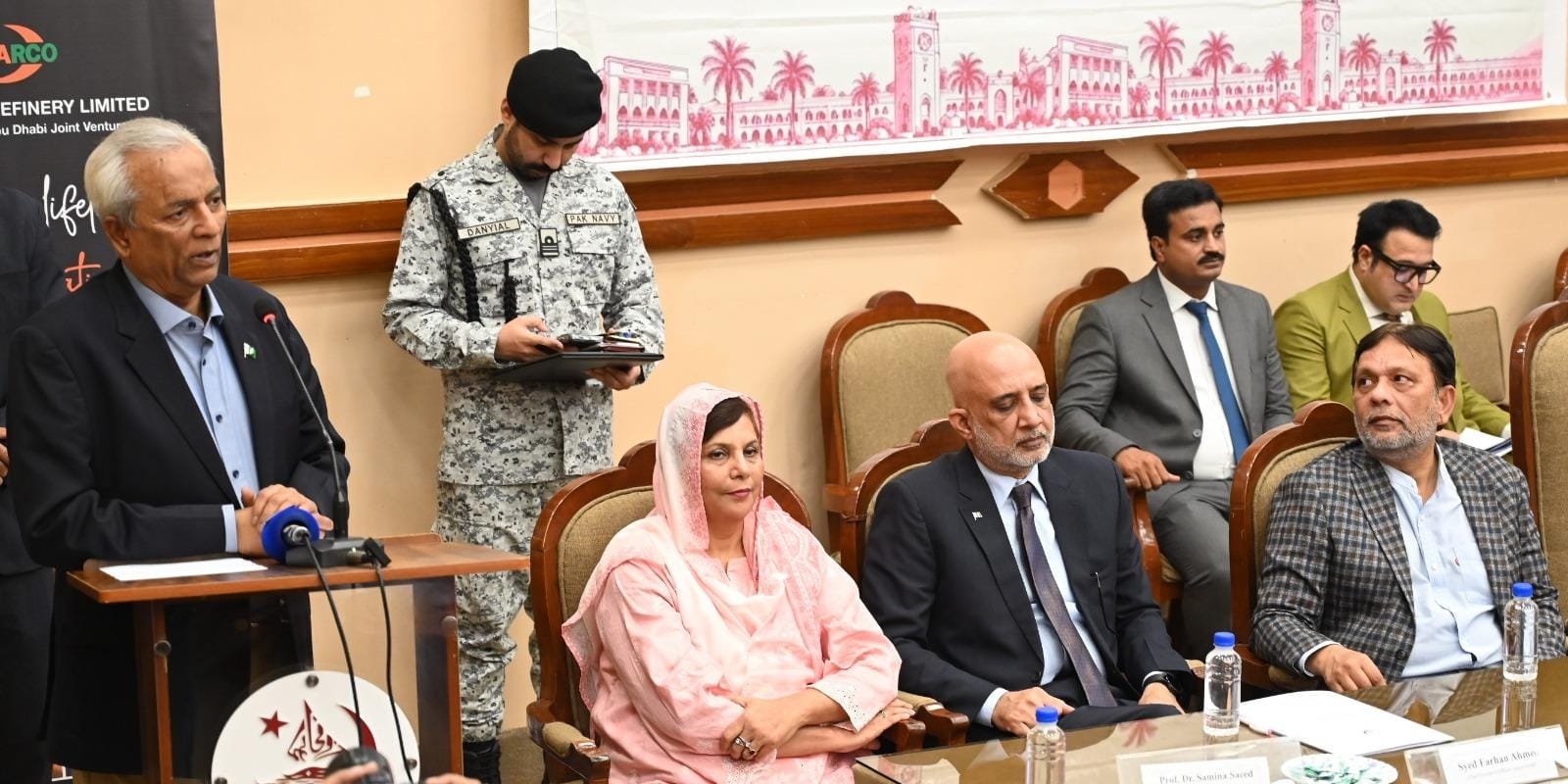
Governor Sindh Urges Youth to Lead Pakistan Towards Technological Self-Reliance
Karachi University Conference Calls for Responsible AI Use and Research-Driven National Development
Karachi – 30 October 2026 (MT Team) : The Governor Sindh Syed Nihal Hashmi stated that in order to set Pakistan on the course of self‑reliance in research, innovation, and modern technology, it is essential to foster the creative abilities of the youth and to provide them with a conducive environment for inventions.
He emphasized that instead of relying on the technology of others, we must focus on our own research and inventions so that Pakistani youth can prove their abilities at the global level. He expressed hope that the students of the University of Karachi will secure a distinguished position in the field of technology.
He mentioned that Pakistan possesses immense potential in the fields of innovation, research, and technology. We must abandon the notion that modern inventions can only be made by countries such as Japan, India, or Russia. Pakistani youth, too, can introduce the world to modern scientific and technological inventions through their abilities, creative thinking, and research—provided they are given appropriate opportunities, resources, and patronage.
He was addressing the closing session of the two day long international conference on ‘reimagining society in the 21st century: technology, innovation and sustainable transformation’, held at the KU’s Chinese Teachers’ Memorial Auditorium on Thursday. The event was organized by the Office of KU’s Dean of Arts and Social Sciences in collaboration with the KU’s Office of Research, Innovation and Research.
He said that success in the Marka-e-Haq (the Battle of Truth), and the vision and farsighted strategy of Field Marshal Hafiz Asim Munir, have enhanced Pakistan’s recognition at the international level. According to him, Pakistan’s effective diplomatic role and its active participation in global affairs are highlighting the country’s international importance.
Governor Sindh Nihal Hashmi remarked that the creation of Pakistan was not the result of force but of a long political, constitutional, and democratic struggle. The Father of the Nation, Quaid‑e‑Azam Mohammad Ali Jinnah initially endeavored to promote Hindu‑Muslim unity, coexistence, and peaceful struggle, and later, by leading a constitutional struggle for the protection of the political rights of the Muslims of the subcontinent, achieved the goal of establishing an independent homeland.
He expressed concern that at times the unhelpful attitude of teachers and supervisors in educational institutions becomes an obstacle to the development of students’ creative abilities. He stressed that teachers should encourage, guide, and mentor students, while also assisting them in giving practical shape to their innovations and in securing legal protection, particularly patents. According to him, a teacher should work for the success and progress of students with the same sincerity with which parents wish to see their children advance.
Speaking about the development and future of the University of Karachi, Syed Nihal Hashmi said that he has full confidence in the KU Vice Chancellor Dr Wasim Qazi, believing that he will play an effective role in once again placing the university among the world’s distinguished institutions and in restoring its rightful status. He said that Dr Wasim Qazi has the capability to lead the University of Karachi towards new milestones of progress. He hoped that the University of Karachi will once again become the first choice of international students, and the youth will bring honor to the country through technology and research.
The Governor of Sindh said that Artificial Intelligence (AI) is an important means of access to knowledge and research in the modern era, from which students should benefit fully. However, instead of relying completely on AI, it is necessary to employ one’s own intellect, understanding, wisdom, and critical thinking.
He said that human intellect and creative abilities are invaluable blessings bestowed by Allah Almighty, for which there is no substitute. Research, inquiry, and the pursuit of knowledge are an important part of our intellectual and religious tradition. Therefore, students should make technology an aid in their academic and research activities, rather than becoming subservient to it.
The Governor Sindh Syed Nihal Hashmi concluded by saying that, in the light of Quaid‑e‑Azam Mohammad Ali Jinnah’s democratic, peaceful, and progressive ideas, it is the need of the hour to build a society that not only paves the way for national development and self‑reliance but also plays an effective role in promoting global peace, mutual respect, and coexistence.”
On this occasion, the KU VC Professor Dr Wasim Qazi stated that in order to align with the demands of the digital age, it is essential to train students in the effective, positive, and responsible use of modern technology and artificial intelligence. He said that the responsibility of universities should not remain confined merely to the provision of knowledge; rather, it is necessary to link research and knowledge with the resolution of social problems, public welfare, and national development.
He emphasized that in addressing issues such as poverty, lack of access to clean water, basic health facilities, and the future of youth, universities, teachers, and students must play an effective role. He noted that the ongoing research activities at the University of Karachi in fields such as food technology, agricultural technology, and biotechnology are aligned with national needs. He advised that their results must be practically utilized to bring improvements in the lives of the people.
The KU VC Professor Dr Wasim Qazi stressed that universities should instill social awareness, a sense of responsibility, and the spirit of service in students, so that they may contribute to the formation of a developed, just, and welfare‑oriented society in accordance with the vision of Quaid‑e‑Azam Mohammad Ali Jinnah.
He informed that the University of Karachi is organizing academic and research activities in connection with the celebration of its 75th anniversary, as well as 150th birthday anniversary of the Father of the Nation, Quaid-e-Azam M. A. Jinnah, which include various programs by the Pakistan Studies Centre from August to December. The concluding ceremony of these activities will be held on December 14, with the objective of promoting scholarly dialogue on national history, Pakistan’s ideological identity, and the country’s development.
The KU VC Professor Dr Wasim Qazi mentioned that the University of Karachi is also preparing to celebrate its 75th anniversary in the second week of December.
The former Chairman of the KU’s Department of International Relations and expert on international affairs, Professor Dr Sikandar Mehdi said that students, especially young teachers, must give fundamental importance to critical thinking and intellectual insight in the use of AI.
He said that completing assignments and research papers merely by copying and pasting may appear to be a way of securing good marks, but in reality, it causes the greatest harm to the student himself. “This practice damages the habit of hard work, creative abilities, and intellectual growth, while also depriving a person of the opportunity to employ his true potential.”
Dr Sikandar Mehdi, while mentioning the positive aspects of artificial intelligence, said that one important benefit of this technology is that access to books, scholarly material, and research information has become relatively easier. In societies where it is not possible for every individual to purchase expensive books, artificial intelligence can provide new opportunities for acquiring knowledge and conducting research.
He emphasized that critical thinking is indispensable for understanding the present complex global situation and for effectively facing the challenges ahead. Students and young teachers should undertake comparative studies of different societies of the world, their experiences, and their ways of thinking in relation to the conditions of their own society, so that better comprehension and understanding may be developed and effective strategies may be adopted for solving problems.
The Special Assistant to CM on Information Technology Ali Rashid urged students to always keep their thinking positive and to make full use of modern technology.
He said that the positive or negative use of social media depends on our own thinking and behavior. The correct and effective use of technology can provide students with new opportunities for knowledge, research, and development.
He further said that in order to align with the demands of the present era, merely obtaining an academic degree is not sufficient; rather, acquiring practical and professional skills is also indispensable for students.”
Earlier, the CEO Aegis Group Syed Farhan Ahmed, General Secretary, Oil Companies Advisory Council, Dr Nazir Abbas Zaidi, and others also spoke on the occasion.