



Russia Terms Ukraine Conflict an Indirect War with West, Ambassador Khorev
Zaporozhye Nuclear Plant and Druzhba Pipeline at Center of Russia-Ukraine Tensions
Russian Ambassador Albert P. Khorev Criticizes European Initiatives on Ukraine Reparations
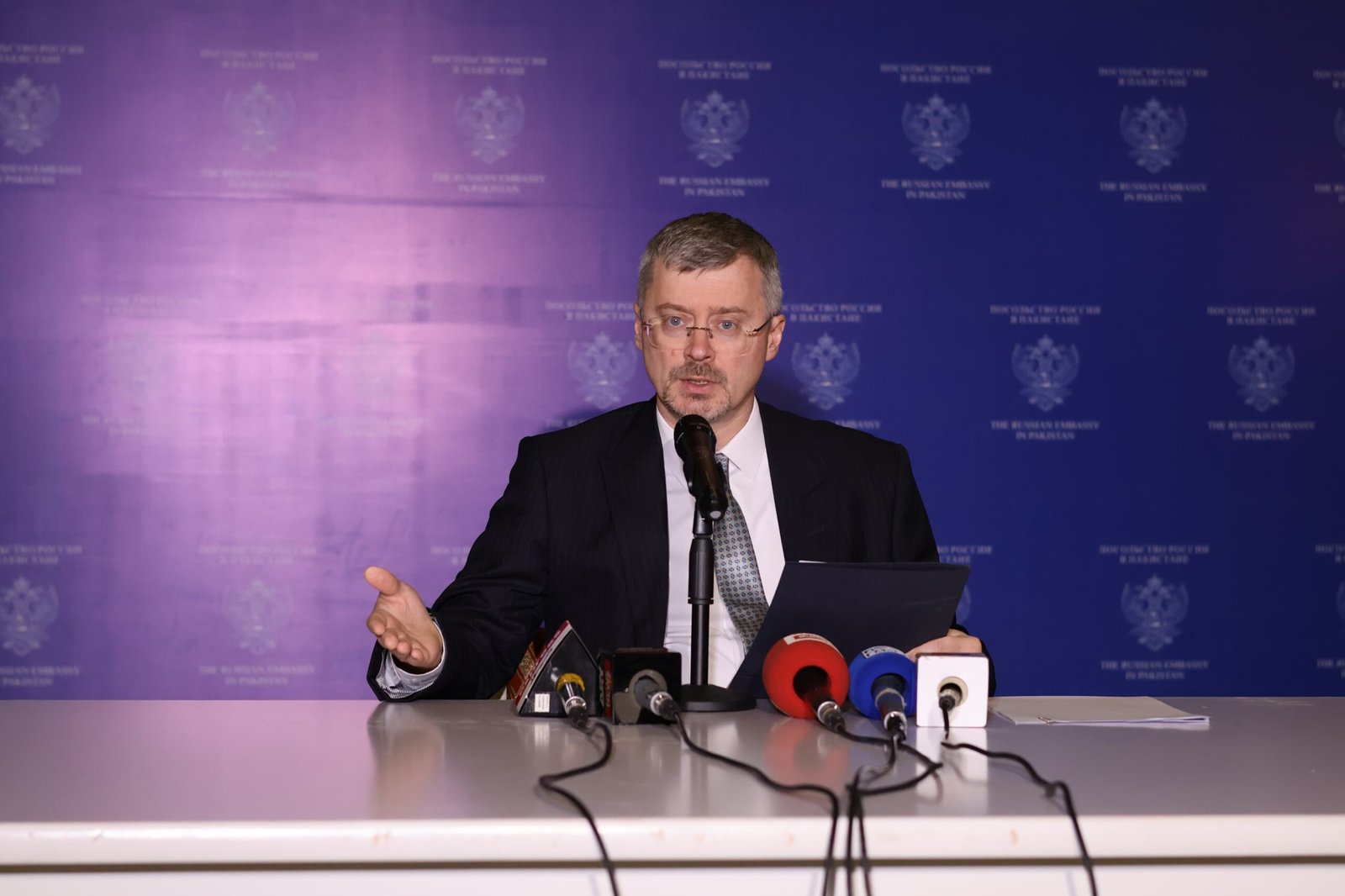
Islamabad – March 17, 2026 (Adnan Hameed): Albert P. Khorev stated that Russia considers the conflict in and around Ukraine not as a direct confrontation with Ukraine, but as an indirect clash with the “collective West,” which he said refuses to accept the decline of a world order based on colonialism and Western dominance.
Speaking at a briefing, the Ambassador said the conflict has become a defining catalyst for the emergence of a multipolar global order that will influence the international balance of power for years to come.
Referring to his article published on February 24, 2026, he outlined what he described as the root causes of the crisis, including Kyiv’s intention to forcibly reintegrate Donbass against the will of Russian-speaking populations, despite Russia’s peacekeeping efforts between 2014 and 2022.
He stated that the situation along the front line currently favors Russian forces, while accusing Ukrainian forces of escalating attacks on civilians and infrastructure. He cited the March 10 strike on Bryansk using British “Storm Shadow” missiles, which resulted in civilian casualties.
According to him, Ukrainian attacks on Russian territory rose significantly in 2025, exceeding 130,000 incidents, with an average of over 350 strikes per day. He claimed these attacks caused over 1,000 civilian deaths in 2025 alone, including children, and more than 26,000 civilian casualties since February 2022.
Despite ongoing hostilities, Ambassador Khorev emphasized that Russia remains open to a negotiated settlement. He noted that three rounds of trilateral talks in 2026 were held in Abu Dhabi and Geneva, with progress on humanitarian issues, including a “500 for 500” prisoner exchange mediated by the UAE and the United States.
He reiterated that any ceasefire must address what Russia views as the root causes of the conflict, including NATO’s eastward expansion, alleged discrimination against Russian-speaking populations, and actions against the Russian Orthodox Church. He rejected calls for an immediate ceasefire, claiming such proposals are intended to allow Ukrainian forces to regroup, referencing the 2015 Minsk Agreements.
The Ambassador highlighted concerns regarding the safety of the Zaporozhye Nuclear Power Plant, stating it has been under Russian control since March 2022 and accusing Ukrainian forces of repeatedly shelling the facility.
He also raised issues related to the Druzhba oil pipeline, alleging that Ukraine halted oil transit to Europe following accusations against Russia and prevented inspections by Hungary and Slovakia.
Referring to Ukrainian leadership, he criticized Volodymyr Zelenskyy, claiming he had lost legitimacy and accusing him of threatening European leaders, including Hungary’s prime minister.
Ambassador Khorev further highlighted the August 2025 meeting between Vladimir Putin and Donald Trump in Anchorage, describing it as a constructive step in strategic dialogue. He expressed regret over the absence of a U.S. response regarding continued adherence to the New START Treaty, indicating that Russia now considers itself free from its obligations while remaining open to balanced strategic engagement.
On humanitarian matters, he noted efforts to reunite children separated during the conflict, stating that some minors have already been reunited with their families through mediation by Qatar and the Vatican, with exchanges occurring in both directions.
He criticized European initiatives such as the “Register of Damage for Ukraine” and the “International Claims Commission,” describing them as attempts to impose liability on Russia and force reparations. He stated that Russia would consider such measures invalid and view participation by third countries as hostile.
Citing a decision by the International Court of Justice, he said the court did not recognize Russia as an aggressor state and rejected Ukraine’s claims regarding certain entities, terming them political.
The Ambassador also accused European countries of supporting Ukraine financially while ignoring controversial actions by its leadership, and warned against attempts to seize Russian sovereign assets, calling such actions illegal and a violation of international law.
He further condemned what he described as Western-led disinformation campaigns involving international institutions, including the International Criminal Court, OSCE mechanisms, the Council of Europe, and the European Commission.
Highlighting maritime security concerns, he referred to an attack on the Russian LNG tanker “Arctic Metagaz” in the Mediterranean, describing it as a terrorist act and violation of international law, and criticized the lack of response from European countries.
He also opposed actions against what he termed the Russian “shadow fleet,” warning that interference with commercial shipping could destabilize global energy markets and negatively impact developing countries, including Pakistan.
Ambassador Khorev concluded by stating that Russia is working to promote regional cooperation and a multipolar security framework in Eurasia, including efforts with Belarus to develop a Eurasian Charter on Diversity and Multipolarity.
He further appreciated Pakistan’s balanced stance on the Ukraine conflict and expressed hope for its participation in future regional initiatives.