



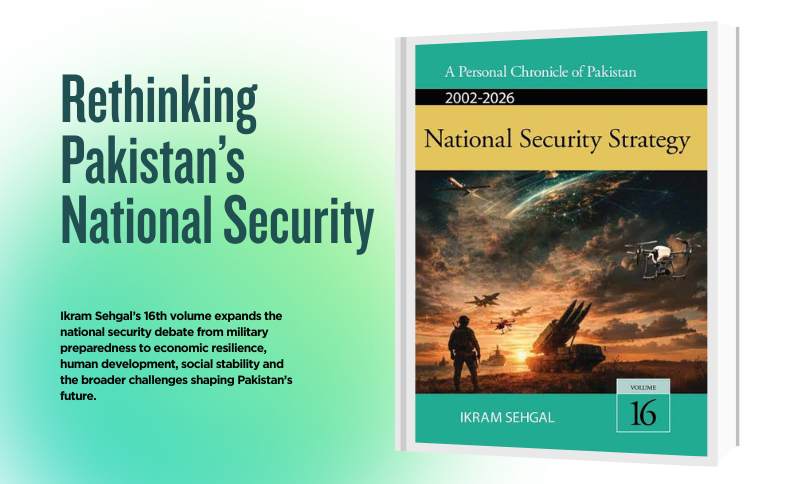
Ikram Sehgal’s 16th volume expands the national security debate from military preparedness to economic resilience, human development, social stability and the broader challenges shaping Pakistan’s future.
The 16 th volume of Ikram Sehgal’s “A Personal Chronicle of Pakistan” series, the “National Security Strategy”, was launched at the Serena Hotel, Islamabad, on Friday, July 17, 2026. Hosted by Ikram Sehgal and Zarrar Sehgal, the reception brought together senior military officers, diplomats, academics and policymakers. With the Commander of the Islamic Military Counter Terrorism Coalition and former COAS Pakistan Army, Gen(Retd) Raheel Sharif NI(M) HI(M) the Chief Guest, eminent speakers reflected on the book’s contribution to Pakistan’s national security discourse from different perspectives as well their association with the author Ikram Sehgal.
For decades, discussions on national security in Pakistan have largely been dominated by military threats, the possibility of conflict with neighbouring countries, terrorism and regional geopolitical rivalries. While military strength remains essential for safeguarding sovereignty, there is a growing realization that Pakistan’s most serious threats are no longer limited to its borders. Many of the country’s greatest challenges come from within.
In this context, National Security Strategy makes an important contribution by looking at national security from a broader, people-centric perspective. A secure Pakistan is one where citizens have access to food, education, healthcare, justice and economic opportunities. Poverty, unemployment and deprivation can pose serious threats to long-term stability. The fight for Pakistan’s future, therefore, must take place not only on military frontiers but also across agricultural fields, declining industrial zones, overcrowded schools and water-scarce villages.
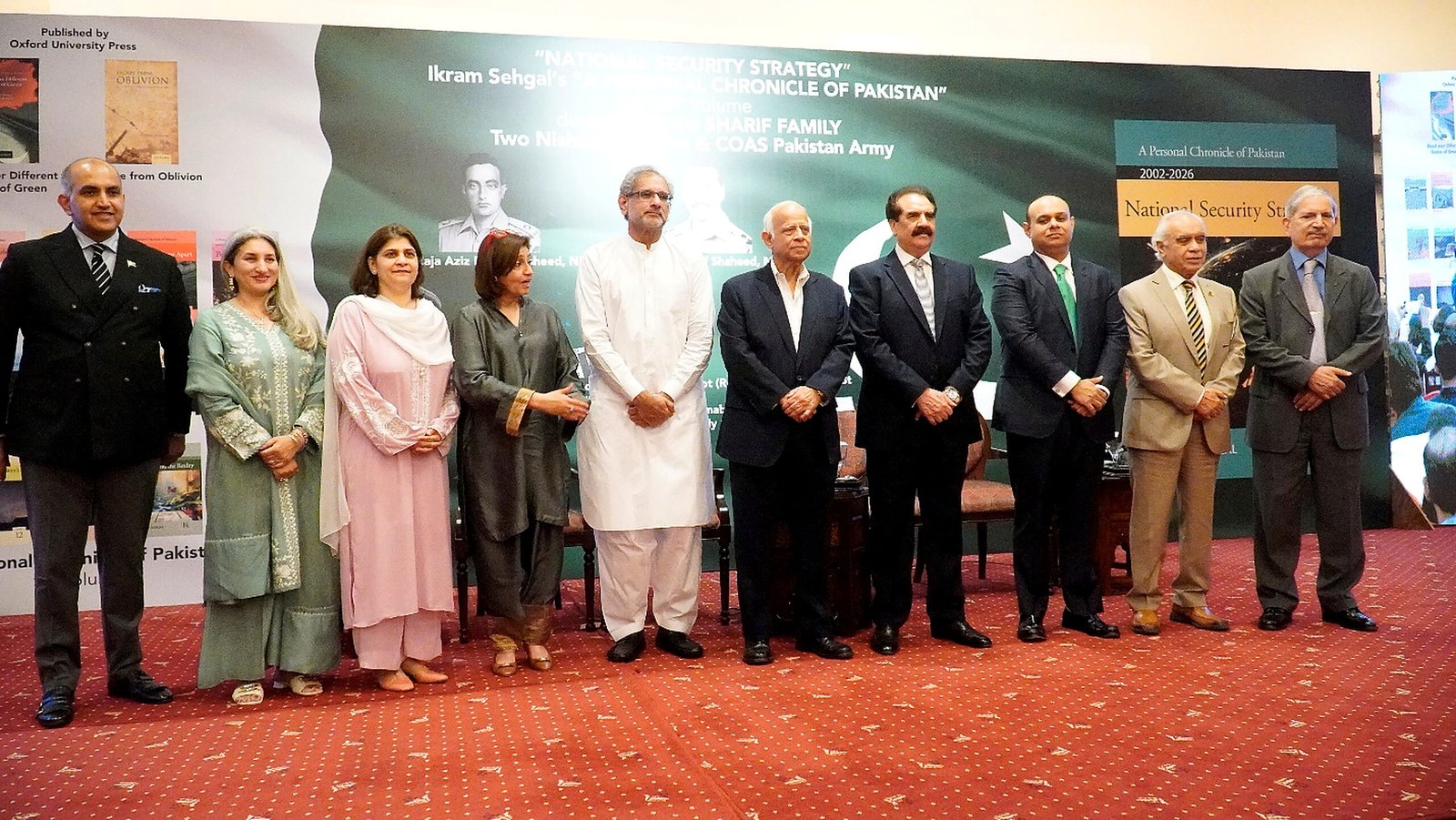
Prof. Dr Huma Baqai spoke about Ikram Sehgal’s authorship, patriotism, his father’s legacy and the sacrifices of Pakistan’s Armed Forces. She described the book as a people-centric chronicle of Pakistan’s geopolitical and economic transformation, highlighting issues including state-society relations, food security, population growth, equality and education.
The book is also significant against the background of Pakistan’s historical absence of a formal, comprehensive national security framework. Air Marshal (Retd) Masood Akhtar recalled that Pakistan lacked a formal “National Security Policy” framework in the early 2000s. At the National Defence University (NDU), even a basic policy format was unavailable. In 2002, NDU tasked Ikram Sehgal with delivering its first lecture on “National Security Strategy”. Air Marshal Masood Akhtar acknowledged and applauded Sehgal’s intellectual contribution in this field.
Shahid Khaqan Abbasi recalled his longstanding family association with Ikram Sehgal. His uncle, Brigadier Mohammad Taj SJ & Bar, one of the most decorated soldiers of the Pakistan Army, was Sehgal’s commanding officer during the 1971 War. Abbasi praised Sehgal’s extensive body of work and encouraged him to document more of his personal experiences, describing them as an important part of Pakistan’s history. He also commended Sehgal’s decades of quiet service, noting the many initiatives and institutions he had built without seeking recognition.
Gen (Retd) Raheel Sharif paid tribute to Sehgal’s lifelong friendship with the Sharif family and thanked him for dedi-cating the book to them. Recalling that he had known Sehgal since childhood in Lahore, he spoke of his admira-tion for Sehgal and his brothers, Major Shabbir Sharif (NH) and Capt Mumtaz (SBt). He described Ikram Sehgal as a distinguished infantry soldier, aviator, defence analyst, author and businessman, while also recognizing his longstanding efforts to project Pakistan’s perspective internationally.
Pakistan has produced extensive literature on defence, foreign policy and military affairs, but there remains a significant gap in articulating a truly comprehensive National Security Strategy integrating all elements of national power. Sehgal’s book addresses this gap through decades of observation, analysis and concern for Pakistan’s future.
More than simply another work on defence and security, National Security Strategy seeks to broaden the national security conversation. Its significance lies in connecting military preparedness with economic strength, social stability, human development and the wellbeing of citizens. As the 16th volume of A Personal Chronicle of Pakistan, it combines Sehgal’s personal experiences and observations with a wider reflection on the country’s strategic challenges, offering an important contribution to the continuing debate on Pakistan’s national security and future.
The write can be contacted at sehrish.mustafa@wppk.co