


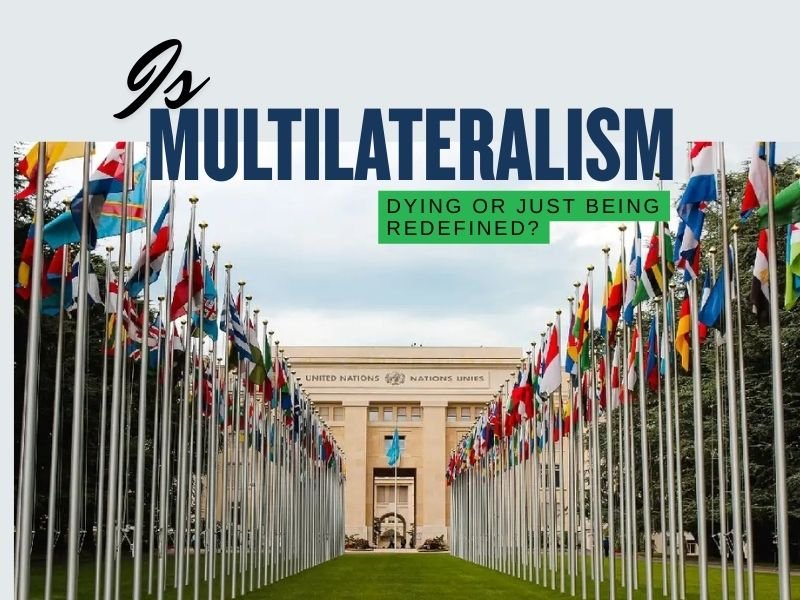
Dying or Just Being Redefined?
UN, IMF, WTO under strain, what replaces them?
The international order built after 1945 was premised on a simple but ambitious idea: that shared rules, institutions, and collective decision-making could prevent another global catastrophe. For decades, multilateralism, anchored in institutions such as the United Nations, the International Monetary Fund, and the World Trade Organization, provided a grammar for global cooperation.
Today, that grammar appears strained, contested, and in some arenas, ignored. Wars grind on without resolution, trade rules are bent or bypassed, debt crises multiply, and climate negotiations move at a pace painfully out of sync with planetary reality. The question that increasingly animates diplomats, policymakers, and scholars is not merely whether multilateralism is failing but whether it is being fundamentally redefined.
This is not an obituary. Nor is it a defence of institutional inertia. It is an attempt to understand what is breaking, what is adapting, and what may yet endure.
A System Under Visible Strain
Few institutions illustrate the crisis more starkly than the United Nations. Designed to embody collective security, the UN Security Council has increasingly become a theatre of vetoes and geopolitical paralysis. From Ukraine to Gaza, from Syria to Sudan, the Council’s inability to act decisively has exposed the limits of a structure frozen in the power realities of 1945. As UN Secretary-General António Guterres himself acknowledged in Our Common Agenda, global institutions “reflect yesterday’s power structures, not today’s realities.”
This admission is significant. It signals that the crisis of multilateralism is not merely external criticism, but is internally recognised. The erosion of trust is particularly acute in the Global South, where many states view the UN system as normatively universal but politically selective: vocal on principles, constrained in enforcement.
The IMF faces a different but equally corrosive legitimacy challenge. Long positioned as the guardian of global financial stability, it has become, in the eyes of many developing countries, a symbol of conditionality without compassion. Joseph Stiglitz’s long-standing critique, that IMF programmes often impose austerity at precisely the wrong moment, has found renewed resonance as debt distress spreads across Africa, South Asia, and parts of Latin America.
The contradiction is stark: countries most vulnerable to climate shocks and external crises are asked to compress social spending in the name of fiscal discipline, even as advanced economies deploy massive stimulus packages when their own systems are under strain. The result is not merely economic pain but a deeper erosion of institutional credibility.
The WTO, once the crown jewel of rule-based globalization, has been quietly hollowed out. Its dispute settlement mechanism arguably the backbone of the system has been paralysed, while trade has increasingly been weaponised through tariffs, sanctions, and industrial policy. The 2023 World Trade Report warned that as global trade fractures into politically aligned blocs, low-income economies risk losing the market access, predictability, and value-chain integration that once underpinned their development gains. Yet the political will to restore binding multilateral trade discipline remains elusive, as major powers increasingly privilege strategic autonomy and security over adherence to shared trade rules.
Why the Multilateral Consensus Is Fracturing
The current malaise cannot be explained by institutional design alone. It is rooted in deeper structural shifts reshaping global politics.
First, the return of great-power rivalry has fundamentally altered incentives. The post-Cold War moment, when cooperation appeared both possible and profitable, has given way to strategic competition, most notably between the United States and China. In such an environment, multilateral institutions are no longer neutral arenas but contested battlegrounds for influence.
Second, domestic politics have intruded forcefully into global governance. Nationalism, populism, and economic anxiety have made international commitments politically costly. Dani Rodrik’s “globalization paradox” the tension between democracy, national sovereignty, and deep economic integration has moved from academic theory to lived political reality.
Third, the scale and complexity of contemporary crises have outpaced institutional adaptation. Climate change, pandemics, cyber insecurity, and AI governance demand speed, flexibility, and technical coordination that traditional consensus-based forums struggle to provide. When institutions fail to deliver timely outcomes, states seek alternatives.
Finally, there is the issue of legitimacy. For many in the Global South, the problem is not multilateralism per se but who sets the rules and who bears the costs. As the UNDP’s Human Development Report 2023–24 observed, the current international financial architecture often deepens global divergence rather than mitigating it.
Death or Evolution?
To frame the moment as the “death” of multilateralism is tempting but misleading. What we are witnessing is less a collapse than a reconfiguration. Stewart Patrick’s notion of a “new new multilateralism” captures this shift well. Rather than universal, all-encompassing institutions, cooperation is increasingly organised through flexible, issue-specific coalitions what analysts term minilateralism. These arrangements are smaller, faster, and more pragmatic, designed to deliver outcomes rather than symbolic consensus.
Climate clubs bring together a small group of countries that are willing to meet higher standards, instead of waiting for agreement from everyone in global talks. Techno-logy alliances work with trusted partners to manage supply chains and set rules outside traditional trade systems. Security cooperation is increasingly handled through regional and issue-based partnerships, rather than through global institutions with universal membership.
This does not mean that universal institutions are irrelevant. Rather, they are no longer the sole or even primary venues for effective action.
Parag Khanna, a geopolitical expert claims that global governance is becoming “networked, regional, and pra-gmatic” reflects a world where cooperation no longer runs through a single global headquarters, but unfolds across multiple, overlapping arenas at once through regional blocs, functional partnerships, and issue-specific alliances driven more by necessity than ideology. The centre of gravity is shifting away from grand architectures toward modular, adaptable frameworks.
The Global South: Redefinition, Not Rejection
Perhaps the most misunderstood aspect of this transformation is the Global South’s role within it. Contrary to some narratives, developing countries are not turning away from global cooperation. They are demanding a different version of it.
The frustration is not with multilateralism as an idea but with its asymmetries. When rules appear to constrain some while empowering others, legitimacy erodes. When institutions prescribe austerity without addressing structural inequities, trust collapses.
Analysts observe the crisis of multilateralism as fundamentally a crisis of legitimacy. Cooperation fails not because states reject it, but because they no longer believe the system operates in their interest.
This perspective matters profoundly for countries like Pakistan. Reliant on multilateral finance, vulnerable to climate shocks, and strategically positioned in a contested region, Pakistan cannot afford institutional breakdown. Yet it also cannot ignore the constraints imposed by existing frameworks. The challenge is to navigate between dependence and reform engaging institutions while pushing for greater voice, flexibility, and fairness.
.
Pakistan and the Middle-Power Dilemma
For middle and lower-middle-income countries, the redefinition of multilateralism presents both risks and opportunities.
On the one hand, fragmentation reduces predictability. If rules become contingent and alliances fluid, smaller states risk being squeezed between competing blocs. Trade fragmentation, for instance, can undermine export-led growth strategies, while selective climate finance leaves vulnerable countries exposed.
On the other hand, a more flexible order can create space for agency. Issue-based coalitions allow states to engage where interests align, rather than being locked into rigid institutional positions. South–South cooperation, regional platforms, and development banks offer alternatives alb-eit imperfect ones to traditional dependency.
The key question is whether these emerging arrangements will complement or undermine universal institutions. Will they act as laboratories for reform, or as substitutes that accelerate fragmentation?
Three Futures for Multilateralism
Looking ahead, three broad trajectories suggest themselves.
First, managed decline.
Institutions survive but lose relevance, functioning primarily as forums for dialogue rather than engines of action. Cooperation continues, but outside formal structures.
Second, fragmented order.
Competing blocs, regional alliances, and ad-hoc coalitions replace global consensus. Rules become situational, power-driven, and unevenly applied. For smaller states, this is the most precarious scenario.