



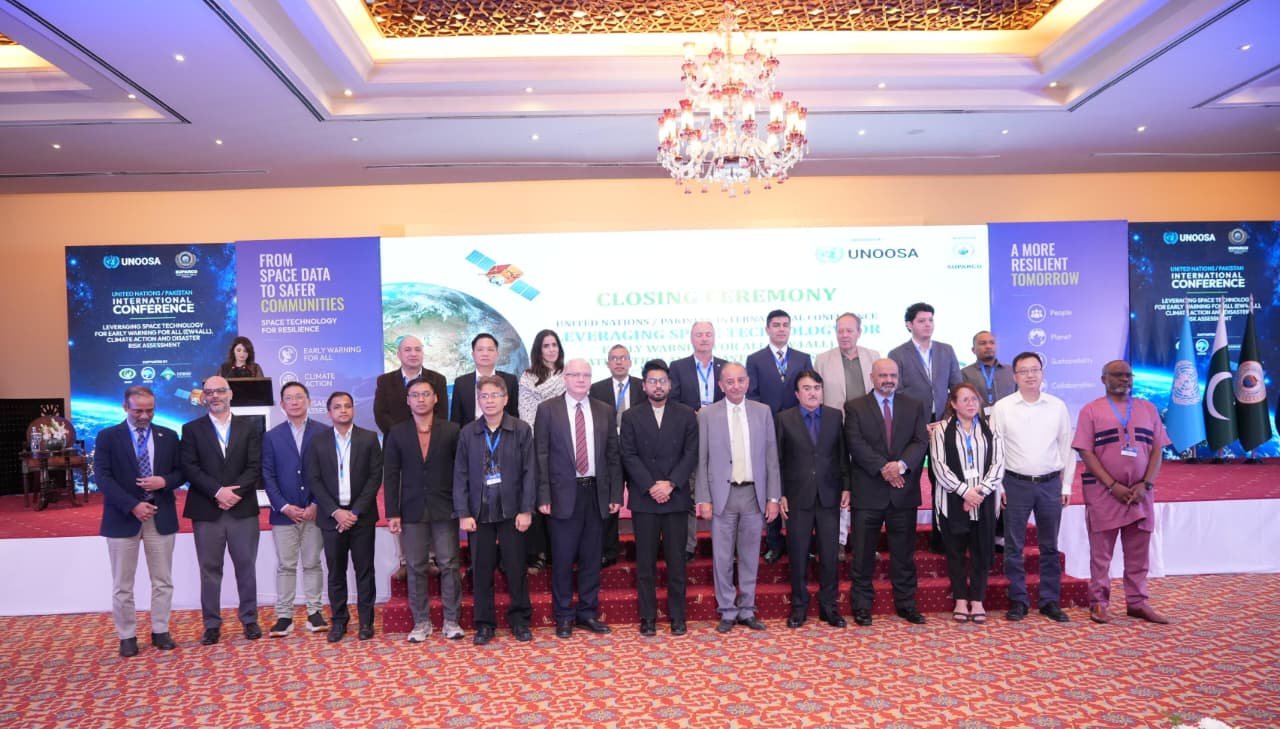
Five-day PAK–UN International Conference Concludes in Islamabad, Call for Strengthening Space-Based Climate Intelligence and Early Warning System
Islamabad – 31October 2026 (Adnan Hameed) : The five-day UN/Pakistan International Conference on “Leveraging Space Technology for Early Warning for All (EW4All), Climate Action and Disaster Risk Assessment” hosted by Pakistan Space & Upper Atmosphere Research Commission (SUPARCO), concluded today in Islamabad, bringing together distinguished national and international experts, policymakers, scientists and representatives of international organizations to deliberate on strengthening space-based early warning systems, enhancing multi-hazard risk assessment and improving preparedness and timely response to climate-related disasters, while advancing climate resilience and sustainable development.
The closing ceremony was graced by Musadik Malik, Federal Minister for Climate Change and Environmental Coordination, as the Chief Guest.
The conference brought together approximately 250 participants from across Pakistan, including representatives of federal and provincial ministries, academia and relevant national institutions, alongside delegates and representatives from 22 countries.
The ceremony was graced by the Host of the Conference, Muhammad Yousaf Khan, Chairman SUPARCO and President ISNET; Lorant Czaran, Director, Space Applications, United Nations Office for Outer Space Affairs (UNOOSA); the Secretary, Ministry of Climate Change and Environmental Coordination; the Secretary, Rehabilitation Department, Government of Sindh; representatives of the United Nations Platform for Space-based Information for Disaster Management and Emergency Response (UN-SPIDER), Asia-Pacific Space Cooperation Organization (APSCO), Inter-Islamic Network on Space Sciences and Technology (ISNET), Kazakhstan Gharysh Sapary and other international organisations, along with distinguished delegates and participants.
The conference featured 17 sessions, comprising 2 high-level plenary sessions, 5 panel discussions and 10 technical sessions. The technical sessions included 67 presentations delivered by national and international participants. Furthermore, 10 keynote talks were delivered by distinguished experts, while 32 panelists contributed to thought-provoking discussions on critical issues concerning space technology-based climate intelligence, climate action, disaster risk reduction, the Sendai Framework, the Paris Agreement and the Early Warnings for All (EW4All) initiative.
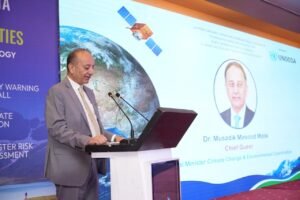
Addressing the gathering as Chief Guest, Honourable Dr. Musadik Malik, Federal Minister for Climate Change and Environmental Coordination emphasised that Pakistan must shift from a reactive to a preventive approach to disaster management, using space technology, satellite imagery, radar and hyperspectral data, AI and advanced predictive modelling to identify risks before they turn into disasters. Drawing an analogy with cardiology, he argued that just as early diagnosis and timely treatment can prevent a patient from needing surgery, scientific monitoring and accurate forecasting should help prevent loss of life and property. He highlighted Pakistan’s growing space capabilities and stressed that scientific data must be translated into practical, timely interventions.
His central message was that a warning without an address is a warning addressed to no one. Disaster alerts must move beyond broad regional forecasts to precise, location-specific warnings that reach individual households and vulnerable communities. He called for annual satellite-based reports on floodplains and encroachments, stronger coordination among institutions and across borders, accurate mapping of disaster-prone areas, and greater engagement of young innovators through collaborative research, hackathons and innovation initiatives. He concluded that science must serve humanity, with rescue operations being the last resort rather than the first response, and the protection of vulnerable people as the ultimate purpose of technology.
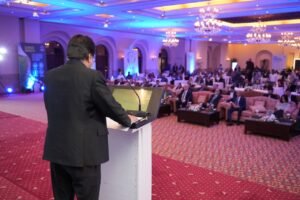
In his address, Chairman SUPARCO, Muhammad Yousaf Khan, emphasized that the real value of satellite technology lies in translating space-based information into timely decisions and practical action. He highlighted three key priorities emerging from the conference: integrating information into decision-making processes, strengthening interoperable systems and data-sharing arrangements, and sustaining institutional and human resource capacities.
Addressing the ceremony, Mr. Lorant Czaran, Director, Space Applications, UNOOSA, highlighted the importance of international cooperation and the effective utilization of space-based technologies in addressing global climate and disaster-related challenges. He acknowledged the significance of collaborative initiatives and knowledge-sharing platforms in strengthening the capacity of countries to utilize space applications for sustainable development and disaster management.
The deliberations underscored the growing importance of satellite-based Earth observation, geospatial information and advanced space applications in strengthening multi-hazard early warning systems, assessing climate vulnerabilities, monitoring environmental changes and supporting informed decision-making. Participants emphasized the need to translate space-based information into actionable intelligence, strengthen institutional capacities, enhance regional and international cooperation and ensure that timely warnings reach vulnerable communities.
During the closing ceremony, a comprehensive summary of the conference proceedings and key recommendations was presented, highlighting the major outcomes and areas for future collaboration. SUPARCO also presented its Pakistan Space4Climate Initiative, reaffirming its commitment to leveraging national space capabilities and satellite-based applications to support climate monitoring, disaster risk assessment and national resilience.
The conference concluded with a renewed commitment to harnessing space technology, scientific innovation and international partnerships to strengthen climate resilience, improve disaster preparedness and advance the vision of Early Warnings for All.