


Bridging Technology and Trust: UNESCO Pakistan Champions Effective RTI Frameworks for the AI Age
Islamabad – 9 October, 2026 (Adnan Hameed) : Pakistan – Every year on September 28, the global community celebrates the International Day for Universal Access to Information (IDUAI). Proclaimed by the UNESCO General Conference in 2015 and formally adopted by the UN General Assembly in 2019, IDUAI highlights a fundamental truth: access to information is a basic human right and a pillar of transparent, democratic societies.
Pakistan stands as a regional leader in establishing robust legal frameworks for citizen access to information, anchored by the federal Right to Access to Information Act of 2017 and strong provincial Right to Information (RTI) laws. These landmark legislations have provided a robust framework for public access, institutional transparency, and civic participation across the country.
However, as Artificial Intelligence (AI) and automated tools rapidly transform how information is generated, shared, and stored, traditional RTI frameworks face complex new challenges. Ensuring public trust in the modern age requires addressing algorithmic transparency, regulating AI-generated content, preventing automated misinformation, and guaranteeing equal digital access across society. To stay effective, Pakistan’s RTI mechanisms must evolve alongside these rapid technological advances.
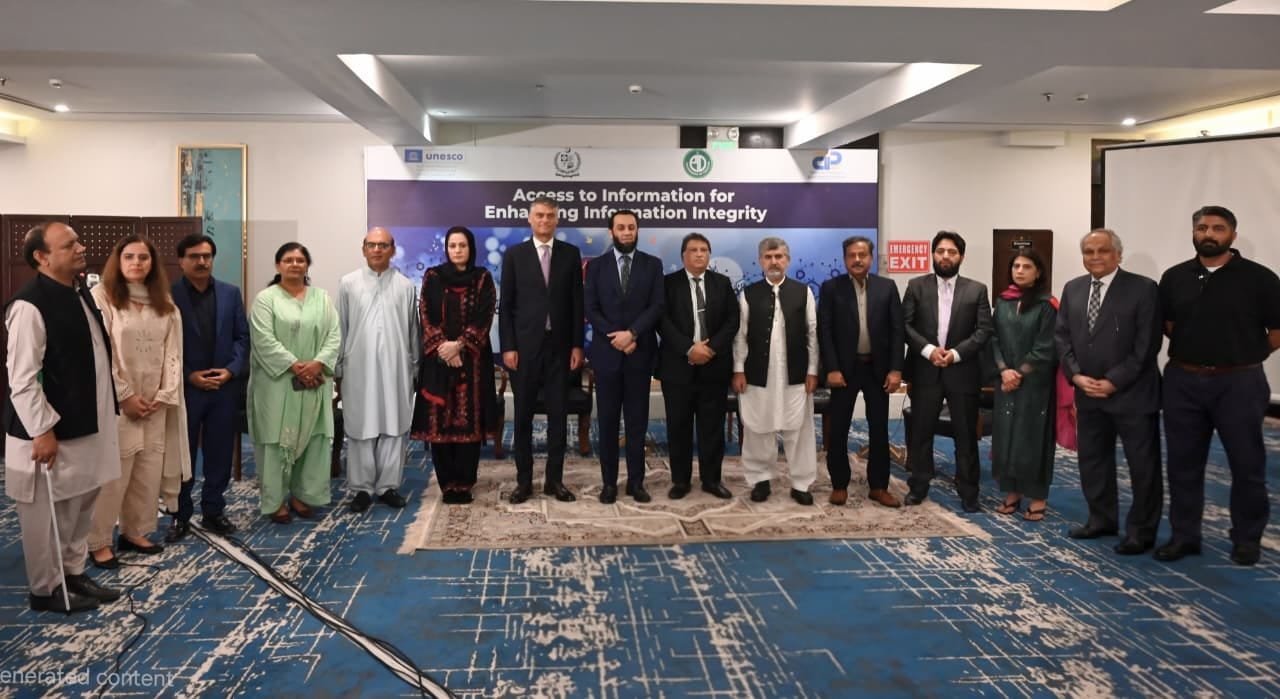
Against this backdrop, UNESCO Pakistan, in collaboration with the National Forum of Information Commissioners (NFIC), convened the Eighth National Forum of Information Commissioners and hosted an open dialogue titled “Access to Information for Enhancing Information Integrity” in Islamabad to mark IDUAI 2026.
The high-level event brought together Information Commissions, policymakers, legal experts, media professionals, and civil society leaders to establish practical priorities for stronger institutional cooperation, peer learning, and effective RTI implementation.
Key discussion themes focused on the direct relationship between access to information and information integrity, covering proactive disclosure, institutional transparency, digital accessibility, AI-generated content, and building public trust. Participants underscored that maintaining information integrity requires coordinated action across transparent public institutions, proactive Information Commissions, independent journalism, informed citizens, and evidence-based policy choices.
Delivering his keynote address at the dialogue, Attaullah Tarar, Minister for Information and Broadcasting, stated, “Pakistan will gladly work with UNESCO to build institutional capacities and set a standard for the developing world. The Ministry of Information and Broadcasting stands resolute in its commitment to supporting the independence and capacity of our Information Commissions, says press note. Let us use today’s dialogues to refine our model procedures, strengthen our digital infrastructure, and reaffirm our promise to the citizens of Pakistan: a government that is open, accountable and fundamentally theirs.”
Highlighting the imperative of public access and critical evaluation, Fuad Pashayev, UNESCO Representative to Pakistan and Head of Office, remarked, “Ensuring that information is timely, credible, accessible, and understandable is essential for strong democratic institutions. Alongside robust legal guarantees, we must focus on strengthening citizens’ ability to critically assess information in an era increasingly shaped by Artificial Intelligence.”
Reaffirming its role as a key technical partner under SDG Target 16.10, which mandates public access to information and fundamental freedoms, UNESCO pledged to continue working closely with Pakistani institutions to translate international commitments on universal access to information into concrete, impactful local actions that expand civic participation and keep RTI protections strong for the digital age.