



UNESCO and Partners call for action to advance literacy for all
Islamabad – 9 September 2026 (Adnan Hameed) : With a national literacy rate of around 61 – 63 per cent, Pakistan continues to face significant challenges of illiteracy, learning poverty and out-of-school children.
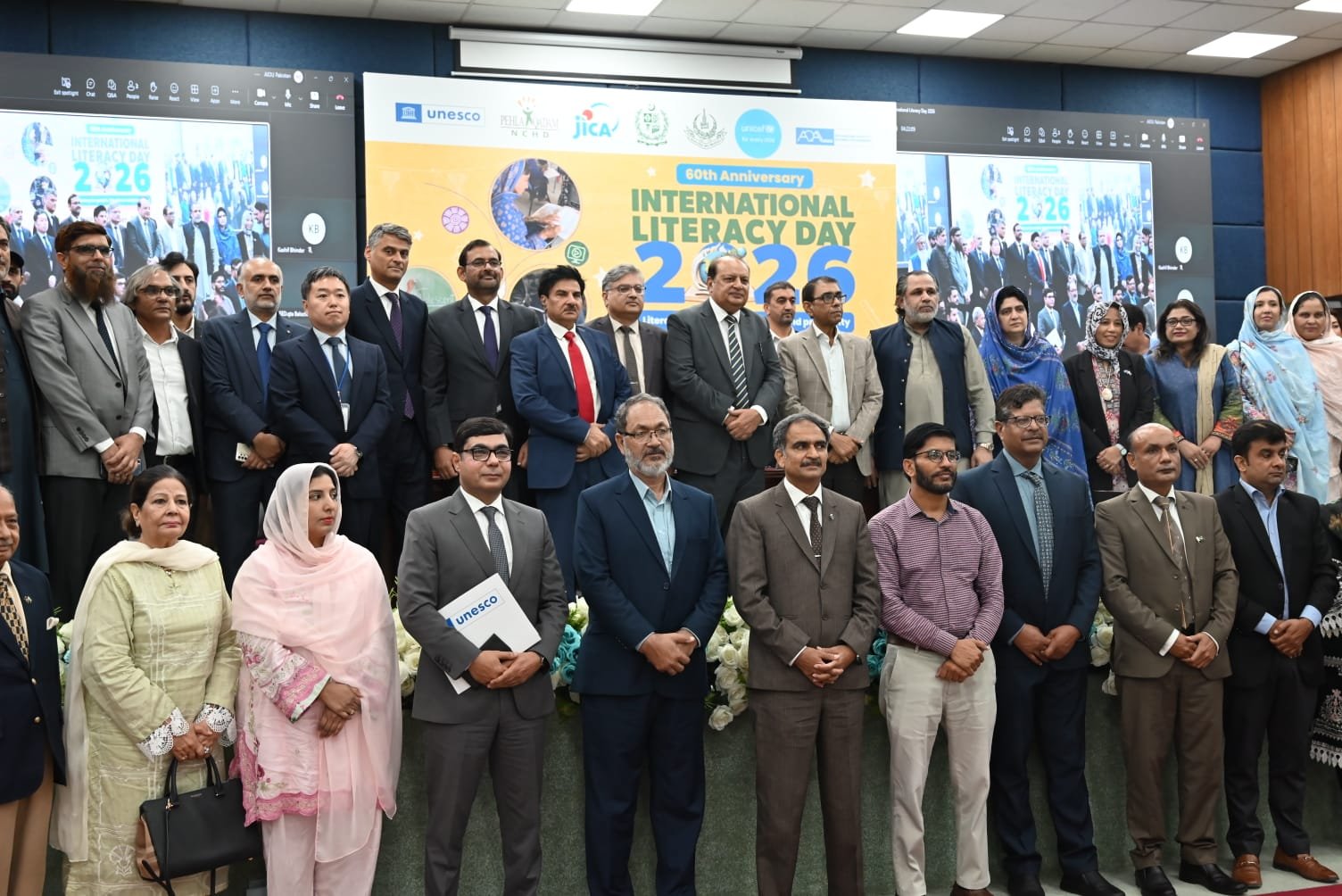
This is the grave reality realized today, as we mark the 60th Anniversary for International Literacy Day. UNESCO, in collaboration with the National Commission for Human Development (NCHD), the Ministry of Federal Education and Professional Training, UNICEF and the Japan International Cooperation Agency (JICA), commemorated this year’s theme of “Literacy for people, the planet and prosperity”, at Allama Iqbal Open University in Islamabad.
The event was addressed by Dr. Khalid Maqbool Siddiqui, Federal Minister for Education and Professional Training; Ms. Rahila Hameed Durrani, Provincial Minister for Education, Government of Balochistan, Mr. Fuad Pashayev, UNESCO Representative in Pakistan;, Ms. Sharmeela Rassool, Deputy Representative, UNICEF Pakistan; Mr. Takayuki Sugawara, Deputy Chief, JICA Pakistan Office; Mr. Iftikhar Sadiq, Member of the National Assembly (MNA) and Chairman of NCHD; and Mr. Ali Asghar, Director General of NCHD.
“Literacy is a fundamental human right and the foundation for lifelong learning and sustainable development. It requires inclusive and equitable learning opportunities, especially for young girls, women and marginalized communities. We must work together to ensure that today’s out-of-school children do not become tomorrow’s non-literate adults”. Mr. Fuad Pashayev, UNESCO Representative in Pakistan.
Over 200 representatives from federal and provincial governments, United Nations agencies, development partners, civil society and academia participated in the event. A key highlight of the event was the launch of the “Each One, Teach One” mobile application, developed by NCHD to promote literacy through digital technology.
Highlighting the significance of International Literacy Day, Dr. Khalid Maqbool Siddiqui, Federal Minister for Education and Professional Training, Government of Pakistan, emphasized the need for stronger collective and coordinated action among the government, development partners, civil society, communities and other stakeholders to address the interconnected challenges of illiteracy and out-of-school children.
Mr. Takayuki Sugawara, Deputy Chief, JICA Pakistan Office, highlighted JICA’s support through the Advancing Quality Alternative Learning (AQAL) Project, which works closely with federal and provincial governments and other partners to expand access to quality alternative learning opportunities.
Echoing the sentiment that no single entity can tackle Pakistan’s literacy challenges alone; UNICEF reinforced the call for unified action:
“We must put literacy and foundational learning at the heart of education reform, investing in teachers, quality learning environments and approaches that reach underserved children, so that every child has the opportunity to learn, thrive and reach their full potential,” Pernille Ironside, Resident Coordinator Pakistan (a.i.) and UNICEF Representative in Pakistan.
International Literacy Day, proclaimed by UNESCO in 1966 and first celebrated in 1967, is observed annually on 8 September to highlight the importance of literacy as a foundation for inclusive and sustainable societies.
The 60th anniversary observance in Islamabad reaffirmed the importance of collective action among government of Pakistan, United Nations agencies, development partners and academia to advance literacy and expand learning opportunities across Pakistan. The global celebration by UNESCO, is being held on 8–9 September 2026 in collaboration with the Government of Mexico.