



As the war involving the United States and Iran has disrupted oil markets and shipping routes across the Middle East. The Strait of Hormuz, one of the world’s most important energy corridors, has faced severe disruption, while threats and attacks around the Red Sea have added further pressure to global shipping. Oil prices have swung sharply in response to developments on the battlefield and at the negotiating table. On August 4, Brent crude settled at $79.36 a barrel after falling more than 5 percent on hopes of progress in U.S.-Iran talks, while analysts continued to warn that prices could remain highly sensitive to developments in the conflict.
For American agriculture, the significance extends far beyond the price of diesel at the pump. Modern farming depends on energy at almost every stage of production. Diesel powers tractors, combines and irrigation equip-ment. Natural gas is a critical feedstock for nitrogen fertil-izer. Petroleum and petrochemicals are embedded in pesticides, plastics, machinery, packaging and transpor-tation. When energy markets are disrupted, the conseq-uences can eventually reach farms, food processors, exp-orters and consumers.
The United States is therefore facing a deeper question: How resilient is American agriculture when the energy system on which it depends becomes vulnerable to geopolitical shocks?
The Hidden Energy Dependency of American Agriculture
American agriculture is among the world’s most produc-tive farming systems, but that productivity has been built partly on abundant and relatively affordable energy. Fuel allows farmers to cultivate and harvest enormous areas with highly mechanized equipment.
Natural gas is essential to the production of ammonia and other nitrogen fertilizers. Electricity supports irrigation, grain drying, refrigeration and processing. Petroleum-based products are also used throughout the agricultural supply chain.
This does not mean that every increase in oil prices auto-matically produces an agricultural crisis. USDA’s latest 2026 farm-sector forecast is more nuanced. Net farm in-come is projected at $153.4 billion, down just 0.7 percent from 2025 in nominal terms, while total production exp-enses are forecast at $477.7 billion, about 1 percent higher than in 2025. Fuel and oil expenses are actually projected to decline in 2026, although electricity and some other costs are expected to rise.
The vulnerability lies elsewhere: energy shocks can rapidly change the economics of individual crops and regions ev-en when the overall farm sector remains financially stable.
For generations, American farmers have worried about drought, floods, disease and commodity prices. In 2026, however, another variable has become impossible to ignore: energy.
When American Farms Also Produce Fuel
The relationship between energy and agriculture is particularly complicated because American farms do not only consume energy they also help produce it.
Corn is the principal feedstock for U.S. ethanol. Soybean oil, along with other vegetable oils, animal fats and waste oils, is used to produce biodiesel and renewable diesel.
USDA maintains a dedicated bioenergy database because these markets have become important enough to influence agricultural commodity demand and prices.
The soybean story is especially revealing. USDA data show that soybean oil’s role in biofuel production expanded dramatically over the past two decades.
In marketing year 2022/23, about 46 percent of U.S. soybean oil was used for biofuel production. However, the latest data show a more diversified feedstock market. In 2024/25, soybean oil accounted for about 34 percent of total feedstocks used in U.S. biomass-based diesel prod-uction, while total disclosed feedstock use was about 34 billion pounds.
This creates a powerful link between energy and agricul-ture. Strong demand for renewable fuels can support de-mand for corn, soybeans and vegetable oils. But it can also raise the value of agricultural feedstocks and influen-ce what farmers choose to plant.
E15 and the Politics of Corn
U.S. biofuel policy has increasingly connected energy security with agricultural policy. The latest example is E15, gasoline containing 15 percent ethanol. In March 2026, the Environmental Protection Agency issued a temporary em-ergency waiver allowing nationwide E15 sales beginning May 1, 2026, as part of an effort to strengthen fuel supp-lies. The measure also removed federal impediments to nationwide E10 sales.
For corn growers, expanded ethanol demand can provide an important market. But biofuel policy also illustrates the difficult balance Washington must maintain between energy security, farm incomes, fuel prices, environmental policy and food markets.
The issue is not simply whether more corn should become fuel. It is whether energy policy can expand renewable fuel markets without creating excessive pressure else-where in the agricultural system.
Fertilizer: The Critical Link Between Natural Gas and Food
The most important connection between energy and crop production may not be diesel at all. It may be fertilizer.
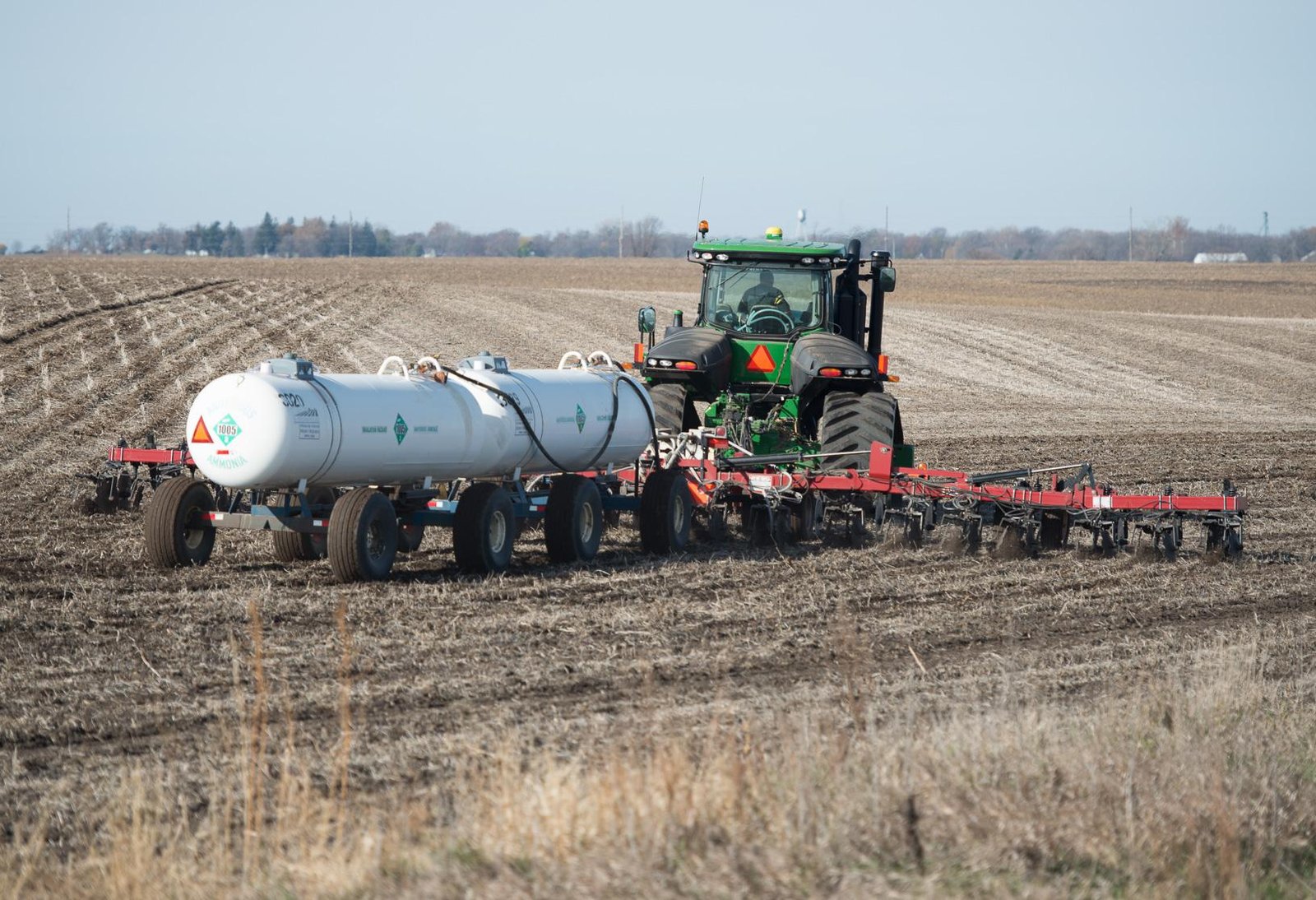
Nitrogen fertilizer production is highly energy-intensive and relies heavily on natural gas. A disruption in natural-gas markets can therefore affect fertilizer manufacturing, availability and prices.
If fertilizer becomes more expensive, farmers face a choice between absorbing higher costs, reducing applica-tion, changing crops or accepting lower margins. That matters because crop economics differ significantly. Corn generally requires substantially more nitrogen than soy-beans. Consequently, when fertilizer costs rise relative to expected crop prices, farmers have an economic incentive to reconsider their planting decisions.
USDA’s latest projections show that this broader profit-ability calculation is already shaping the American crop landscape. The agency projects corn acreage at about 95 million acres for 2026/27, while soybean acreage is proj-ected at around 85 million acres in its long-term baseline.
Separately, the June 2026 acreage report indicated that U.S. farmers planted 85.4 million acres of soybeans in 2026, 5 percent more than the previous year.
Energy prices are not the only factor behind these decisions. Weather, expected yields, commodity prices, crop insurance, soil conditions and trade prospects all matter. But energy and fertilizer costs have become increasingly important variables in the calculation.
Wheat and the Food Price Connection
Wheat demonstrates another side of the problem. The United States produced about 2 billion bushels of wheat in marketing year 2025/26 from 37.2 million harvested acres. Wheat remains the country’s third-largest field crop by acreage, production and gross farm receipts, after corn and soybeans.
In 2026, wheat prices have also been volatile. USDA’s July Food Price Outlook reported that farm-level wheat prices were 11.1 percent higher in June 2026 than a year earlier and forecast an 11.8 percent increase for 2026. The outlook reflects expectations of a significant decline in U.S. wheat output.
This illustrates why food inflation cannot be explained by energy prices alone. Weather, global production, invent-ories, trade and crop conditions interact with energy and transportation costs. Yet energy remains an important multiplier. Higher fuel, fertilizer and freight costs can raise the cost of bringing crops from fields to mills, processors, feedlots and consumers.
From Farm Costs to Grocery Prices
The transmission from energy markets to food prices is neither immediate nor one-to-one. Farm commodities represent only one component of the final retail price. Processing, packaging, labor, transportation, storage and retail margins also matter. Nevertheless, the pressure is visible in the broader food economy. USDA’s July 2026 Food Price Outlook shows that U.S. food prices were 3 percent higher in June 2026 than a year earlier.
Food-at-home prices were 2.7 percent higher, while food-away-from-home prices were 3.4 percent higher. USDA forecasts overall food prices to rise 3.1 percent in 2026, with food-at-home prices expected to increase 2.7 percent.Some categories face much greater pressure than others. Beef and veal prices were 11.8 percent higher in June 2026 than a year earlier, while USDA expects beef and veal prices to increase 10.7 percent over 2026.
The cattle market is being affected by a U.S. cattle herd that has fallen to its lowest level in 75 years. The lesson is important: energy shocks interact with existing weaknesses rather than acting alone.
USDA forecasts overall food prices to rise 3.1 percent in 2026, with food-at-home prices expected to increase 2.7 percent
Shipping Is the Missing Piece
Agricultural commodities are global products. American grain, oilseeds and meat do not stop at the farm gate.
They move through highways, railways, ports and international shipping networks. Disruption in major maritime corridors can therefore increase costs even when a farm itself is far from the conflict.
The 2026 Middle East conflict has highlighted this vulnerability. Disruptions around the Strait of Hormuz and Red Sea have threatened major energy and shipping routes. The result is a more complicated global logistics environment in which fuel costs, insurance, vessel availability and transit times can all influence agricultural trade. For American farmers competing in global markets, every increase in transportation costs can affect export competitiveness.
A More Complicated Farm Economy
It would be misleading, however, to portray American farmers simply as victims of an energy crisis. USDA’s 2026 projections show a farm sector that remains remarkably resilient. Net cash farm income is forecast at $158.5 billion, up 3 percent from 2025 in nominal terms. Average net cash farm income for farm businesses is forecast to rise to $135,000 in 2026, while farm-sector equity is projected to reach approximately $3.92 trillion.
The real challenge is therefore not an across-the-board collapse. It is uneven exposure. Some farmers benefit from stronger commodity prices or government support. Others face weak margins, high debt, rising machinery costs, uncertain export demand or unfavorable crop economics. Farm households also depend heavily on income outside agriculture.
USDA forecasts median off-farm income at $92,815 in 2026, compared with median farm income of negative $1,161. That reality complicates the popular image of the American farmer as someone whose livelihood depends entirely on crop sales.
The Future of American Agriculture Is Also an Energy Question
The central lesson of the 2026 energy shock is broader than the price of diesel, fertilizer or corn. Modern food systems are energy systems. Oil moves agricultural machinery and transport. Natural gas supports fertilizer production. Electricity powers irrigation and processing. Biofuels create demand for agricultural commodities. International shipping connects American farms with consumers around the world.
That means geopolitical instability can travel from a battlefield to an oil terminal, from an oil terminal to fertilizer and freight markets, and eventually from those markets to farms and food prices. The United States remains one of the world’s most productive agricultural powers. Its farmers have repeatedly adapted to droughts, trade disputes, technological disruptions and changing markets. The challenge now is to make that resilience less dependent on stable global energy markets.
The goal should not simply be to produce more food.
It should be to build an agricultural system that can keep producing affordable food when energy markets, trade routes and geopolitical conditions become unstable.
xIn the years ahead, agricultural policy and energy policy will increasingly have to be designed together. Food security is no longer only a question of land, water and crops. It is also a question of energy security and of whether the world’s largest food-producing economies can withstand the shocks that increasingly connect the two.
The writer can be reached at qaisernawab098@gmail.com