


UNOPS Hands Over WASH Infrastructure Benefiting 300,000 Pakistanis
US-Funded UNOPS Project Expands Clean Water Access Nationwide
Islamabad – 27 July 2026 (Adnan Hameed) : The United Nations Office for Project Services (UNOPS), with funding support from the United States Department of State, today formally handed over key Water, Sanitation, and Hygiene (WASH) infrastructure to the Public Health Engineering Departments (PHED) of Sindh and Khyber Pakhtunkhwa (KP). The USD 7.6 million initiative, titled “Improved Access to Water and Sanitation Services in KP and Sindh,” is transforming lives across Umerkot District, Sindh, and Tank District, KP, by delivering clean drinking water, modern sanitation facilities, and institutional capacity-building to nearly 300,000 people.
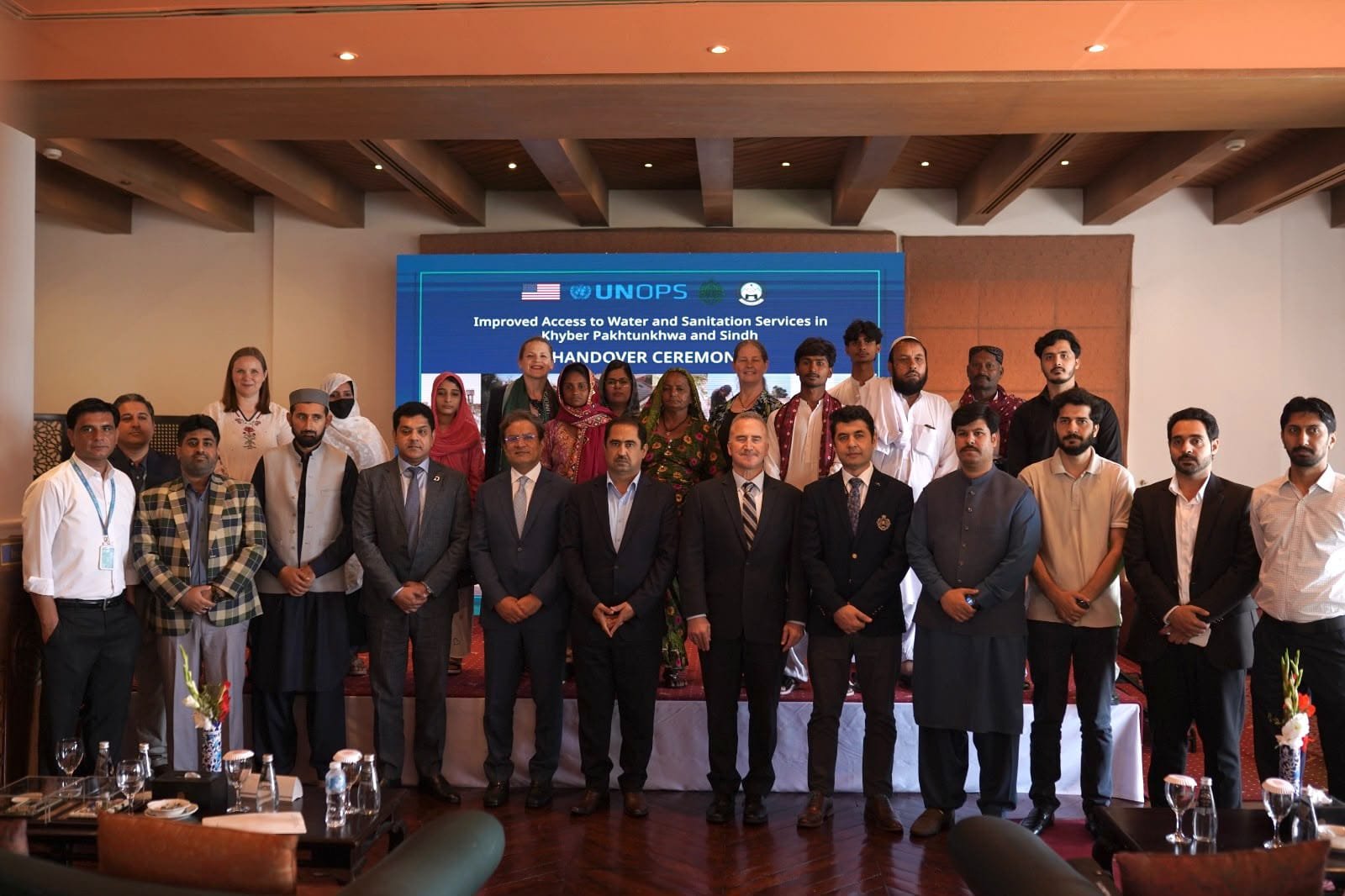
To mark the formal transfer of the infrastructure for long-term provincial operation and maintenance, UNOPS convened senior government leaders, donor representatives, and community members in Islamabad. Key participants included Angelina Wilkinson, Assistance Coordinator at the U.S. Embassy in Islamabad; Sara Netzer, Regional Director for Asia and the Pacific, Usman Akram, South Asia Multi Country Office (SAMCO) Director, UNOPS; Jennifer Ankrom, Country Manager, UNOPS Pakistan; elected representative MPA Qasim Soomro; and senior officials from the Local Government Department, as well as the Public Health Engineering Departments (PHED) and Planning & Development Departments of Sindh and Khyber Pakhtunkhwa. Beneficiaries from the project communities in Tank and Umerkot also participated in person, sharing how access to safe drinking water has transformed their daily lives.
Speaking on the impact of sustainable WASH infrastructure, and United States’ commitment to improving public health in Pakistan, Angelina Wilkinson, Assistance Coordinator for the U.S. Embassy in Islamabad, said: “Clean water and sanitation are the foundation of healthy, thriving communities. Through this project, the American people have delivered reliable water and sanitation services to more than 295,000 Pakistanis, and by strengthening the capacity of Pakistan’s institutions to sustain these gains, we are investing not just in infrastructure, but in Pakistan’s future.”
Emphasizing UNOPS’s infrastructure expertise while highlighting the strong partnership with the U.S. Department of State, Sara Netzer, Regional Director, Asia Pacific Region, UNOPS, stated:
“As the operational arm of the United Nations, UNOPS specializes in turning vision into tangible results. Through our strong partnership with the U.S. Department of State and local governments, this five-year initiative has delivered life-changing, sustainable water and sanitation infrastructure to around 300,000 people in Tank and Umerkot. We remain committed to executing projects that build resilient communities and drive long-term development.”
During the ceremony, project outcomes and a documentary screening highlighted real-life impact stories from Umerkot and Tank.
Under the project, UNOPS delivered six drinking water supply schemes, rehabilitated three existing schemes, and constructed three new ones. It also laid a total of over 14 kilometres of distribution pipelines for the six schemes and installed more than 1300 water collection points, significantly improving access to safe drinking water for local communities in Tank and Umerkot.
Additionally, a fully equipped water testing laboratory was established and transferred to PHED to enable continuous water quality monitoring for 164,000 residents. Recognizing that safe water must go hand in hand with dignified sanitation, six school toilet blocks were constructed, providing clean, secure sanitation access to 6,440 students, significantly reducing barriers to education. With clean water now accessible at home, local women are reallocating daily hours toward income-generating activities such as handicrafts, kitchen gardening, and agriculture, driving long-term socio-economic growth.
Under the project, UNOPS rehabilitated three and constructed five drinking water supply schemes, providing clean drinking water with over 1300 water collection points. UNOPS installed over half a megawatt of solar power capacity across the project, enabling more reliable and energy-independent operation of water supply schemes. These renewable energy systems enhance long-term sustainability while contributing to climate change mitigation and reducing the project’s carbon footprint.
Elected government representatives from the beneficiary districts also addressed the gathering, expressing appreciation for the support of the United States Government and praising the operational excellence of UNOPS in delivering sustainable solutions to underserved communities. Speaking on behalf of the local leadership and beneficiary communities, they shared, “On behalf of the communities in Tank and Umerkot, we extend our heartfelt gratitude to the U.S. Government and UNOPS for delivering on the commitment to safe drinking water and dignified sanitation. This infrastructure directly addresses one of our region’s most critical challenges, turning daily water hardship into doorstep access, improved health, and new economic opportunities for our people.”
Going forward, the PHED of Sindh and Khyber Pakhtunkhwa (KP) will operate and maintain the infrastructure, ensuring these systems continue to deliver safe, reliable drinking water for generations to come. Designed as self-sustaining systems powered by solar energy, the schemes operate independently of the electricity grid, enhancing their reliability and long-term sustainability.
To further strengthen institutional capacity, UNOPS has also planned a series of capacity-building training for government counterparts, equipping them with the knowledge and skills needed to effectively operate, maintain, and sustain the infrastructure well into the future. By turning long daily journeys for water into doorstep access, this initiative does more than meet a basic need – it unlocks opportunities for education, improves health outcomes, and supports economic development, laying a resilient foundation for community progress.