



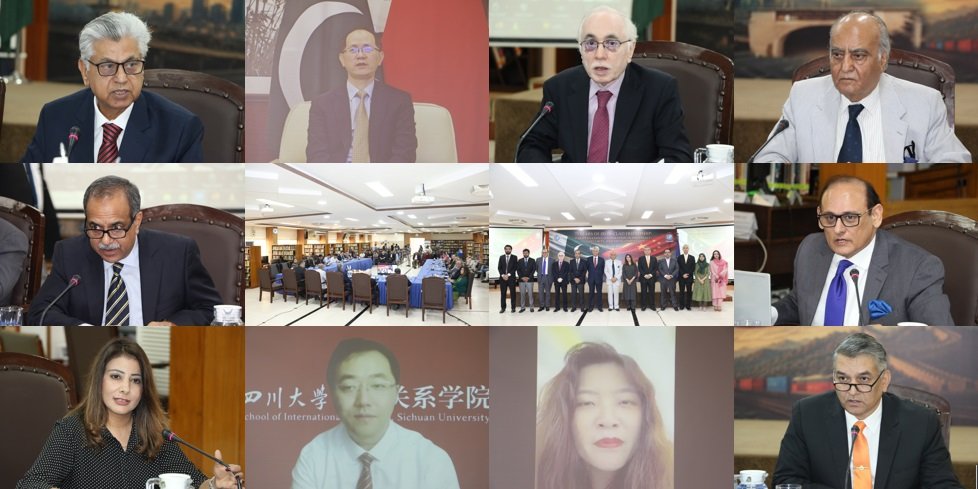
ISSI Hosts International Seminar on,75 Years of Iron-Clad Friendship: Pakistan–China Cooperation in Diplomacy, Security, and Development
China-Pakistan Study Centre (CPSC) at the Institute of Strategic Studies Islamabad (ISSI) hosted a commemorative International Seminar titled ,75 Years of Iron-Clad Friendship: Pakistan–China Cooperation in Diplomacy, Security, and Development.
The Chief Guest, Mr. Murtaza Solangi, Spokesperson to the President of Pakistan, highlighted the civilizational depth of Pakistan–China relations rooted in the Silk Road. He emphasized China’s consistent policy of non-interference and respect for sovereignty as a cornerstone of the “all-weather” friendship. He paid tribute to leadership on both sides and Pakistan’s support for China in international forums. He underscored expanding cooperation across defence, infrastructure, energy, aviation, and emerging technologies, and highlighted CPEC’s transformative impact from Gilgit to Gwadar, including its expansion into AI, digital technologies, space cooperation, climate resilience, and green development. He expressed confidence that Phase II of CPEC would further deepen connectivity and shared prosperity.
In his welcome remarks, Ambassador Khalid Mahmood, Chairman BoG ISSI, described Pakistan–China relations as an “all-weather strategic cooperative partnership” grounded in mutual trust, sovereign equality, and unwavering support for core interests. He highlighted the expansion of cooperation across diplomacy, defence, trade, connectivity, energy, education, and people-to-people exchanges. Referring to CPEC, he noted that Phase I strengthened energy and infrastructure development, while Phase II focuses on industrial cooperation, agriculture, SEZs, and socio-economic uplift, with Gwadar as a key economic hub.
Mr. Shi Yuanqiang, Deputy Head of Mission at the Chinese Embassy in Islamabad, highlighted that China–Pakistan relations have remained resilient and “iron-clad” for 75 years despite global and regional changes. He stressed sustained high-level exchanges and growing strategic trust, reinforced by recent leadership interactions and consensus on building a closer community with a shared future. He underscored CPEC as the central pillar of Belt and Road cooperation, highlighting achievements in energy, infrastructure, investment, and employment, and its evolution toward “CPEC 2.0” focused on industry, agriculture, mining, innovation, and green development. He also emphasized close coordination on regional and global issues, including peace, multilateralism, and cooperation within the Global South.
Ambassador Masood Khalid traced the historical depth of relations from early diplomatic recognition to landmark projects such as the Karakoram Highway. He emphasized that the partnership is rooted in mutual respect, trust, and non-interference. He highlighted CPEC’s contribution to energy, infrastructure and jobs, and its expansion into agriculture, IT, minerals, and industrial development.
Dr. Fazal ur Rehman highlighted early foundations of ties, including the Bandung era, and stressed that friendship requires continuous nurturing. He called for accelerating SEZs, improving the investment climate, and strengthening vocational and educational cooperation through learning from China’s development experience.
Dr. Hassan Daud Butt emphasized a shift toward a future-oriented partnership focused on technology, innovation, space, agriculture, and connectivity. He called CPEC the backbone of cooperation, stressing industrialization, improved security, Gwadar optimization, and data-driven policymaking, alongside youth engagement and productivity enhancement.
Prof. Dr. Yunsong Huang described the relationship as an “ironclad brotherhood” and a stabilizing force in a changing global order. He highlighted CPEC as the geo-economic backbone of ties, with Phase II focusing on industrial upgrading, SEZ expansion, railway modernization, Gwadar development, and cooperation in green development, space technology, and human capital.
Dr. Ma Zheng emphasized the importance of cooperation amid global uncertainty, particularly in defence, security, and counterterrorism. He highlighted coordination on regional stability, including Afghanistan, and called for stronger strategic communication, CPEC development, and people-to-people exchanges.
Dr. Gulshan Rafiq underscored the human dimension of ties, stressing that long-term sustainability depends on educational, cultural, and people-to-people exchanges. She highlighted academic cooperation and student mobility as key pillars of mutual understanding.
Earlier, in his introductory remarks, Director CPSC Dr. Talat Shabbir highlighted the enduring and trusted nature of Pakistan–China relations, rooted in mutual respect, trust, and consistent support for core interests. He noted expanded cooperation since 1951 across multiple sectors and underscored CPEC as a flagship Belt and Road Initiative project promoting regional connectivity, stability, and shared development.
The seminar brought together leading diplomats, scholars, researchers, and practitioners from Pakistan and China to reflect on the evolution of bilateral ties and explore future avenues of cooperation.