


Book Launch ‘Geopolitical Conflict in the Wolf World, Great Power Competition and the Illiberal Revolt against the Liberal, Order by Marc Saxer
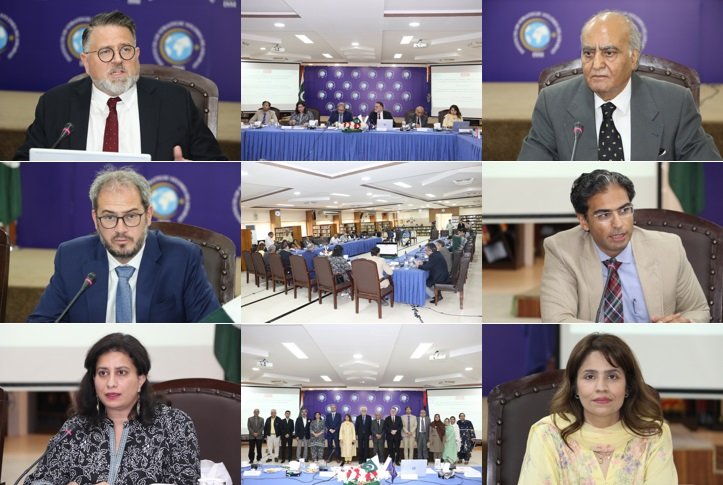
Islamabad – 15 May, 2026 (MT Team) : The Centre for Afghanistan, Middle East & Africa (CAMEA) at the Institute of Strategic Studies Islamabad (ISSI) organised the book launch of ‘Geopolitical Conflict in the Wolf World, Great Power Competition and the Illiberal Revolt against the Liberal Order’ by Marc Saxer Regional Director, Office of Regional Cooperation in Asia Pacific, Friedrich Ebert Stiftung. The reviewers included Ms. Aiza Azam, Director Strategic Affairs, StrafAsia, and Dr. Vaqar Ahmed, Senior Economist. Ambassador Khalid Mahmood, Chairman, Board of Governors, ISSI and Dr. Amina Khan, Director CAMEA also spoke on the occasion.
Ambassador Khalid Mahmood while expressing his views said that Mr. Marc Saxer’s book offers an insightful analysis of the evolving global order characterized by intensifying great power competition, geoeconomic rivalry, and the gradual erosion of the liberal international order. He noted that the book’s discussion on the emergence of an increasingly multipolar world and the importance of strategic and pragmatic engagement and diversified partnerships carries particular relevance for countries like Pakistan.
Dr. Amina Khan observed that Mr. Marc Saxer’s book analyses the decline of the liberal international order and the rise of great power competition. She noted that it highlights how geopolitical and geo-economic tensions are reshaping global alignments in an increasingly multipolar world.
Mr. Felix Kolbitz noted that Pakistan today stands at the intersection of nearly every major global conflict and geopolitical shift. Describing the book as a rigorous attempt to map the forces shaping the contemporary world order, he said it offers an important framework for understanding uncertainty and strategic change. For Pakistan in particular, he stressed, such orientation is urgently needed at a time of growing regional and international flux.
Mr. Marc Saxer, presented the key arguments of his book, and said that the decline of the liberal international order, the rise of great power competition, and the emergence of an increasingly multipolar “Wolf World” are reshaping global politics, economics, and security dynamics. Highlighting the erosion of multilateralism, intensifying geopolitical rivalries, and growing geoeconomic fragmentation, Mr. Saxer observed that the international system is moving away from an era centred on globalization and open markets toward one increasingly driven by strategic competition, economic security, and competing visions of global order. Discussing the major theatres of geopolitical contestation, including Europe, the Middle East, and East Asia, he noted that contemporary conflicts and rivalries are placing growing pressure on existing institutions and frameworks of global governance. He further underscored that no single power is currently capable of imposing a new international order, making dialogue, negotiated compromise, and new forms of international cooperation essential for managing instability in an increasingly contested and multipolar world.
Ms. Aiza Azam while discussing the book, said that it presents a timely and objective analysis of the changing global order. She noted that the concept of a “Wolf World” captures the realities of rising great power competition and an emerging multipolar system. She highlighted the growing role of non-Western and middle powers in global governance. She also remarked that the book calls for a more inclusive and balanced international order. According to her, the book is an important contribution to contemporary geopolitical discourse.
Dr. Vaqar Ahmed highlighted the book’s valuable discussion on middle-power partnerships and the future of the international monetary system in an emerging multipolar order. He argued that strategic autonomy requires more than defence spending alone, noting that even Europe must adapt to multipolarity through broader partnerships. For Pakistan, he stressed three key lessons: the need for macroeconomic stability in a fragmented world, the importance of deepening multiple strategic partnerships, and the necessity of remaining an active voice as the erosion of global rules disproportionately harms smaller and middle powers.
The event was attended by diplomats, academics, students, practitioners and members of the civil society.