


‘Rethinking Europe’s Middle East Policy: Balancing Interests and Values.’
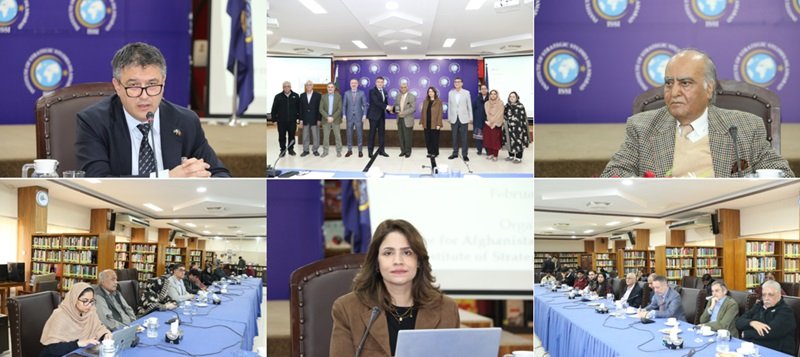
Islamabad – February 16, 2026 (MT Team): The Centre for Afghanistan, Middle East and Africa (CAMEA) at the Institute of Strategic Studies (ISSI) organized a public talk under its Distinguished Lecture series, titled, ‘Rethinking Europe’s Middle East Policy: Balancing Interests and Values.’ The Distinguished Speaker at the event was Dr. Flavius Caba Maria, President of the Middle East Political and Economic Institute (MEPEI), Romania,. Dr. Amina Khan, Director CAMEA and Ambassador Khalid Mahmood, Chairman, BOG, ISSI also spoke on the occasion.
Dr. Amina Khan, in her welcome remarks, highlighted three interlinked priorities shaping EU policy: engagement with the Gulf region, the evolving dynamics of the Israel–Palestine conflict amid the ongoing war in Gaza, and diplomatic management of relations with Iran. She observed that the prolonged Gaza war has influenced public opinion across Europe, increasing pressure on policymakers to reassess their positions, particularly regarding the humanitarian impact of the conflict. At the same time, she underscored that Iran remains central to EU policy considerations, with a continued emphasis on preventing nuclear proliferation and managing regional stability.
Dr. Flavius Caba Maria argued that the European Union’s Middle East policy reflects a cautious, legally anchored, and internally fragmented approach shaped by shifting geopolitical realities. On Gaza, he noted that the EU has reinforced existing international frameworks, welcoming UN Security Council Resolution 2803 and referencing the “Board of Peace” strictly within a UN-led structure, while reaffirming its commitment to international law and the two-state solution and voicing concern over developments in the West Bank that threaten its viability. He observed that most states continue to endorse a two-state framework based on pre-1967 lines, revisiting the legacy of the Oslo Accords, the Montevideo Convention criteria for statehood, and new initiatives such as the Global Alliance for the Implementation of the Two-State Solution, while also acknowledging alternative proposals ranging from confederation models to binational arrangements.
Turning to the Gulf, he highlighted the growing strategic significance of EU–GCC cooperation, particularly following the October 2024 EU–GCC Summit and within the framework of the Joint Action Programme 2022–2027, emphasizing trade corridors, technological exchange, and sustainable energy as pillars of Europe’s diversification and resource independence agenda. On Iran, Dr. Flavius described relations as having reached a historic low, especially after the EU’s designation of the IRGC as a terrorist organization, a step that narrowed diplomatic channels and risks marginalizing Europe from U.S.–Iran negotiations, raising questions about the future of the JCPOA and broader nuclear dynamics in the region. He further underscored that internal EU divisions, reliance on the American security architecture, the decline of the E3’s mediator role after 2018, and wider geopolitical shifts, including Iran’s diversification toward eastern blocs, have constrained Europe’s influence Addressing Syria, he pointed to a recalibrated EU approach driven by security and migration concerns, involving selective engagement, counterterrorism coordination, and significant financial commitments for stabilization and humanitarian assistance
Ambassador Khalid Mahmood, in his remarks, noted that Europe’s evolving role in the Middle East reflects a balance between its stated values, human rights, humanitarian principles, and international law—and its strategic interests in regional stability and security. He observed that the EU continues to support a two-state solution, provide humanitarian assistance in Gaza, and engage diplomatically across the region, including in Lebanon and Syria. Concluding, he emphasized that Europe’s policy illustrates the enduring tension between principles and pragmatism in navigating the region’s complex dynamics.
The talk was attended by diplomats, academics, students, practitioners and members of the civil society and ended with an engaging Question and Answer session.