



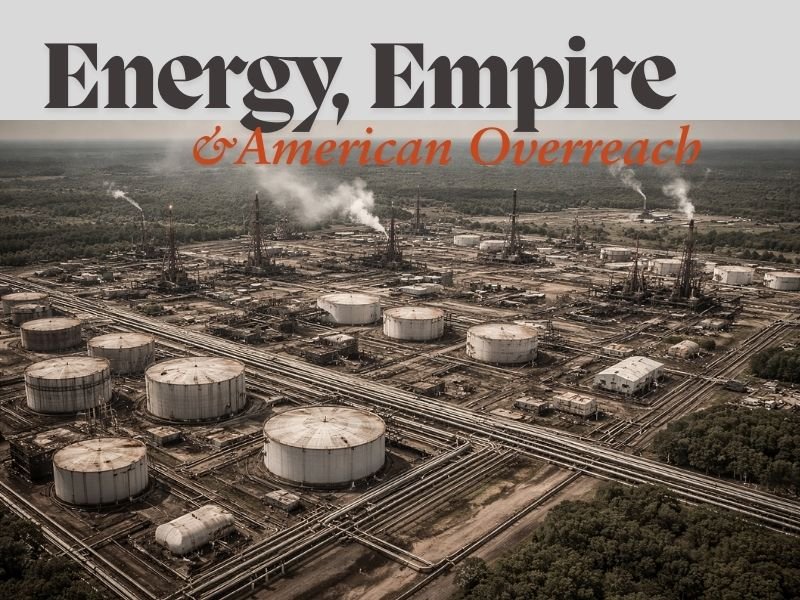
In the cold, early hours of January 3, 2026, the geopolitical tectonic plates appeared to shift violently. Reports and speculative analyses emerging from Washington policy circles described a scenario in which the United States carried out a surprise military operation in Caracas, forcibly detaining Venezuelan President Nicolás Maduro and his wife, Cilia Flores.
Whether understood as an emerging reality or as a revealing thought experiment in imperial revival, the episode was widely interpreted as more than a conventional regime-change operation. It was portrayed as the kinetic baptism of a new strategic paradigm. According to these accounts, Washington abandoned diplomatic ambiguity and openly signaled that major U.S. oil companies would assume operational control of Venezuela’s petroleum sector—resources that constitute approximately 17 percent of the world’s proven oil reserves.
This posture—quickly labeled the “Donroe Doctrine,” a term popularized in U.S. tabloid and opinion media as a portmanteau of “Donald” and “Monroe”—represents a stark fusion of the 1823 Monroe Doctrine’s hemispheric possessiveness with a transactional, resource-centric militarism.
Yet the question echoing through power corridors from Islamabad to Brussels remains deceptively simple: can such a doctrine meaningfully enhance U.S. influence, or does it instead signal the onset of imperial twilight?
Resource Seizure Without Ideology
The official rhetoric attributed to Washington in this framework emphasizes restitution and security. Statements invoking the return of “oil, land, and other assets previously stolen from the United States,” alongside declarations that the Western Hemisphere constitutes “our hemisphere,” reflect a language of ownership rather than leadership.
Stripped of ideological justification democracy promotion, counterterrorism, or humanitarian intervention the doctrine appears grounded in overt resource acquisition. This marks a significant departure from post-Cold War norms and carries profound strategic risk. By replacing legitimacy with coercion, the United States risks accelerating the fragmentation of the very order it seeks to preserve.
The Trap of Strategic Overstretch
The central contradiction of the Donroe Doctrine lies in its divergence from a long-standing consensus within U.S. strategic circles: that American power requires consolidation, not expansion. For over a decade, policymakers across administrations have emphasized retrenchment, fiscal discipline, and disengagement from “forever wars.”
Direct military involvement in the management of a sovereign state’s core industry represents a reversal of that logic. Historical precedent—from Iran in 1953 to Iraq in 2003—suggests that protecting Western energy interests through force produces diminishing returns. However, the scale implied here is unprecedented. Rather than influencing policy or leadership, the United States would be assuming de facto control over an entire energy ecosystem, reportedly encompassing more than 300 billion barrels of proven reserves.
The strategic objective appears to be the creation of a “hegemonic supply circle,” wherein access to energy is contingent upon alignment with U.S. geopolitical priorities. Maintaining such a system, however, requires continuous enforcement. The seizure of oil tankers in the Caribbean, often described in Western security analysis as part of Russia’s so-called “ghost fleet”, illustrates the extent to which maritime coercion would become routine rather than exceptional.
Even if American firms were to inject capital and technical expertise to revive Venezuelan output, the cost of securing infrastructure against sabotage, insurgency, and regional backlash would likely echo the financial sinkholes of Iraq and Afghanistan. The result would not be consolidation of power, but prolonged entanglement in a resource war that drains fiscal capacity while domestic infrastructure continues to erode.
The Economic Fallacy: High Cost, Low Reward
Proponents of such an intervention argue that it would enhance U.S. energy security. Yet prevailing market conditions undermine this rationale.
By the mid-2020s, international energy agencies, including the International Energy Agency (IEA) and the U.S. Energy Information Administration (EIA), were already warning of persistent oversupply in global crude markets. Estimates placed the surplus at nearly four million barrels per day by 2025.
Venezuela’s pre-intervention production, meanwhile, hovered below one million barrels per day, insufficient to meaningfully alter global supply dynamics. Market behavior reinforces this reality. Even amid heightened geopolitical tension, Brent crude prices trended near the $60 range, suggesting that risk was already priced in and that traders perceived no imminent supply shock.
The doctrine thus attempts to solve a non-existent supply problem through military occupation, generating instability in the process. Moreover, flooding the market with additional crude to weaken OPEC+ coordination risks depressing prices to levels that undermine U.S. shale producers themselves. The paradox is stark: an intervention designed to secure energy dominance could accelerate a long-term supply glut, rendering the entire operation economically self-defeating.
Geopolitical Fracture and the Alienation of Allies
Perhaps the most consequential impact of the Donroe Doctrine lies in its diplomatic fallout. The approach echoing earlier U.S. rhetoric about acquiring Greenland and expanding coercive leverage over regional partners has unsettled allies rather than reassured them.
European states, including Denmark, have quietly recalibrated their assumptions about American stewardship, increasingly wary of a partner that appears willing to treat sovereignty as negotiable real estate. In the Global South, the implications are even more severe. By weaponizing both the dollar and energy access so explicitly, Washington reinforces long-standing fears about dependency and vulnerability within U.S.-led systems.
Rather than reinforcing dollar primacy, such behavior incentivizes diversification. China, whose much-touted strategic partnership with Venezuela would, under this scenario, appear strikingly ineffective would almost certainly accelerate efforts to insulate its supply chains and financial infrastructure from U.S. leverage. The broader result would be not renewed hegemony, but faster fragmentation of the global economic order.
Power Without Legitimacy
In its essence, the Donroe Doctrine is a strategic anachronism. It seeks to confront 21st-century realities, multipolarity, energy transition, and economic interdependence with tools inherited from 19th-century gunboat diplomacy.
While such an approach might disrupt OPEC+ coordination in the short term, history offers a consistent warning: power exercised without legitimacy invites resistance. By substituting leadership with occupation and cooperation with coercion, the United States risks not extending its influence, but enclosing itself within a fortress of its own making powerful, isolated, and increasingly brittle.
The writer can be contacted at: urojbabar51@gmail.com
Third, reimagined multilateralism.
Universal institutions undergo meaningful reform expan-ding representation, modernising mandates, and embracing flexible geometry cooperation. In this scenario, mini-lateralism complements rather than replaces the multilateral core.
The third path is the most desirable and the most difficult. It requires those who benefited most from the old order to accept dilution of privilege in the interest of legitimacy and effectiveness.
Reinvention or Irrelevance
Multilateralism is not dying. But neither can it continue unchanged.
The institutions created in the aftermath of global war were products of their time bold, visionary, and imperfect. To remain relevant, they must now undergo a similar act of imagination. Reform is no longer a matter of idealism; it is a condition of survival.
As UN Secretary-General Guterres warned, global cooperation is not optional in an interdependent world. Pandemics, climate change, financial contagion, and technological disruption do not respect borders. The choice, then, is not between multilateralism and sovereignty, but between adaptive cooperation and unmanaged chaos.
The real question is not whether the world will cooperate but on whose terms, through which structures, and with what consequences for those least able to absorb failure.
For mature observers of global affairs, the task is to move beyond nostalgia for a fading order or cynicism about its flaws, and instead engage seriously with the work of reinvention. The future of multilateralism will not be declared it will be built, contested, and negotiated in real time.
And the cost of getting it wrong will be borne not by institutions, but by people.