


A New Experiment in Managing Global Conflicts
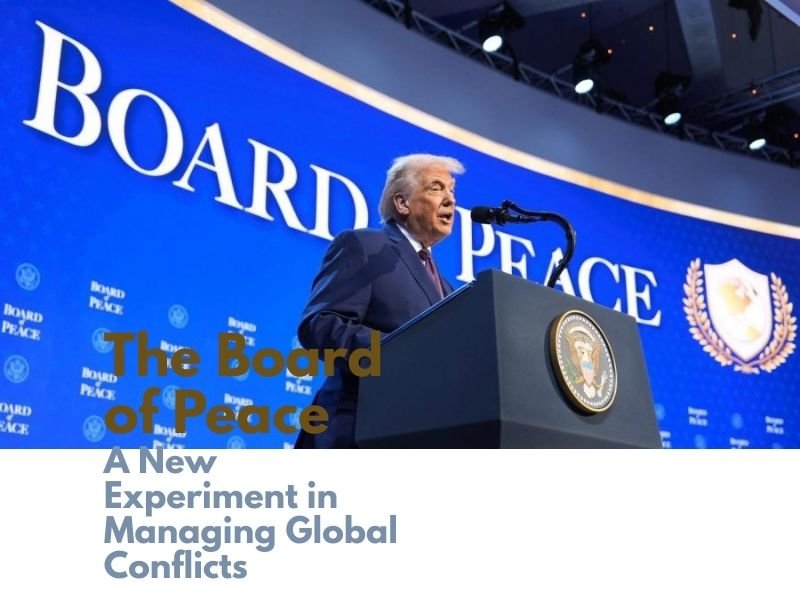
When the Board of Peace was officially launched, the message was carefully packaged. Former U.S. President Donald Trump stood at the centre of the announcement, surrounded by representatives from over two dozen countries. The words used were familiar to anyone who follows global diplomacy: stability, security, reconstruc-tion and governance. These terms have been repeated for decades. Yet the world remains deeply unstable.
What makes the Board of Peace different is not its language, but its approach. The initiative reflects frustration with traditional multilateral systems, especially the United Nations. Its backers argue that existing institutions move too slowly and are trapped by political deadlock. The Board is presented as an alternative, faster, more focused and controlled by a smaller group of decision-makers.
The Board of Peace is not a treaty organisation. It is not part of the UN system. Instead, it operates as a voluntary coalition of states and donors. A limited leadership group takes key decisions, while participating countries contribute politically and financially. Supporters say this model allows quicker responses in conflict zones. Critics fear it concentrates power and weakens international law.
Pakistan has chosen to join this initiative. At the World Economic Forum in Davos, Prime Minister Shehbaz Sharif signed the accession documents, making Pakistan part of the U.S.-led Board. Gaza has been identified as the first test case, with the Board focusing on post-conflict reconstruction, humanitarian support, and governance arrangements.
According to Pakistan’s Foreign Office, Islamabad’s decision rests on three stated objectives. First, support for a lasting ceasefire in Gaza. Second, humanitarian assistance and reconstruction for civilians. Third, contribution to a just and durable peace in line with United Nations Security Council resolutions. The government says this step is consistent with Pakistan’s long-standing position on Palestinian rights.
However, speed alone does not ensure fairness or sustainability. Fast decisions may solve logistical problems, but peace requires legitimacy, public trust, and political consent. Without these, stability remains fragile.
Gaza as the First Test
Choosing Gaza highlights both the urgency and the danger of the Board’s model. Under this framework, Gaza is treated mainly as a reconstruction and governance challenge. Roads must be rebuilt. Security must be managed. Aid must be delivered. These tasks are essential. But Gaza is not just an administrative problem. It is a deeply political issue shaped by occupation, blockade, displacement, and unresolved questions of sovereignty.
Why the Board Was Formed
The creation of the Board of Peace reflects growing dissatisfaction with the UN system. Years of discussions have often failed to produce action. Security Council vetoes, procedural hurdles, and geopolitical rivalries have delayed responses to crises.
Supporters of the Board argue that when consensus becomes mandatory, paralysis follows. In their view, a smaller group that can act quickly is better than a universal body that struggles to act at all. They say delayed decisions can cost lives, especially when civilian suffering continues.
History offers warnings. In Iraq and Afghanistan, massive international interventions failed to deliver long-term stability. External plans collapsed because local ownership was weak and political legitimacy was missing.
The Board’s documents focus heavily on coordination and recovery. They are cautious when addressing sensitive political issues like representation and self-determination. This creates concern that peace may be treated as a technical exercise rather than a negotiated political settlement.
For Palestinians, this distinction matters. Governance imposed without meaningful participation risks increasing mistrust rather than restoring confidence.
Operating Outside the UN
The creation of the Board of Peace reflects growing dissatisfaction with the UN system. Years of discussions have often failed to produce action. Security Council vetoes, procedural hurdles, and geopolitical rivalries have delayed responses to crises.
Although the Board says it complements the United Nations, it operates largely outside it. It does not depend on Security Council mandates or universal membership. Decision-making power is concentrated, not shared.
Participation is voluntary, but influence is linked to political weight and financial contribution. Several European states have reportedly stayed away, citing concerns about transparency and accountability.
Diplomats warn that this model could normalise a future where conflicts are managed by power-based coalitions instead of collective rules. Despite its flaws, the UN remains the only forum with global legal legitimacy.
Funding and Influence
One of the most debated aspects of the Board is the link between money and influence. Supporters argue that those who pay for reconstruction naturally expect a say.
Critics respond that this approach risks turning peace-building into a transactional process. Donor priorities can override local needs. Past experiences show that such models can weaken local institutions and delay political legitimacy.
Still, many countries have joined. In today’s global system, staying outside new initiatives can reduce diplomatic access. For smaller states, participation offers visibility, even if influence is limited.
Pakistan’s role is currently diplomatic. Islamabad will raise humanitarian concerns and engage in discussions. The Board’s charter makes clear that membership does not require military involvement. Any such decision would remain subject to national law and consent.
Several Muslim-majority countries have also joined, including Egypt, Jordan, Qatar, Saudi Arabia, the UAE, Turkey, Indonesia and Pakistan. Their participation reflects a belief that engagement may allow some influence over outcomes.
Trump’s Imprint
The Board of Peace carries Donald Trump’s political style. Centralised authority and transactional negotiation. Dis-trust of traditional multilateral institutions. Emphasis on speed and execution. Supporters call this decisiveness. Critics see volatility. Initiatives closely tied to individual leaders often struggle to survive political transitions.
This raises questions about the Board’s long-term future.
Stability or Peace?
At its core, the Board assumes that conflict is a management problem. Improve security. Rebuild infrastructure. Restore order. But stability is not peace. Without justice, representation, and legitimacy, violence may pause but grievances remain. History shows that ignoring root causes produces only temporary calm.
Domestic Debate and Pushback
In Pakistan, the decision to join the Board has sparked debate. Political and religious groups have criticised the government for acting without parliamentary consultation, while the Khyber Pakhtunkhwa Assembly passed a resolution opposing participation, warning that Pakistan’s principled stance on Palestinian self-determination could be diluted. Externally, Israel has rejected any Pakistani role in Gaza-related security or peace efforts, highlighting the geopolitical sensitivities surrounding the initiative and constraining its operational space. Yet, amid political pushback at home and resistance abroad, the government’s decision to remain engaged reflects a calculated diplomatic choice to participate without relinquishing Pakistan’s longstanding principled positions.
A Risky Experiment
The Board of Peace is a high-stakes experiment. It could improve coordination and speed in crisis response. It could also weaken international norms by shifting power away from inclusive institutions. The real test will not be held in conference halls. It will unfold on the ground, in places like Gaza, where decisions affect lives, security, and dignity.
The central question remains unresolved: is the world willing to sacrifice legitimacy and inclusivity for speed and control and what price will be paid for that choice?